Start with something you want to be able to do. Choose a small path, make room for practice, and let your attempts tell you what to change.
Explore Cadence's daily courses
We make Cadence, an app for short daily courses built around your goal. You can use this guide without the app. Explore our reviewed course library to see whether its current focus fits your next learning goal.
Learning Cadence editorial, , 6 min readHow we work
A self-study plan often starts as a list of resources: six books, four courses, several newsletters. That list tells you what exists. It does not yet tell you what to do on Tuesday, how to recognise progress or what to change when the week gets busy.
The plan below is an original four-week example for learning to explain percentage changes in everyday reports. It is deliberately small. Four weeks is a planning container, not a promise of mastery. You can adapt its structure to another topic while keeping the same question: what will I attempt, and how will I check it?
The short answer
Plan around an outcome and evidence of progress.
Define a specific outcome, check your starting point, choose one main resource and schedule a few realistic sessions. Give every session an attempt and a way to check it. Review the plan weekly, narrowing the scope or revisiting prerequisites when your attempts show a gap.
The method
Build the first week before filling the month.
Use the time that is actually available. A smaller plan with a clear next action is easier to revise than a long unsorted reading list.
01
Write the outcome and a starting attempt
Replace 'learn statistics' with 'explain the difference between a percentage change and a percentage-point change using a real report.' Try a simple example now. Keep your answer so you can see which part of the task currently needs help.
02
Choose one main resource
Pick a source that explains the idea at your level and gives examples you can check. Keep a second reference for a specific gap. When you add a resource, write the question it will resolve; otherwise put it on a later list.
03
Give each session a visible output
For three available sessions, write three concrete outputs: an annotated example, a closed-notes explanation and a new solved problem. Reserve some time for checking. Reading can support the output, but the page count alone does not show whether you can use the idea.
04
Set a weekly decision
At the end of the week, inspect your attempts. Continue if the next task is within reach, revisit a prerequisite if errors point there, or reduce scope if the calendar was unrealistic. Record the next session before closing your notes.
Worked plan
Four weeks with a different job each week.
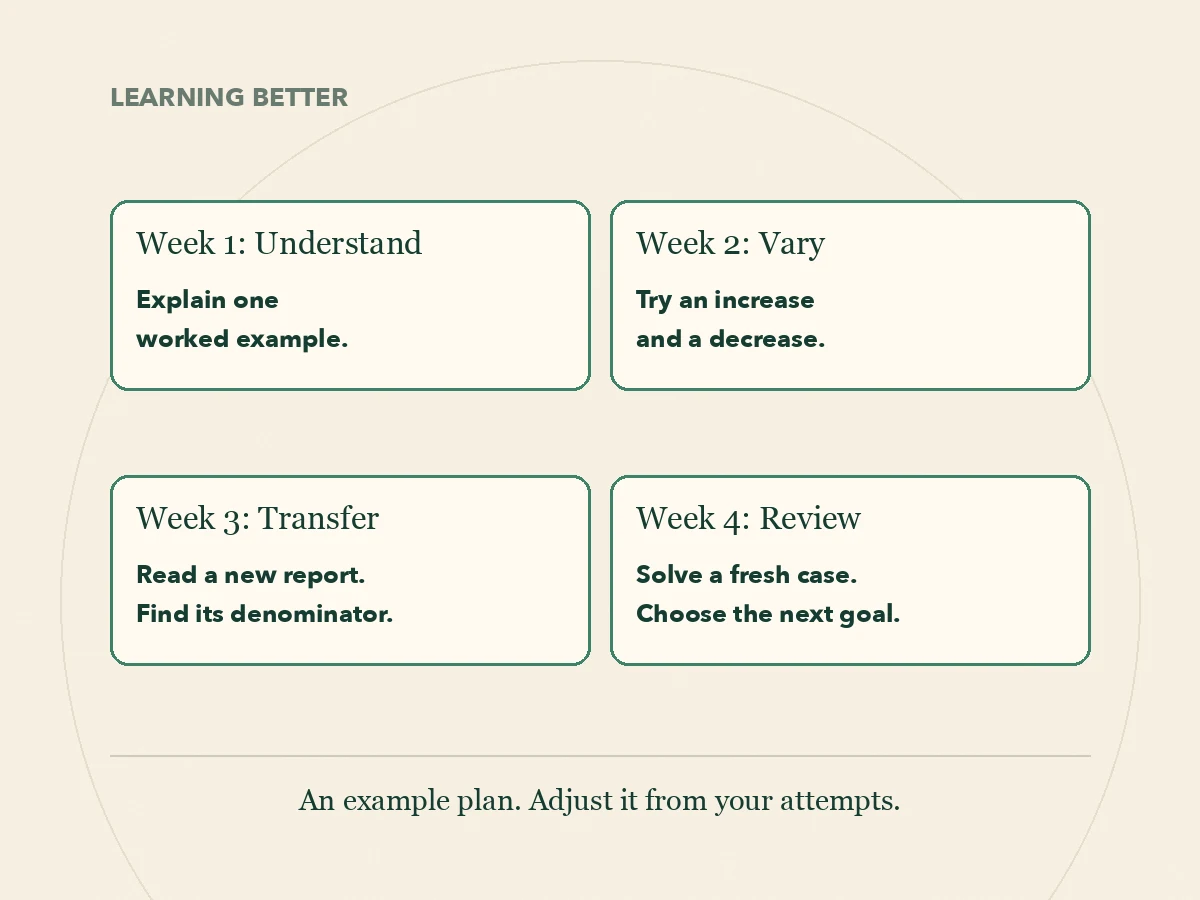
Week one: understand the distinction. Read one explanation of percentages and percentage points. Annotate a change from 40% to 50%, then explain it without the page. Check that you can produce both 10 percentage points and a 25% relative increase and name the denominator.
Week two: vary the example. Work through an increase and a decrease with different starting values. Write one deliberately misleading sentence and repair it. Your output is two checked calculations and an explanation of what the original wording hid.
Week three: transfer to a source you did not write. Choose a public report with a clear date, population and percentage. Find the underlying values, identify whether it reports a relative change or a point difference, and write a two-sentence interpretation. If the denominator is missing, record that limitation rather than guessing.
Week four: revisit and explain. Return to the first attempt without reading the answer. Solve a fresh example and explain it to another person, or record yourself. Compare the reasoning with your starting attempt. Keep the mistake that still matters as the next learning goal.
Write these fields on one page: This week's outcome. Main source. Available sessions. Attempt for each session. How I will check it. What I will do if I miss a session. Sunday review decision. Fill them with actions and evidence rather than broad subject labels.
For example: Tuesday, 20 minutes, explain one worked example; Thursday, 20 minutes, solve two variations; Saturday, 30 minutes, read a short report and check its denominator. If Thursday is missed, use Saturday for the two variations and move the report. Do not compress every unfinished task into a late-night catch-up session.
Those durations are illustrative. Some topics need longer uninterrupted work, equipment, another person or expert feedback. Fit the session to the task and your circumstances. Keep the next action small enough that you can start without choosing among ten resources again.
Optional assistant
Use AI to draft a plan you can inspect.
Try this prompt: Help me plan [outcome] from [starting point]. I have [actual sessions] available each week. Use [main source]. Propose the first week's attempts and how I can check each one. Identify prerequisites and uncertainties. Leave room for review, and ask before expanding the scope.
Inspect the proposal. Does it assume a skill you do not yet have? Are its links real and relevant? Can the workload fit in the available time? Does it require a paid service or equipment you did not choose? A calendar full of confident lesson titles still needs this check.
You can keep the plan entirely on paper. An assistant is useful when it reduces the work of organising possibilities, while your actual attempts decide whether the sequence fits. When the generated feedback itself is uncertain, verify it using the source or someone qualified in the subject.
Why this structure
Use the plan to make the next decision.
UNC's Learning Center recommends organising study by topic, practising actively, distributing work across sessions and comparing planned tasks with available time. This guide adapts those principles into a small self-directed example. UNC did not evaluate this four-week plan, and following its dates does not guarantee a particular outcome.
At the weekly review, distinguish three problems. If you never started, simplify the starting action or calendar. If you started but could not understand the material, revisit the source or prerequisite. If you understood the example but could not apply it, add a new attempt with feedback. Each calls for a different adjustment.
We make Cadence. The exercises here are free to use on their own; choosing a learning app is a separate decision about your goal and the support you need.
We make Cadence, an app for short daily courses built around your goal. You can use this guide without the app. Explore our reviewed course library to see whether its current focus fits your next learning goal.
Questions
Common questions.
How do I make a self-study schedule when I work full time?
Start with the sessions that fit your existing week. Assign a specific attempt to each and leave a recovery rule for missed sessions. Reduce the topic scope when the plan consistently exceeds your available time.
How many resources should I use?
Start with one main resource and add another when you can name the question it needs to resolve. A bigger reading list is not automatically a better sequence.
Can AI create my study plan?
It can draft a sequence from your goal, starting point and schedule. Check prerequisites, sources, workload and assessment methods before using it. Revise the plan from your own attempts.
What should I do after missing a week?
Choose the next useful attempt, check what you still remember and rebuild the coming week from the time you have. Move or remove lower-priority work instead of treating the backlog as an obligation to finish immediately.
We make Cadence, an app for short daily courses built around your goal. You can use this guide without the app. Explore our reviewed course library to see whether its current focus fits your next learning goal.