Write the two rates
The first event has 20 attendees out of 100 invited, or 20%. The second has 30 out of 100, or 30%. Label which is the starting value before doing anything else.
Practical guide
A rate moving from 20% to 30% rises by ten percentage points and by fifty percent. Both are correct, but they answer different questions.
Explore Cadence's daily courses
We make Cadence, an app for short daily courses built around your goal. Explore the reviewed course library to see its current focus and decide whether it fits what you want to learn.

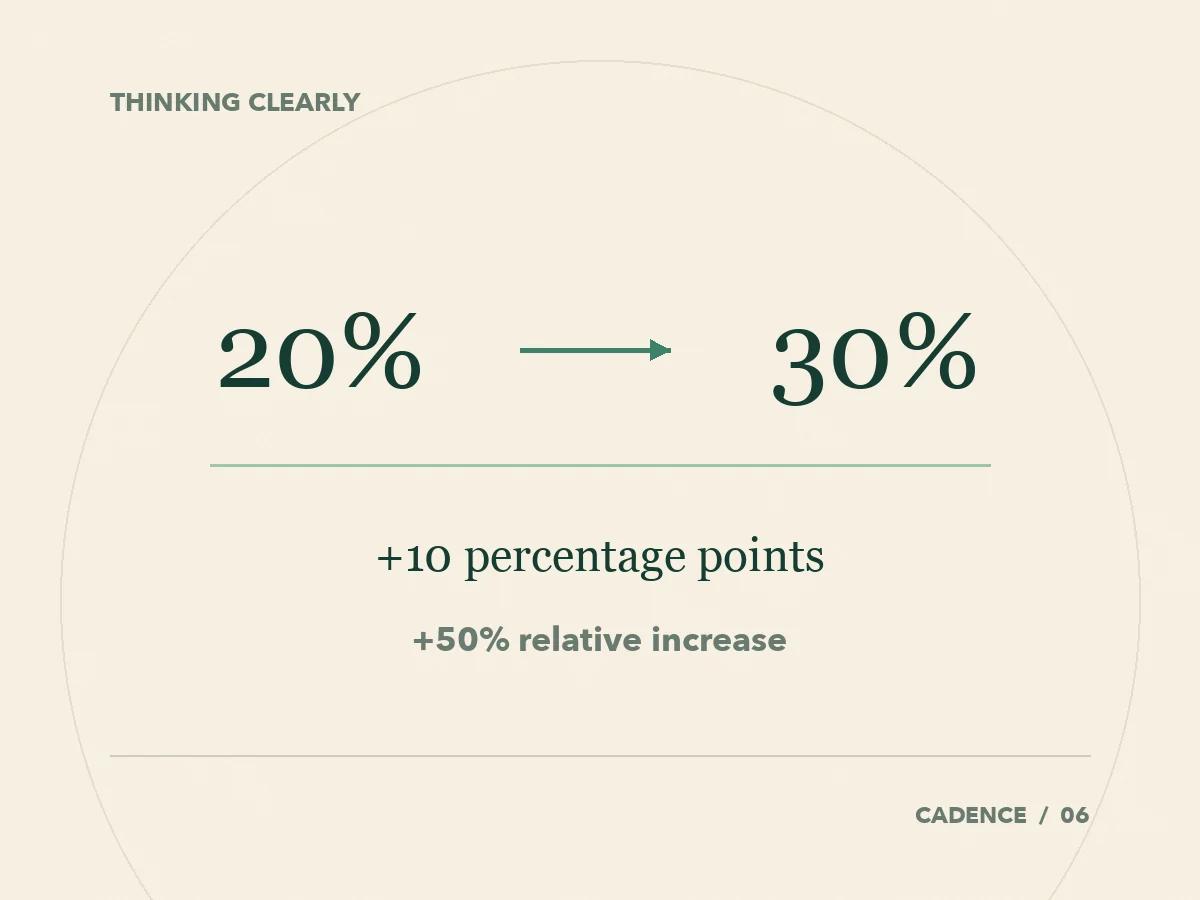
A club's attendance rate rises from 20% to 30%. One announcement celebrates a 50% increase; another reports a ten-point increase. There is no disagreement in the arithmetic. The comparison has changed.
Start with an invented attendance example before working with abstract percentages. Of 100 invited members, 20 attended the first event and 30 attended the second. Keep the group size fixed for this first calculation.
The short answer
Percentage points describe the difference between two percentages. Percentage change describes that difference relative to the starting value. Always name the starting value and keep the denominator visible.
The method
These calculations use invented attendance figures, not results from a real study or Cadence.
The first event has 20 attendees out of 100 invited, or 20%. The second has 30 out of 100, or 30%. Label which is the starting value before doing anything else.
30% minus 20% equals 10 percentage points. This describes the distance between the rates. It does not say that attendance increased by only 10% relative to where it started.
The increase is 10, and the starting rate is 20. Divide 10 by 20 to get 0.5, then multiply by 100 to get 50%. In this fixed-size example, ten additional attendees are half of the original twenty.
Write: attendance rose from 20% to 30%, a rise of 10 percentage points, or 50% relative to the starting rate. Often the before-and-after figures are the clearest part of the sentence.
The terminology
The European Union's data-visualisation guidance distinguishes the arithmetic difference between percentages from a relative percentage change. Using percentage points for the former prevents a reader from having to guess which calculation you meant.
The common trap
Now attendance falls from 30% back to 20%. The fall is still 10 percentage points. But the relative fall is 10 divided by 30, about 33.3%. It is not a 50% decrease because the starting value is now 30.
A second trap appears when the group size changes. If 30 of 200 invited people attend, there are more attendees than the original 20, but the attendance rate is only 15%. Decide whether you are comparing a count or a rate, then use the corresponding denominator.
Try the arithmetic
A rate rises from 4% to 5%. Answer: up 1 percentage point and up 25% relative to its starting value. A rate falls from 50% to 40%. Answer: down 10 percentage points and down 20%. A count rises from zero to five. Answer: five more, but an ordinary relative percentage increase is undefined because its denominator would be zero.
For your next chart or report, write the baseline beside every percentage change. If someone could mistake a count change for a rate change, include both the count and the denominator.
From the publisher
We make Cadence. This arithmetic is useful when reading any product's claims, including ours. Keep the starting value, group size and time period in view before deciding whether a reported change matters.
Put it into practice
We make Cadence, an app for short daily courses built around your goal. Explore the reviewed course library to see its current focus and decide whether it fits what you want to learn.
Questions
It is a ten percentage point increase. Relative to the starting 20%, it is a 50% increase.
The denominator changes. The fall from 30 to 20 is measured against 30, while the rise from 20 to 30 is measured against 20.
Report the absolute change. The usual relative-change calculation requires dividing by the starting value and cannot be used when that value is zero.
Prefer an explicit before-and-after comparison. If you use a relative increase, include enough context for readers to identify the starting value.
Sources

Try Cadence today
We make Cadence, an app for short daily courses built around your goal. Explore the reviewed course library to see its current focus and decide whether it fits what you want to learn.