How to learn with AI and check what you understood
Give the assistant a smaller job: one question, a useful hint and feedback you can check. Keep the final explanation in your own words.
Explore Cadence's daily courses
We make Cadence, an app for short daily courses built around your goal. You can use this guide without the app. Explore our reviewed course library to see whether its current focus fits your next learning goal.
Learning Cadence editorial, , 6 min readHow we work
You ask an assistant to explain a difficult idea. The answer is clear, the analogy feels helpful, and you move on. Ten minutes later, someone asks you to explain it and you cannot get started. The missing part of that session was a chance to produce an answer yourself.
This guide builds that chance into a 20-minute example. The timing is an editorial suggestion, not a scientifically optimal session length. You can use the method with a general chatbot, a dedicated study mode or a human study partner. The goal is an explanation you can use after the conversation ends.
The short answer
A useful AI study session ends with an independent attempt.
Choose a specific learning goal and a trustworthy source. Ask AI to question you before explaining, answer in your own words, check its feedback against the source, and finish with a new problem without help. A fluent conversation alone does not show what you learned.
The method
Run one small study session.
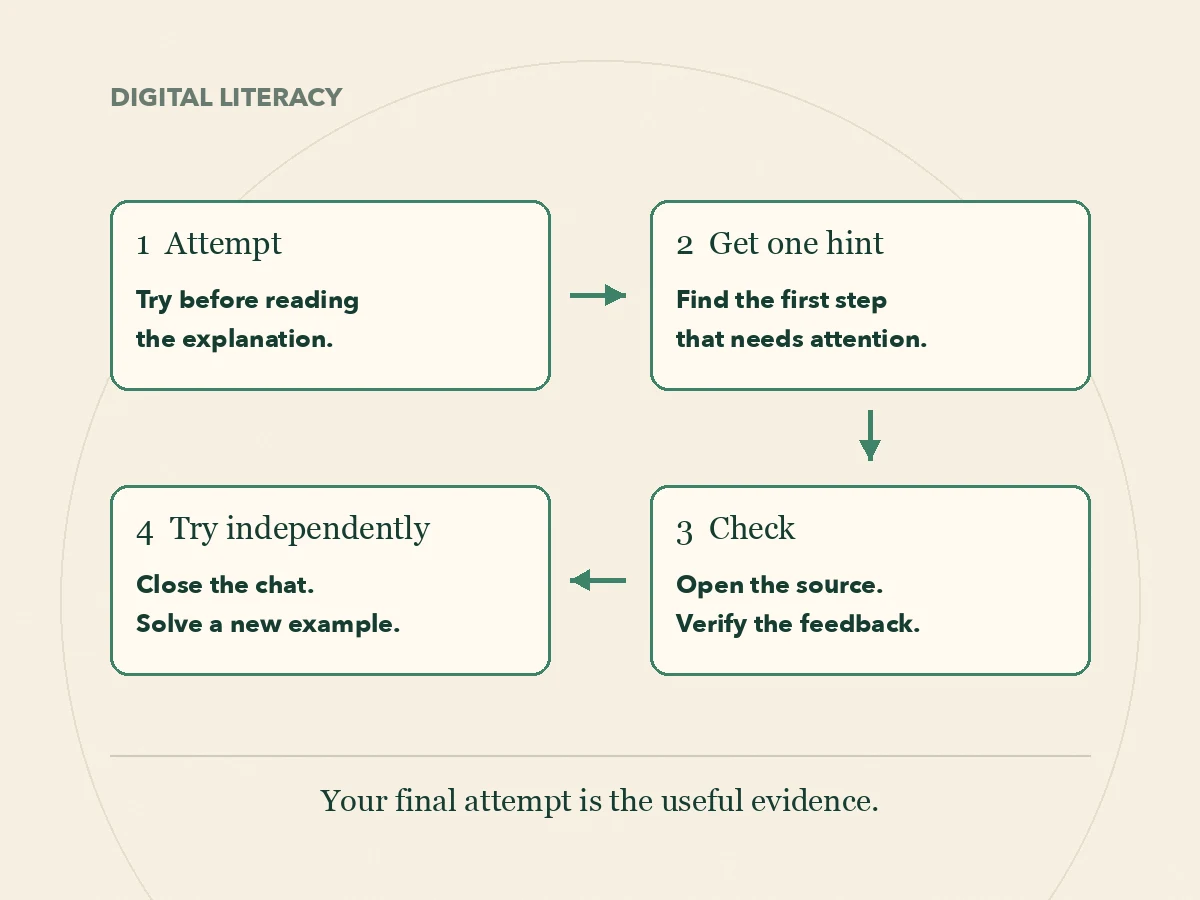
Use a public source you can check. For this 20-minute example, spend three minutes choosing the goal and source, four on your first attempt, eight on hints and checking, and five on a new independent attempt. Adjust those timings to the task.
01
Choose an observable goal
Write what you want to do by the end: distinguish a percentage-point change from a relative percentage change, for example. Add your starting point and the source you will use. Avoid asking the assistant to teach an entire subject in one conversation.
02
Attempt a question before the explanation
Give yourself a short problem and answer it before asking for help. Keep the attempt, including any uncertainty. This gives the assistant something specific to respond to and gives you a record to compare with your final answer.
03
Ask for one hint, then check feedback
Ask the assistant to identify the first mistaken step and offer one hint. Try again. Open the source when feedback makes a factual claim. If the assistant and source disagree, stop that branch and resolve the disagreement before practising it.
04
Finish without assistance
Close the chat and solve a different example. Explain why your method works, not just the result. Check afterwards and write down the exact step you still need to practise. Return to that step in a later session.
Copy and adapt
A prompt that leaves room for your thinking.
Try this prompt: I am learning [specific skill]. I currently understand [starting point]. Use [source] as the reference. Ask one question at a time and wait for my attempt. If I get stuck, give one hint before a solution. After each answer, explain any error and point to the relevant source passage. If the source does not support an answer, say so. Finish with a new question for me to solve independently.
This prompt specifies a teaching interaction. It cannot guarantee that a model will follow every instruction or assess every answer correctly. If it immediately reveals the solution, ask it to restart with a different example. If it invents a source passage, return to the original material and correct the record.
Worked example
Use a second problem to expose a hidden gap.
Here is an invented session. You are comparing attendance rates. In the first problem, attendance rises from 40% to 50%. Your attempt says that attendance grew by 10%. A useful hint asks what quantity the 10 represents and which starting value belongs in the denominator.
You revise the answer: the difference is 10 percentage points. The relative increase is 10 divided by 40, or 25%. Check both calculations yourself. Ask why the two statements describe the same change using different units.
For the final attempt, close the chat. Attendance now falls from 50% to 40%. The change is minus 10 percentage points and a 20% relative decrease, because the starting value is now 50. If you reuse 25%, the new example has found something specific to revisit: the denominator changes with the starting point.
NIST identifies confabulation as a risk of generative AI: a system can produce false content that sounds confident. A citation-looking string or an encouraging assessment is therefore a starting point for checking. It is not independent evidence that the explanation is right.
For a factual topic, open the cited source and find the supporting passage. For a calculation, recompute the result. For an interpretation, ask which visible evidence supports it and what another reasonable interpretation would be. Do not upload private workplace records or someone else's personal information to create a practice example; an invented scenario usually serves the exercise.
Carnegie Mellon's teaching guidance describes retrieval practice as recalling material from memory, with feedback and repeated opportunities to retrieve. That supports making your own attempt part of studying. It does not establish that this particular AI workflow or a particular chatbot improves learning.
End with three lines in your notes: what I can now explain, the mistake I corrected, and the next example to try. A saved transcript is useful reference material, but this smaller record tells you where to start tomorrow. If the topic requires physical technique, expert judgement or assessed work, include the appropriate real practice and follow your institution's rules on AI use.
We make Cadence. The exercises here are free to use on their own; choosing a learning app is a separate decision about your goal and the support you need.
We make Cadence, an app for short daily courses built around your goal. You can use this guide without the app. Explore our reviewed course library to see whether its current focus fits your next learning goal.
Questions
Common questions.
What is a good prompt for learning with AI?
State your goal, starting point and source, then ask for one question at a time, a hint before a solution, and feedback tied to the source. Finish with a new question you answer independently.
Can AI replace a teacher?
An assistant can help generate questions and alternative explanations. It can also misunderstand an answer or supply incorrect feedback. Use teachers, subject experts and trusted materials when the task needs reliable assessment or specialist judgement.
How do I know whether I learned anything?
Attempt a new problem or explanation with the conversation closed, then check it. Record the specific errors and try again later. Feeling familiar with the assistant's explanation is a different observation.
Do I need a paid AI study tool?
This practice structure does not require a paid plan. Use a tool you already have access to, or work with a person and a source. Evaluate payment against a specific limitation you actually encounter.
We make Cadence, an app for short daily courses built around your goal. You can use this guide without the app. Explore our reviewed course library to see whether its current focus fits your next learning goal.