
Practical guide

How to turn notes into practice questions you can trust

A large quiz is easy to generate. A useful one asks a clear question, checks the right idea and has an answer you can trace to your notes.

Explore Cadence's daily courses

We make Cadence, an app for short daily courses built around your goal. You can use this guide without the app. Explore our reviewed course library to see whether its current focus fits your next learning goal.

Download on the App Store
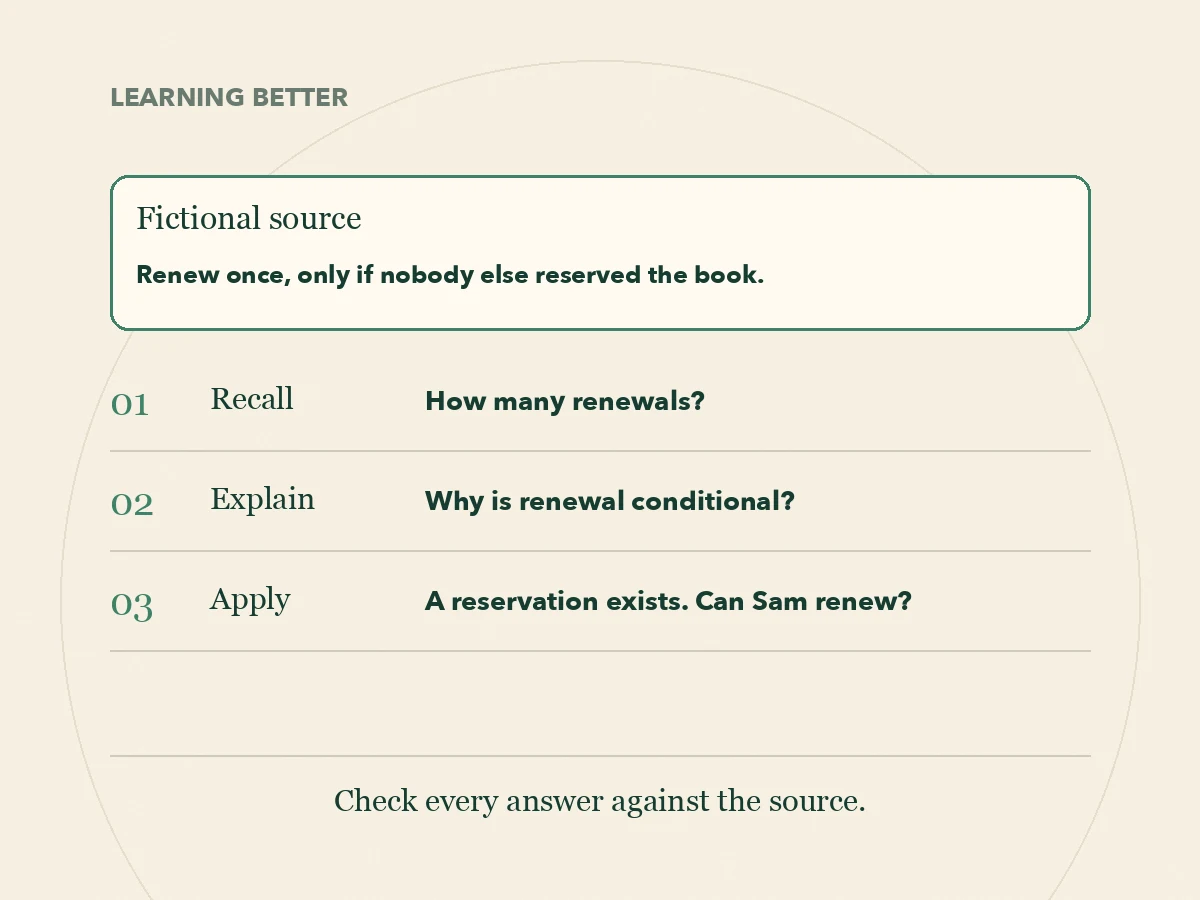
A fictional library rule leads to recall, explanation and application questions, each checked against the source.

A folder full of notes can feel like preparation even when you have not tried to recall anything from it. Turning those notes into questions gives you something to attempt. The quality of those questions matters more than the size of the generated set.

The example below starts with three sentences about a fictional library policy. That deliberately simple material makes it possible to inspect the entire answer key. Use the same check on a section of your own notes before asking a tool to process a whole textbook or a long PDF.

The short answer

Build a small checked set before generating more.

Choose a short source passage, identify what it should help you understand, and write questions that ask you to recall, explain and apply it. Keep an answer key with source references. Check each question for ambiguity and unsupported facts before using it to study.

The method

Make five questions and inspect all five.

Paper, a notes app and an AI tool can all support this workflow. The source and answer checks stay the same.

Select a bounded source

Choose one section with a clear topic. Record its title and page or heading. If the source is a scanned PDF, check that the extracted text, formulas and table labels match the page you can see. A question based on a broken extraction starts from the wrong material.

Choose what the questions should test

Name the distinction or action you want to practise. Ask for a mix: a fact to recall, a relationship to explain and a new case to apply. A flashcard with a single term tests something different from a scenario requiring a decision.

Create the answer key separately

For each question, write the expected answer, the supporting source location and why a tempting alternative would be wrong. If the source leaves the issue open, label it unresolved. Keep answers out of view until after your attempt.

Repair before repeating

Answer the questions yourself and check the key. Remove ambiguous questions, unsupported answers and clues that reveal the answer. Start studying with the checked set, then revise any item that repeatedly confuses wording with understanding.

Worked example

A source, three questions and a checkable key.

Invented source: Riverton Library loans books for 14 days. A member may renew a book once if nobody else has reserved it. Reference books must stay in the library. These are fictional practice rules, not information about a real library.

Recall: How long is the ordinary book loan? Answer: 14 days, supported by sentence one. Explain: Why is 'members can always renew once' inaccurate? Answer: renewal also depends on nobody else having reserved the book, from sentence two.

Apply: Sam has an ordinary book due today and another member has reserved it. Can Sam renew under these rules? Answer: no, because the reservation blocks renewal. Contrast that with an unsupported question: What fine will Sam pay tomorrow? The source provides no fine policy. A tool that supplies a number has added information you did not give it.

Copy and adapt

Ask for evidence with the answer key.

Try this prompt: Using only the passage below, draft five practice questions for [learner and goal]. Include recall, explanation and application questions. Show the questions first. Put a separate answer key afterwards, with a short explanation and the source sentence or page supporting each answer. Mark anything the passage cannot answer. Do not invent missing facts. Passage: [text].

Use material you have permission to share, and leave out confidential or personal information. A request to use only the passage is a constraint to verify, not a guarantee. Check the output against the actual source before treating it as study material.

Choose the format

Match the question to the learning task.

A flashcard is useful when you want to produce a short answer before revealing it. Keep the prompt precise enough that you can tell whether your response was complete. A card that says 'Explain history' gives you no clear standard. A card asking which condition blocks renewal in the fictional policy does.

A multiple-choice item adds answer options. Check that one answer is defensible, the options are comparable and the question does not give away the answer through wording. Add a short explanation after selection. For skills such as writing a clear handover, also write a handover; recognising the best option is only part of the task.

Google's current Gemini Notebook help describes generating flashcards and quizzes from uploaded sources, adjusting difficulty and requesting explanations. That is one documented tool option for this workflow. This guide is based on its documentation, not a hands-on comparative product test; account access and controls should be checked in the tool you use.

Google Help: generating flashcards and quizzes

After creation

Attempt, check and return to the difficult idea.

Carnegie Mellon's retrieval-practice guidance supports recalling information, receiving feedback and returning to it. In this workflow, creating a question set prepares the material. The retrieval attempt happens when you answer with the notes and key hidden.

Keep a small error log: question, your answer, correction, and the idea to revisit. If a question was defective, fix the question before counting the attempt as evidence about your knowledge. For the library example, a wrong fine amount tells you nothing about recall because no correct amount was provided in the source.

We make Cadence. The exercises here are free to use on their own; choosing a learning app is a separate decision about your goal and the support you need.

Carnegie Mellon University: retrieval practice

Put it into practice

Start it today, ten minutes at a time.

We make Cadence, an app for short daily courses built around your goal. You can use this guide without the app. Explore our reviewed course library to see whether its current focus fits your next learning goal.

Download on the App Store

Questions

Common questions.

Can I make a quiz from a PDF?

Yes, with a tool that accepts that source type, or by using a short passage manually. Check the extracted text and page references first, especially for scans, tables and formulas, then verify every answer against the original.

Are AI-generated flashcards accurate?

Accuracy needs checking. A card can omit a condition, ask an ambiguous question or introduce an unsupported fact. Start with a small set and inspect each answer and source reference.

How many questions should I generate?

Begin with a set small enough to review completely. Five is this guide's starting exercise, not a universal optimum. Add questions when they cover a missing idea or expose a different misunderstanding.

Should I use flashcards or practice problems?

Use short-answer cards for bounded recall and explanations. Add problems, scenarios or real tasks when you need to apply an idea. The useful mix depends on what you want to be able to do.

Try Cadence today

Build a skill, one lesson at a time.

We make Cadence, an app for short daily courses built around your goal. You can use this guide without the app. Explore our reviewed course library to see whether its current focus fits your next learning goal.

Download on the App Store

Android early access

Join Cadence on Android.

Tell us your goal and Google Play email. We will send your tester invite when it is ready.

Use the email on the Google account you use with Google Play. We only use it for your tester invite and Android testing updates.