Choose a question before closing the page
Pick a prompt with a checkable answer: what is the difference between percent and percentage points? Avoid vague prompts such as do I understand this, which do not require you to produce anything.
Practical guide
An idea can feel familiar while the page is open. Close it, try to explain it, and check what you left out before deciding that you understand.
Explore Cadence's daily courses
We make Cadence, an app for short daily courses built around your goal. Explore the reviewed course library to see its current focus and decide whether it fits what you want to learn.

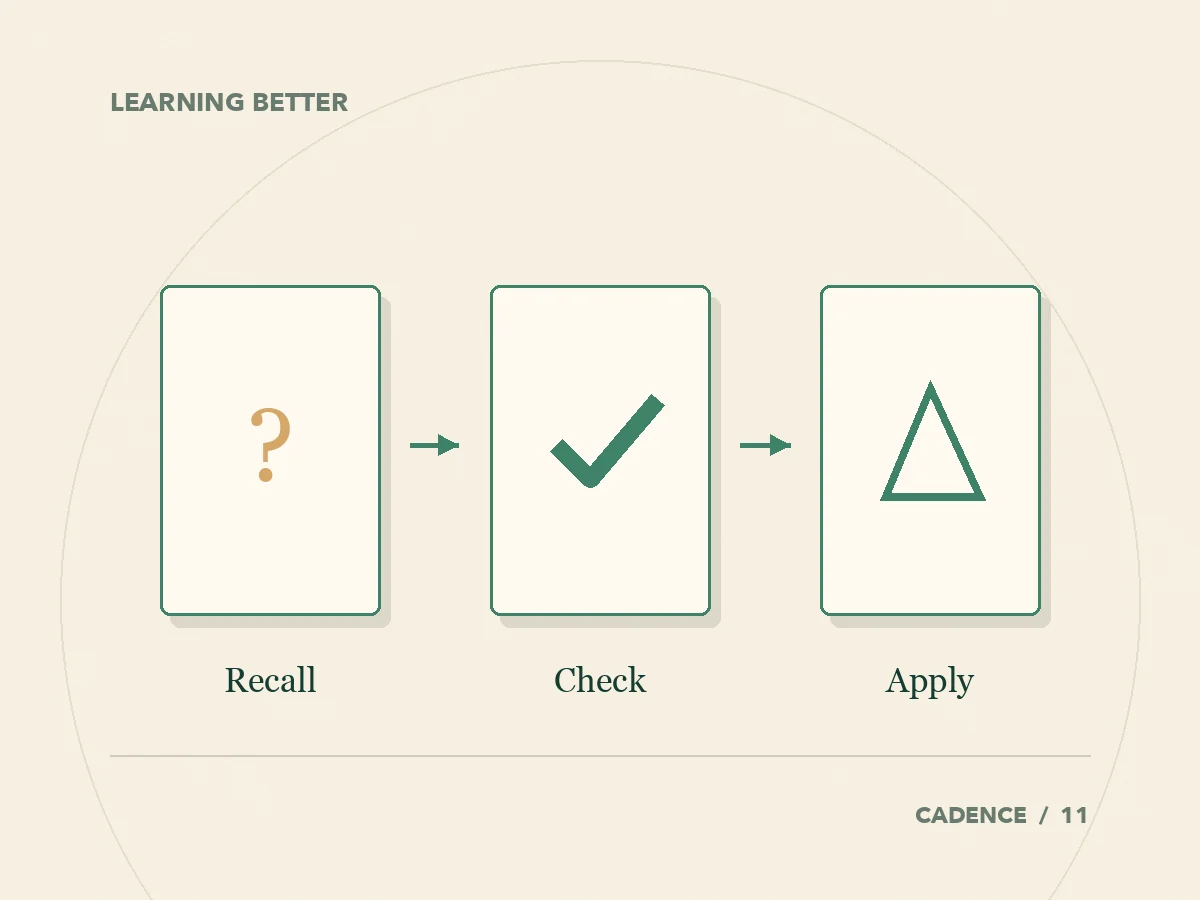
You finish an explanation of percentage points and it all seems clear. Then someone asks why a rise from 20% to 30% is a 50% increase, and you reach for the article again. The page helped you follow the reasoning, but you have not yet checked what you can produce without it.
Use the short routine below with something you are already reading. The timing and examples are suggestions for a manageable practice session, not a research-backed claim about an optimal schedule.
The short answer
After reading a small section, put it away and answer a question from memory. Compare your answer with the source, correct the gap, and try again later. Add a new example to check whether you can use the idea.
The method
Start with one idea you can check accurately rather than testing yourself on a whole chapter at once.
Pick a prompt with a checkable answer: what is the difference between percent and percentage points? Avoid vague prompts such as do I understand this, which do not require you to produce anything.
Write or say your explanation from memory. Include an example if the concept allows it. If you get stuck, record the point where you got stuck rather than quietly checking the page mid-answer.
Reopen the source. Mark the specific missing distinction, incorrect step or unsupported detail. Rewrite that part accurately. The correction should tell you what to work on, not merely assign a score.
On a later day, try the question again and change the numbers or situation. For percentage points, switch from 20% to 30% to a change from 8% to 10%. Explain why the arithmetic works, not just the final number.
What the research supports
Carnegie Mellon's teaching guidance describes retrieval practice as recalling information, with feedback to identify and correct mistakes. It explains how retrieval can contribute to learning. That supports the recall-and-check principle here; the particular notebook routine is our suggested application.
Carnegie Mellon University: retrieval practice for improved learning
Worked example
Prompt: an attendance rate rises from 8% to 10%. A first answer says it rose 2%. On checking, the correction is: 2 percentage points, and a relative increase of 2 divided by 8, or 25%. The gap was recognising the type of comparison.
Your next prompt could ask why a fall from 10% to 8% is a 20% relative decrease. That checks whether you understand the changing denominator instead of remembering one pair of numbers.
Keep it proportionate
For a historical article, distinguish a recalled date from an interpretation. For a practical skill, add an actual attempt, such as writing the opening of a conversation. A memory question can check a concept, but it cannot by itself establish that you can perform a complex task in real conditions.
If every question is a struggle, reduce the amount of new material and review the explanation. If every answer is automatic, ask for a comparison or a fresh application. Use the result to choose the next practice, not to judge your intelligence.
From the publisher
Cadence is our app. Whatever learning tool you use, look for opportunities to attempt an answer and understand the correction. Completing a lesson is useful activity, but the attempt gives you different evidence about what you can recall and apply.
Put it into practice
We make Cadence, an app for short daily courses built around your goal. Explore the reviewed course library to see its current focus and decide whether it fits what you want to learn.
Questions
No. Use it to understand the material and correct gaps. Add an attempt without the page so you can distinguish following an explanation from recalling it.
Compare with a reliable answer and correct the specific error. Do not repeatedly rehearse an unchecked guess.
No. A blank page, a spoken explanation or a short practice question can serve the same immediate purpose. Choose a format appropriate to the subject.
Try returning on a later day and adjust to your goal, difficulty and performance. This article does not prescribe one ideal interval for every learner or topic.
See it in concrete terms
Inspect the syllabus for these workplace courses to decide whether the topic and level fit your goal.
Design cues, friction, rewards, and review loops so a habit survives normal weeks instead of ideal weeks.
Read workplace metrics, question weak evidence, explain uncertainty, and recommend a next step without learning SQL.
Use practical decision tools for incentives, bottlenecks, second-order effects, and reversible moves.
Sources
Try Cadence today
We make Cadence, an app for short daily courses built around your goal. Explore the reviewed course library to see its current focus and decide whether it fits what you want to learn.