Turn the material into questions
Review means answering, not rereading. Write questions you can attempt with the answers hidden, as in our notes-to-questions guide. Twelve good questions are more useful than sixty unchecked ones.
Practical guide
Reviewing the same material in several brief attempts, with gaps between them, usually beats one long session for remembering it later. The useful part is deciding when each review happens.
Read the guidePractise recall on a schedule that adjusts
We make Cadence, an app that builds a short daily course around a goal you describe, such as remembering a new process before a briefing. Start free on iPhone or request Android access.

A week before a test, a presentation or a trip, it is tempting to block out one long evening and go over everything. That session can feel productive: the material looks familiar by the end. Familiar is not the same as remembered, and the difference usually shows up a few days later.
Spaced repetition splits the same work into shorter attempts with gaps between them. This guide shows one worked three-week schedule, a paper method that adjusts the gaps to your own answers, and what the research does and does not say about choosing the gaps. The schedule is an editorial example, not a formula from a study.
The short answer
Start with a set of questions, not a page to reread. Answer them today, again tomorrow, then after longer gaps such as three days, a week and two weeks. Any question you miss comes back the next day. Questions you answer easily wait longer. Keep the final review a few days before you need the material.
The method
You need a set of questions and a date. Paper, a calendar and a flashcard app all work; the rules below stay the same.
Review means answering, not rereading. Write questions you can attempt with the answers hidden, as in our notes-to-questions guide. Twelve good questions are more useful than sixty unchecked ones.
A briefing on day 21, a test next month, a trip in six weeks. The date decides how far apart the later reviews can be. Without one, use a regular check such as once a month.
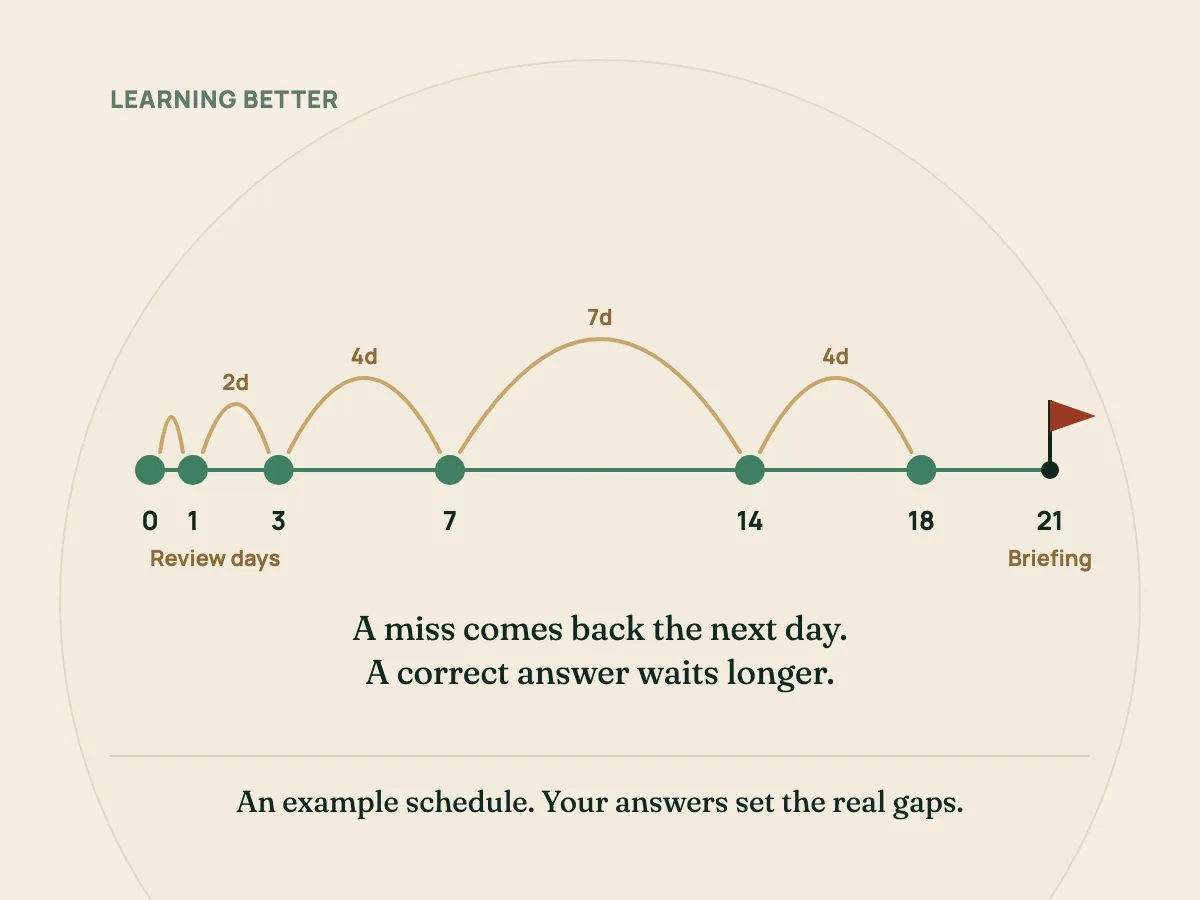
Answer every question today. Put the next attempts in your calendar for tomorrow, then day 3 and day 7. Ten minutes is enough: that is what each review takes in the example below.
A missed question comes back tomorrow. A correct but slow one keeps its current gap. A quick, correct answer moves to the next, longer gap. Your answers, not the calendar, decide what you see next.
Worked example
Invented scenario: you have turned a chapter of notes about a new team process into 12 practice questions. You will explain the process at a briefing on day 21. You can spare about ten minutes on a review day.
Day 0: answer all 12, check them and correct your notes where the answer key disagreed. Day 1: 9 of 12 correct. The 3 you missed come back on day 2, and you get 2 of them. The last one returns on day 3 with everything else. Day 3: 11 of 12. Day 7: 11 of 12, with a different miss, which tells you which idea is fragile rather than which day was bad.
Day 14: 12 of 12, two of them slow. Day 18: one final pass, three days before the briefing, so any surprise still has time to be fixed. Total: seven reviews, about an hour, spread across three weeks. The same hour on day 20 would end with everything looking familiar and no evidence of what you could recall on day 21.
Copy and adapt
Use three envelopes or three columns on a page. Box 1 is reviewed every review day. Box 2 every second review day. Box 3 once a week. Every question starts in box 1.
When you answer correctly, move the question one box up. When you miss it, it goes back to box 1, wherever it was. Write the date of each attempt on the card. After two weeks, the cards still sitting in box 1 are your actual study list. This is a simplified version of the Leitner box system, a long-standing paper method for flashcards.
Keep the rule strict for misses and generous for slow answers. A slow correct answer can stay where it is. A confident wrong answer is the most useful signal you get, because it shows an idea you believe you know.
What the evidence shows
In a 2009 study, students learned vocabulary pairs with web flashcards, either spaced across sessions or massed together. Spacing was more effective than massing for 90% of participants. Yet after the first session, 72% believed massing had worked better. Those are results from vocabulary learning in that study, not a promise for every subject.
The practical lesson is to judge a schedule by a delayed attempt, not by how the session felt. If you want to test this on yourself, split a question set in two, cram one half and space the other, then try both a week later.
What the evidence shows
A 2006 review of 317 experiments on verbal recall found that spacing and the delay before the final test worked together: the best gap depended on how long you needed to remember. A 2008 study of more than 1,350 people learning facts found the best gap was roughly 20 to 40% of a one-week test delay, and 5 to 10% of a one-year delay.
Read that as direction, not a calculator: longer horizons can use longer gaps. Neither study tested the three-week schedule above; its gaps are an editorial starting point that your own misses then adjust. If you need the material for months, keep stretching the gaps instead of reviewing daily forever.
Choose the format
Paper and calendar reminders are enough for a few dozen questions with one date. A flashcard app helps when the set grows into the hundreds or the dates stretch over months. Anki, for example, asks you to rate how well you recalled each card and uses those ratings to schedule the next review. Whatever schedules the reviews, you still need good questions and honest answers.
Spaced repetition suits facts, terms and short explanations well. For skills such as giving feedback or writing a summary, space the practice itself: do a short version of the task on day 1, 3 and 7, then compare the attempts. The spacing is the same idea; the review is a performance rather than a flashcard.
We make Cadence. The exercises here are free to use on their own; choosing a learning app is a separate decision about your goal and the support you need.
Put it into practice
Pick the one problem from this guide that is closest to yours. Cadence turns it into short daily lessons with practice and checks. Cadence is our app.
Questions
Start with today, tomorrow, day 3 and day 7, then stretch the gap each time you answer correctly. Bring any missed question back the next day. The right gaps depend on how long you need to remember the material.
No. Active recall, or retrieval practice, is answering from memory instead of rereading. Spaced repetition is about when you do it. They work best together: recall attempts, placed at growing intervals.
Yes. Three envelopes or three columns on a page are enough: misses go back to the first box, correct answers move up. An app becomes useful when you have hundreds of cards or months of reviews.
Do the review on the next day you can, and continue from there. Do not try to catch up on two sessions at once. A late review is still a review; the schedule only needs to be roughly right.
Try Cadence today
Describe what you want to learn and Cadence builds a course of short daily lessons you can read or play as audio. It is free to start on iPhone, and Android access is by request.