Extract the decisions
For the museum example, list opening hours for your date, admission rules, exhibition dates and booking requirements. These are the facts that determine whether the proposed outing works.
Practical guide
A confident answer and a list of links are a starting point. Verify the claims that matter using evidence outside the answer itself.
Explore Cadence's daily courses
We make Cadence, an app for short daily courses built around your goal. Explore the reviewed course library to see its current focus and decide whether it fits what you want to learn.

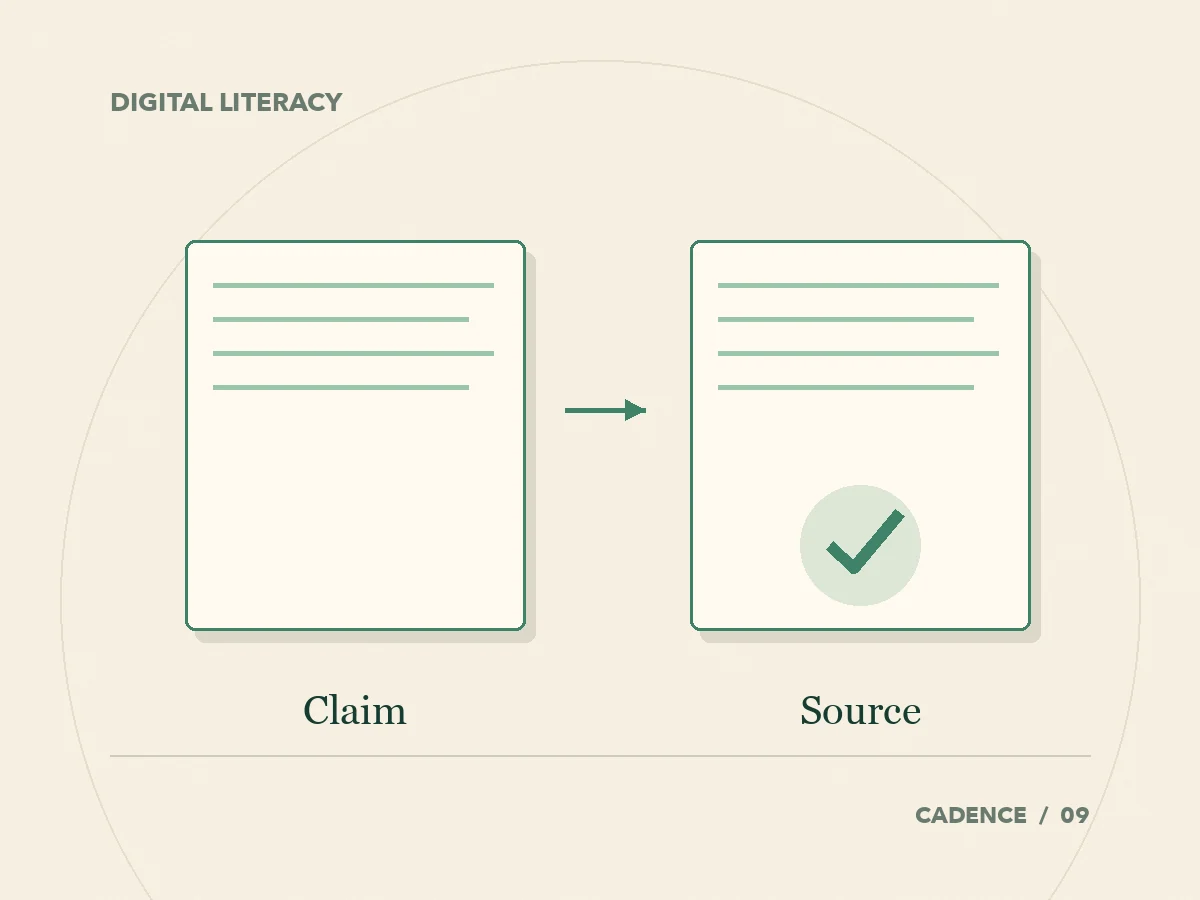
An AI answer might say that a museum opens at nine, admission is free and a particular exhibition ends next month. That looks like one helpful paragraph. For your visit, it contains at least three separate factual claims.
This guide uses a fictional outing to show how to check an answer efficiently. Spend effort on the facts that could change what you do, and preserve uncertainty when you cannot establish them.
The short answer
Pick the claims that would change your decision. Open the original sources, check that they support the exact wording, verify dates and recalculate important numbers. An AI repeating its answer is not independent confirmation.
The method
Start with the most consequential claims, then check the rest in proportion to how you plan to use them.
For the museum example, list opening hours for your date, admission rules, exhibition dates and booking requirements. These are the facts that determine whether the proposed outing works.
Visit the museum's official visitor-information and exhibition pages. A search snippet or an AI-provided citation title is not the page itself. If a linked source does not exist, mark the claim unverified instead of inventing a substitute.
Check whether free admission applies to the permanent collection, the special exhibition, a particular age group or a particular day. A true sentence about one of these can become false when applied to another.
If the answer totals travel and admission for four people, recompute it from the verified inputs. Keep facts, arithmetic and suggestions separate so that a correct calculation does not disguise an incorrect starting assumption.
Why verification matters
NIST's Generative Artificial Intelligence Profile describes confabulation: confidently presented false content, which can include fabricated reasoning or citations. That is why the presence of a reference list is not enough. The source must exist and support the particular claim being made.
NIST: Generative Artificial Intelligence Profile, section 2.2
Worked example
Our fictional answer says that the museum is free. Its official page says the permanent galleries are free but the temporary exhibition requires a ticket. The citation exists, yet the recommendation to arrive without paying for the exhibition is unsupported.
Rewrite the result precisely: the permanent galleries are free; the exhibition has a separate ticket; check availability for the intended date. You have corrected the scope of the claim instead of merely collecting another link.
A reusable note
Write: claim, original source, relevant date, conclusion. Use conclusions such as supported, contradicted or not established. For a quotation, compare the exact wording with the original. For an instruction, check whether it applies to your product version or location.
When the consequences require specialist judgement, a source check may still be insufficient. Treat the answer as preparation for a qualified review rather than asking the same model to certify its own reliability.
From the publisher
Cadence is our app, and this standard applies to AI-generated learning content too. Use original references when checking factual claims. A coherent lesson or a confident explanation is not, by itself, evidence that every detail is correct.
Put it into practice
We make Cadence, an app for short daily courses built around your goal. Explore the reviewed course library to see its current focus and decide whether it fits what you want to learn.
Questions
No. It may revise or explain the answer, but that does not supply independent evidence. Verify the relevant claim against an original source.
No. A real page may concern a different date, population, product version or claim. Check what it actually supports.
Prioritise the claims that affect your decision or that you plan to repeat publicly. Increase scrutiny as the consequences of an error increase.
Label the claim unverified and omit it from any conclusion that depends on it. A plausible detail is not a replacement for missing evidence.
Sources
Try Cadence today
We make Cadence, an app for short daily courses built around your goal. Explore the reviewed course library to see its current focus and decide whether it fits what you want to learn.