Make one patch of light
In a dim room, shine an ordinary torch at a sheet of paper. Hold both steady. Mark the outline of the bright patch lightly with a pencil. Keep the torch a comfortable distance away and away from anyone's eyes.
Practical guide
The useful question is why two places on the same planet can have opposite seasons. A tilted Earth explains what distance from the Sun cannot.
Explore Cadence's daily courses
We make Cadence, an app for short daily courses built around your goal. Explore the reviewed course library to see its current focus and decide whether it fits what you want to learn.

Imagine a friend in Sydney planning a summer picnic while someone in London is putting on a winter coat. They are on the same Earth, at almost the same distance from the Sun. Any explanation of seasons has to account for both people at once.
Start with that puzzle rather than a list of dates. Below is a small demonstration you can do with a torch and a sheet of paper, followed by a way to test whether your explanation actually answers the puzzle.
The short answer
Earth's tilted axis changes the angle of sunlight and the length of the day as Earth travels around the Sun. These changes drive the annual seasons, with opposite patterns in the two hemispheres.
The method
This is a model of light falling on a surface. It is not a model of the whole climate system.
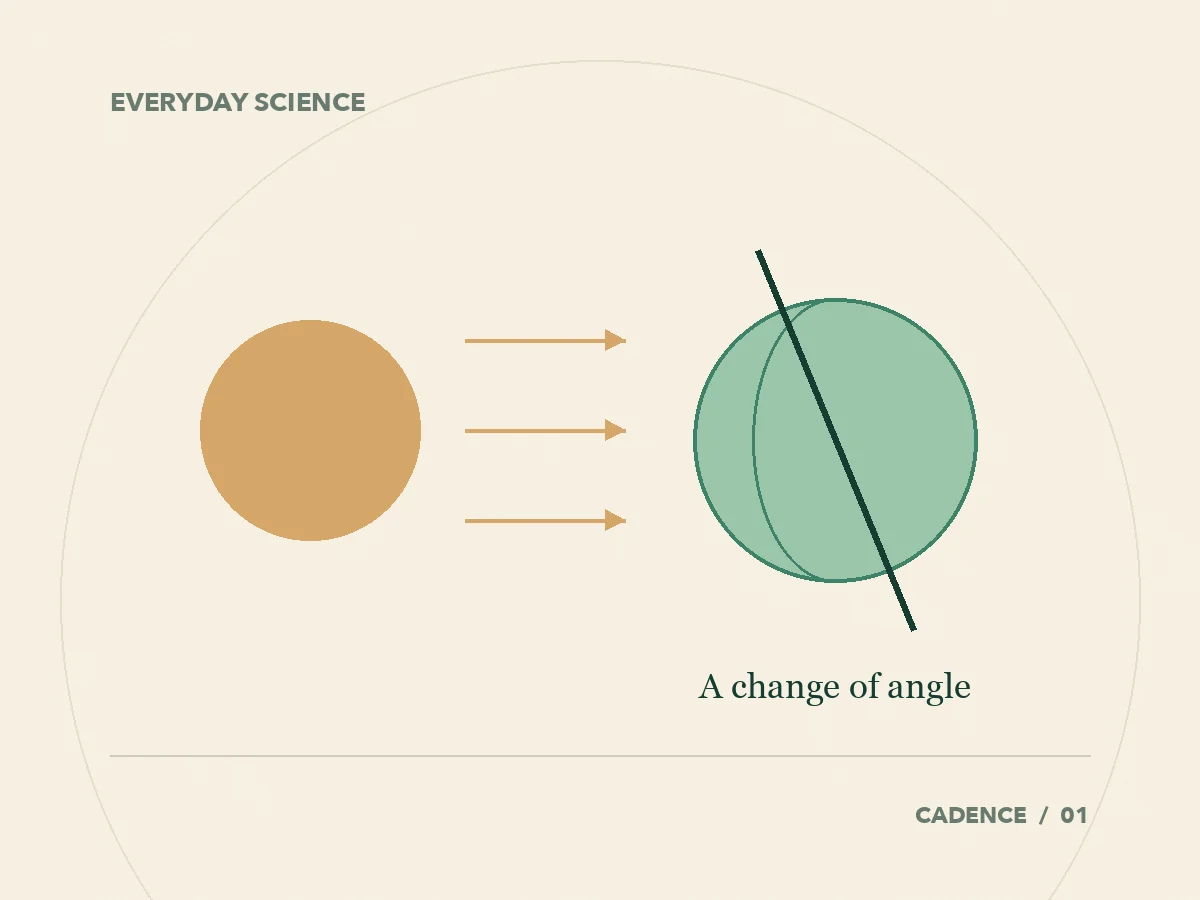
In a dim room, shine an ordinary torch at a sheet of paper. Hold both steady. Mark the outline of the bright patch lightly with a pencil. Keep the torch a comfortable distance away and away from anyone's eyes.
Angle the paper while keeping its centre roughly the same distance from the torch. Compare the new outline with the first. The beam spreads over a larger area. Write down what changed without yet trying to explain a season.
Your paper demonstration changes the angle, but not the number of hours of daylight. Add a second line to your explanation for how long the sunlight arrives. A model can show one part of an explanation without showing every part.
Draw Earth with a tilted axis and put your friends in opposite hemispheres. Use the same drawing to explain their different seasons. If your explanation requires the whole planet to be closer to the Sun for one friend, revise it.
The science
NASA explains seasons through Earth's axial tilt. When a hemisphere leans toward the Sun, sunlight strikes it more directly and its days are longer. Half an orbit later, that hemisphere leans away. Earth's orbit is slightly elliptical, but its changing distance is not the main reason for these opposite seasonal patterns.
Check yourself
Try this thought experiment: a planet has a circular orbit, but its axis is tilted. Could it have seasons? Yes. A changing distance is unnecessary for the angle and daylight pattern to change. Now imagine the same circular orbit without an axial tilt. That particular seasonal mechanism disappears.
This answer concerns the mechanism in our model. It does not predict every planet's weather. When you explain an idea, naming the part your model leaves out is a sign of understanding.
A useful limit
Do not use the torch demonstration to predict whether it will rain on a particular afternoon. Your explanation addresses a yearly pattern in sunlight. A forecast needs additional observations and a weather model. Write two separate questions in your notebook: why does sunlight change through the year, and why is today's weather different from yesterday's?
From the publisher
Cadence is our app. This article is a standalone science explanation; the NASA reference is the next place to explore its diagrams. Our reviewed course library currently concentrates on workplace learning, so treat this article as editorial teaching rather than a claim that we offer a reviewed astronomy course.
Put it into practice
We make Cadence, an app for short daily courses built around your goal. Explore the reviewed course library to see its current focus and decide whether it fits what you want to learn.
Questions
Distance alone cannot explain opposite seasons in the northern and southern hemispheres. Earth's tilt is the central explanation here.
Compare the size of the illuminated patch when the paper faces the torch and when it tilts. Hold the other conditions as steady as you can.
No. It explains changing solar illumination. Local climate, rainfall patterns and individual weather events need additional explanations.
Explain opposite hemispheres using one drawing, then explain why a tilted planet could have seasons even with a circular orbit.
Sources

Try Cadence today
We make Cadence, an app for short daily courses built around your goal. Explore the reviewed course library to see its current focus and decide whether it fits what you want to learn.