Record the viewing conditions
Write the date, local time, approximate direction, and whether the sky was clear. If you cannot see the Moon, record that too. A blank observation does not prove that the Moon was absent from the sky.
Practical guide
The Moon does not need to shrink, grow, or enter Earth's shadow to look different. The part of its sunlit surface visible to us changes.
Explore Cadence's daily courses
We make Cadence, an app for short daily courses built around your goal. Explore the reviewed course library to see its current focus and decide whether it fits what you want to learn.

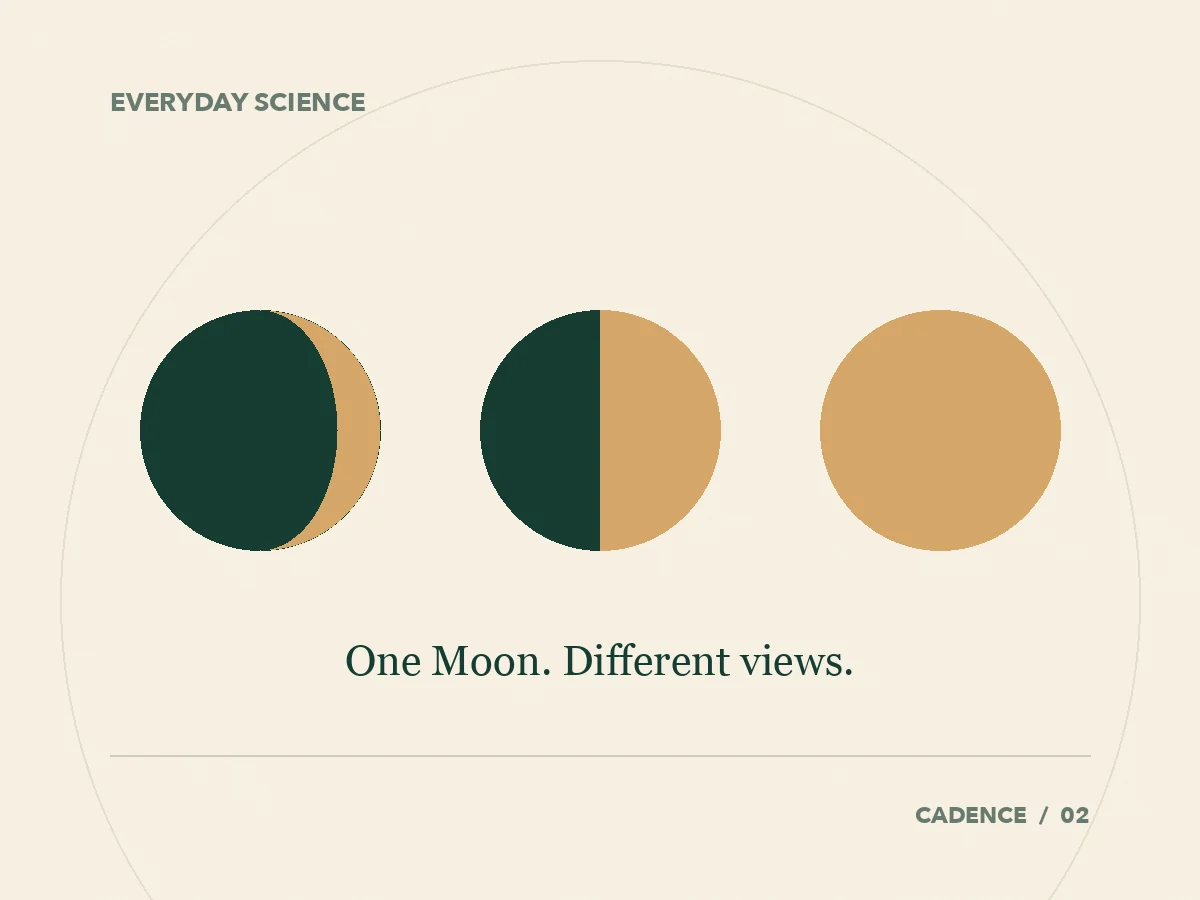
A thin crescent and a full Moon look like different objects. Naming them is easy; explaining the change takes a little more care. In particular, saying that Earth casts a shadow does not explain the ordinary monthly sequence.
You can investigate the pattern with your eyes and a notebook. The goal is not to collect impressive photographs. It is to separate what you observed from the explanation you are testing.
The short answer
The Sun illuminates approximately half the Moon. As the Moon orbits Earth, we see different amounts of that illuminated half. Those views are the phases. A lunar eclipse is a different event.
The method
Try several observations over a few weeks. Gaps and cloudy nights are part of the record.
Write the date, local time, approximate direction, and whether the sky was clear. If you cannot see the Moon, record that too. A blank observation does not prove that the Moon was absent from the sky.
Make a small circle and shade what looks dark. Do not worry about artistic quality. Add a note for how high the Moon appeared above the horizon so that the sketch has some context.
After a few entries, sketch what you expect to see next. Label it prediction. Keep it even if it is wrong, rather than replacing it with the observation. That preserves the comparison you are trying to make.
Use NASA's diagram in the reference below to connect the changing appearance to the positions of the Sun, Earth, and Moon. Identify which part of your drawing is an observation and which part you learned from the model.
The explanation
NASA describes phases as the changing view of the Moon's sunlit half during its orbit. At full Moon we see most of that half; at new Moon it faces mostly away from us. The sequence takes about 29.5 days. The Moon's orbit is tilted relative to Earth's orbit, so the bodies do not line up for an eclipse every month.
Worked example
Suppose your notes say: Monday, a crescent; Tuesday, cloud; Wednesday, not found between nearby buildings. You cannot conclude that the Moon disappeared for two days. Your observation was constrained by sky conditions, viewing time and your line of sight.
A better notebook entry is: I did not observe it from this location at this time. That small change in wording keeps missing evidence separate from a conclusion about the object itself.
Try explaining it
Ask yourself: if ordinary phases were Earth's shadow, what would make them different from a lunar eclipse? Answer without looking above. Then check the reference. Finally, tell a friend your explanation in two sentences without using the words waxing or waning. Vocabulary is useful after the mechanism makes sense.
From the publisher
We make Cadence. You can use this observation exercise without our app. NASA's diagrams are the relevant next resource for this topic; our current reviewed courses should not be mistaken for an astronomy curriculum.
Put it into practice
We make Cadence, an app for short daily courses built around your goal. Explore the reviewed course library to see its current focus and decide whether it fits what you want to learn.
Questions
No. Ordinary phases reflect our changing view of the Moon's illuminated side. Earth's shadow is involved in a lunar eclipse.
No. This exercise concerns the visible outline, so unaided observations are enough. Never look at the Sun through binoculars or a telescope.
Keep it and add what you observed. The difference tells you which part of your explanation needs revision.
Continue and mark the gaps honestly. Compare the dated entries you have rather than inventing observations for the missing days.
Sources
Try Cadence today
We make Cadence, an app for short daily courses built around your goal. Explore the reviewed course library to see its current focus and decide whether it fits what you want to learn.