Apps like Kinnu, and when Kinnu is still the right choice
Kinnu's general knowledge app is free, so most people looking for an alternative want something it does not do: prettier lessons, exact memorising, more variety, problem solving, or a course around their own goal.
Learning Cadence editorial, , 7 min readHow we work
If Kinnu works for you, there is no price reason to leave: its general knowledge app is free on the App Store, with optional in-app purchases. People who look for an alternative usually want a different kind of learning, not a cheaper one. The quick picks below are sorted by that reason.
Kinnu teaches through pathways: short lessons, multiple-choice questions and spaced review across subjects such as psychology, science and history. The same company also sells separate exam-preparation products. We make Cadence, one of the apps compared here, and say so where it appears.
Start here
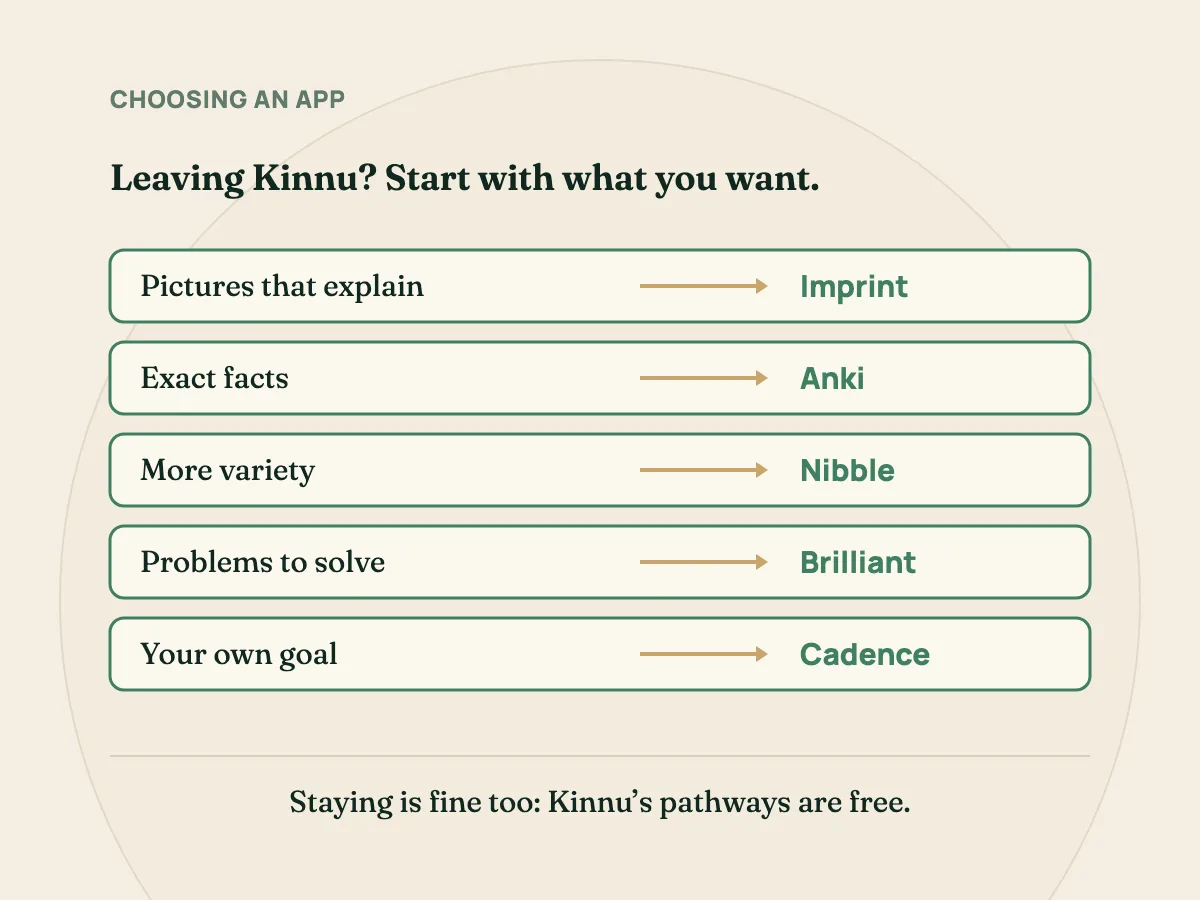
Pick by what you want that Kinnu does not give you.
Pick by what you want that Kinnu does not give you
WhyAn ordered course built from what you want to learn. This is our app.
The apps
Every app, with what it is bad at.
Start with the job you need the app to do, then read the tradeoff.
01
Imprint
Visual explainers, mostly psychology
Imprint offers illustrated lessons across subjects such as psychology, philosophy, and science. Its official App Store description includes daily quizzes and saved insights. We have not compared its learning outcomes with other apps.
Best for
Grasping a concept quickly when a picture genuinely explains it better than a paragraph would.
Not for
A course built around your own goal, or verified feedback on your own workplace scenario. We have not tested open-ended rehearsal in Imprint.
Price
Free to install with a subscription for full access. Its site may show a discount offer before the plan screen.
Anki is a flashcard tool that schedules reviews using spaced repetition. You rate how well you recalled each answer, and the scheduler uses your reviews to estimate when to show a card again. Create cards or choose a shared deck, and check that the material fits what you need to learn.
Best for
Facts, vocabulary, and anything you must recall exactly.
Not for
Replacing explanations, worked examples, or practice in using an idea. Choose cards that support the subject you are studying.
Price
Free on desktop and Android. The iPhone app is a one-time purchase that funds the project.
Nibble describes itself as a curiosity app: interactive ten-minute lessons across around 30 topics spanning STEM, humanities, and general knowledge, with more added monthly. The formats vary more than most, including listening, reading, and chatting with historical figures, and its own pages claim more than 10 million downloads.
Best for
Broad general knowledge in ten-minute sittings, when you want variety more than a syllabus.
Not for
Going deep on one subject, or learning something specific that its catalogue does not already cover.
Price
Free to install with a paid tier for full access and a trial.
Brilliant offers guided maths, science, and computing courses with interactive problems and explanations. Try a sample to see whether the level and feedback suit you. We have not measured its learning outcomes against the other apps in this comparison.
Best for
People who want to work through interactive problems on a guided subject path.
Not for
Subjects outside maths, science, and computing, or learners who need unlimited daily access without a subscription.
Price
Brilliant Free provides two keys a day. Each key unlocks one lesson or practice set, and free users move through courses in order. Premium removes the daily limit, allows jumping ahead, removes ads, and gives full Koji access.
Cadence starts with a problem you want to solve or a curiosity you want to explore, then builds an ordered 7 to 30 lesson course around it. Each lesson takes about ten minutes, can be read or played as audio, and stays connected to the course. Lessons use checks or practice when they help, and Ask Coach stays inside the lesson.
Best for
Turning your own starting point into one coherent course you can keep progressing through.
Not for
Anyone who needs a recognised certificate, a named instructor, or a language course with speaking practice.
Price
Free to start, with 2 new lessons a day, audio and 4 lesson voices included, and 2 new custom courses a month. Plus makes new lessons, new courses, practice, and Ask Coach unlimited, adds 8 more voices for 12 in total, and raises live voice practice to 15 minutes a day, for US$49.99 a year on the web, with a 7-day trial.
Kinnu's general knowledge app is listed as free on the US App Store. Its in-app purchases, as listed on October 6, 2026, are a 'Monthly' item at 1.99 US dollars and 'Kinnu Certificate' items at 7.99, 14.99 and 19.99 US dollars. The listing does not explain what the monthly item adds, so check inside the app before paying for it. Prices can differ by country.
Kinnu's own site describes its pathways as free and lists separate exam-preparation products for the SQE, SAT, CFA and BCBA exams. If you came to Kinnu for exam practice, compare those products with your exam's official materials rather than with the apps on this page.
What you would give up by switching is a free, structured way to build general knowledge with recall questions and review built in. If that is what you want, stay. If the content or format is the problem, the alternatives above solve different problems.
Both cover ideas from psychology, science and history in short lessons. The difference is mostly format and price. Imprint explains with visuals and charges a subscription for full access. Kinnu is plainer to look at, free for its general knowledge pathways, and asks you to answer more questions as you go.
Choose Imprint if pictures are what make an idea click for you and the subscription fits your budget. Choose Kinnu if you want to keep testing yourself without paying. Neither builds a course around a goal you bring yourself.
A common question
What a Kinnu certificate is worth.
A Kinnu certificate shows that you completed material in Kinnu. The App Store listing sells them but does not describe any accreditation, so do not assume an employer or institution will treat one as a qualification. If you want a certificate for a job, ask the employer what they recognise before paying.
For most people, the more convincing evidence is something you can show: an explanation you wrote, a project, or a decision you made using what you learned. That costs nothing extra and says more about what you can actually do.
Try before switching
Test what you kept after a few days.
Pick one pathway you finished in Kinnu at least three days ago. Without opening the app, write down three things you remember and one place you could use them. Then reopen the pathway and check. This is an editorial decision aid, not a validated test or a report of our own trial.
If you remembered the facts but could not see where to use them, an app with more application practice may suit you better. If you remembered little, the problem may be review timing rather than the app; our spaced repetition guide shows a simple schedule. If both went well, Kinnu is working, and switching would mostly change the look.
Where we fit
What Cadence does instead.
We built Cadence, so this section is a disclosure.
Cadence starts from something you want to learn, in your own words, and builds an ordered course around it, with checks or practice when they help. That is a different job from Kinnu's catalogue of pathways: choose it when the subject you want is not in a catalogue, or when you want the course to stay on one goal.
We have not run a learning-outcome comparison against Kinnu. A generated course is not a guarantee of subject accuracy or improved performance.
Put it into practice
Start it today, ten minutes at a time.
Cadence builds a course around your own goal instead of a catalogue, with short daily lessons, practice and saved progress. Cadence is our app.
Questions
Common questions.
What is the best app like Kinnu?
It depends on what you want that Kinnu does not give you. Imprint for visual lessons, Anki for exact memorising, Nibble for more variety, Brilliant for maths and science problems, and Cadence for a course built around your own goal.
Is Kinnu free?
Its general knowledge app is listed as free on the App Store. As of October 6, 2026, the US listing also shows optional in-app purchases: a monthly item at 1.99 US dollars and certificates from 7.99 to 19.99 US dollars. Its exam-preparation products are sold separately.
Is Kinnu better than Imprint?
Neither is better for everyone. Kinnu is free for its general knowledge pathways and asks more recall questions. Imprint uses visuals and needs a subscription for full access. Try one lesson of each on the same idea and check what you remember a few days later.
Are Kinnu certificates worth anything?
They show you completed material in Kinnu. The App Store listing does not describe accreditation, so check with an employer or institution before paying if you need a recognised credential.
See it in concrete terms
Open a real Cadence course.
If Kinnu's psychology and science pathways are what you enjoyed, these Cadence courses go deeper on one question at a time.
Kinnu's general knowledge app is free, so price is rarely the reason people look elsewhere. We started from what a Kinnu user might want that it does not give them: lessons that explain with pictures, exact memorising, more variety, problem solving, or a course around their own goal. Each candidate is described from its current official pages and placed against the one reason it answers best. We also say when Kinnu is still the right choice, because often it is.
What we checked directly: We opened the current official site for Kinnu and for every alternative named here, and checked the described features, what the free tier covers, and how each one is sold.
Limits of this review: We did not subscribe to paid tiers or buy certificates, and we did not test signed-in behaviour in products we do not publish. Kinnu's in-app purchase list is quoted from its US App Store listing as shown on October 6, 2026; other prices are described from official pages without exact amounts because they vary by country and offer.