Write your first answer and how sure you are
Before you think further, note your answer and a rough confidence, such as 70%. This is the baseline. Without it, you cannot tell later whether your thinking changed or whether you only felt more certain.
Practical guide
Thinking better is less about a sharper brain and more about a few habits you use on real decisions: write it down, argue the other side, check one thing, and look back later.
Read the guidePractise thinking on real decisions
We make Cadence, an app that builds a short daily course around a goal you describe, such as catching your own biases before a big decision. Start free on iPhone or request Android access.

Most people who want to think better are not short of intelligence. They decide quickly on a first impression, stay with it, and rarely find out whether it was right. The fix is not to think harder about everything. It is to slow down at the few decisions that matter and give yourself a way to learn from them.
This guide walks through one invented decision with three habits that have research behind them: writing your reasoning down, imagining failure in advance, and practising with feedback. It also says plainly what brain-training games have and have not been shown to do, because that is often the first thing people try.
The short answer
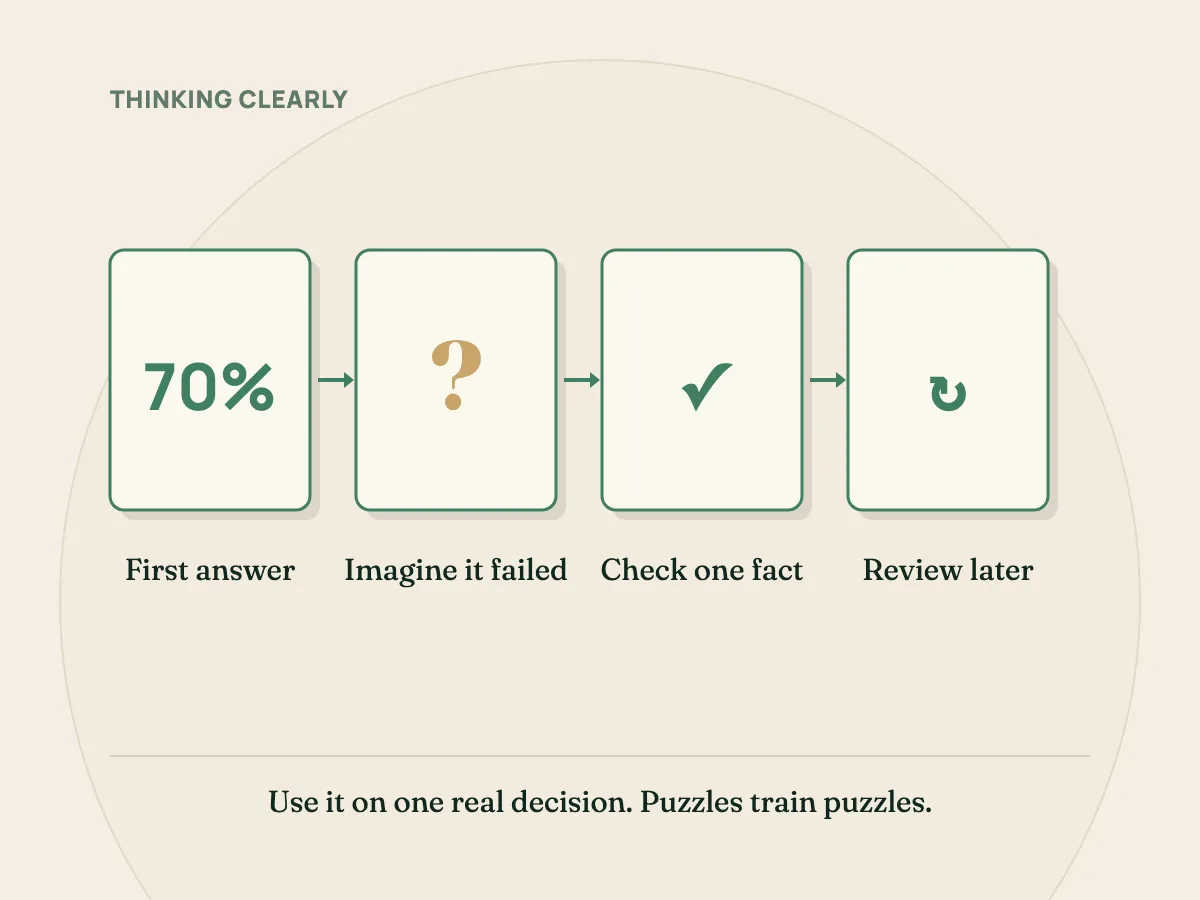
Pick a decision that matters. Write your first answer and how sure you are. Imagine it went wrong and list why. Check the one fact that would change your mind. Decide, write down why, and look back in a month. Practise this on real choices; puzzle games mostly make you better at the puzzles.
The method
Choose something you will actually decide in the next few days: an offer, a purchase, a reply to a difficult message. Ten minutes on paper is enough.
Before you think further, note your answer and a rough confidence, such as 70%. This is the baseline. Without it, you cannot tell later whether your thinking changed or whether you only felt more certain.
Picture yourself a few months later: the decision turned out to be a mistake. Write three plausible reasons why. This is a premortem, and it makes it easier to name doubts you were already half aware of.
Look at your reasons and find the one you could actually test: a number to calculate, a person to ask, a trial to run. Do that check before deciding, not after.
Write the decision, your final confidence and the main reason. Put a reminder in a month. When it comes, compare what happened with what you expected. Over a few decisions, this shows you where your judgement is reliable and where it is not.
Worked example
Invented scenario: you are offered a job paying 9,000 a year more, in your currency, with a commute 40 minutes longer each way. Your first answer is yes, and you are about 70% sure. The raise is easy to picture; the commute is not.
Premortem: it is next spring and you regret the move. Reasons you write down: the commute ate your evenings; the team was less flexible about remote days than the interview suggested; the raise disappeared into transport costs. None of these is certain, but each one points to something you can check.
The one check: 40 minutes each way is 80 minutes a day. Over about 230 working days, that is roughly 18,400 minutes, or about 307 hours a year. The raise works out to about 29 per extra commuting hour, before transport costs. You ask the hiring manager how many remote days the team actually uses. The answer is two a week, which cuts the extra commuting by about 40%.
Decision: yes, now at about 80%, with the reason written down as 'two remote days make the commute workable'. In a month, you check whether that is still true. If the remote days quietly disappear, you have learned something specific about how much weight to put on interview promises.
Why it works
A thought you never wrote down is easy to revise in memory. If the job goes well, it will feel like you always knew; if it goes badly, it will feel like you had doubts all along. A one-line note with your answer, confidence and reason is the only reliable record of what you actually thought.
The premortem comes from Gary Klein's description in Harvard Business Review: imagine the project has already failed, then explain why. He describes it as a way to surface concerns that people hold back during planning. It works for one person as well as for a team, because it gives you permission to argue against a decision you have already started to like.
Klein (2007), Harvard Business Review: Performing a project premortem
What the evidence shows
A 2016 review led by Daniel Simons examined the studies cited by brain-training companies and their supporters. People reliably improved on the tasks they practised. The review found little evidence that this improvement carried over to unrelated tasks, and less that it improved everyday thinking. In January 2016, the US Federal Trade Commission settled with Lumosity for 2 million US dollars over advertising claims, including that its games improved performance at work and school, which the FTC said were not supported.
That does not make puzzles worthless. They can be enjoyable, and you will get better at them. It means a high score is evidence about the game, not about how you will handle a job offer, an argument or a confusing news story.
Simons and colleagues (2016): Do brain-training programs work?
What the evidence shows
Training aimed at specific thinking errors has shown more promise. In a 2015 study by Carey Morewedge and colleagues, a single session of a training game or video taught people about biases such as confirmation bias and anchoring. Bias on test problems dropped immediately and was still lower two months later. The game, which gave personalised feedback and practice, worked better than the video.
The pattern across these findings is simple: you improve at what you practise, especially when you get feedback. If you want to make better decisions, practise making decisions and checking them. If you want to argue more clearly, practise building and testing arguments. Those effects come from a particular study and set of measures; they are a reason to practise deliberately, not a guarantee of a wiser life.
Start here
Thinking better means different things to different people. Choose the one closest to yours and practise only that for a few weeks.
If you go with your first impression and stick to it, start with spotting your own biases: note your first number, argue the opposite and check the decision later. If you replay situations for hours, start with separating what happened from your interpretation of it. If your mind goes blank when someone puts you on the spot, start with thinking clearly under pressure. If arguments that sound convincing often turn out to be wrong, start with testing premises and conclusions.
These are suggested courses in Cadence's library, listed further down this page. Each course page has a worked example you can try without the app. The habits in this guide work on paper too; a course adds daily practice on one problem and checks on what you got right.
We make Cadence. The exercises here are free to use on their own; choosing a learning app is a separate decision about your goal and the support you need.
Put it into practice
Pick the one problem from this guide that is closest to yours. Cadence turns it into short daily lessons with practice and checks. Cadence is our app.
Questions
They make you better at the games. A 2016 scientific review found little evidence that brain-training games improve unrelated tasks or everyday thinking. Use them for fun, not as a way to improve your decisions.
Save the effort for decisions that matter. For those, write your first answer and confidence, imagine the decision failing, check one fact, and review the outcome later. That small routine does more than trying to be careful about everything.
Separate what actually happened from your interpretation of it, and give yourself one next step. If you keep returning to the same thought, write it down with the one check that would settle it. If worry is affecting your daily life, talk to a qualified professional.
Choose one that makes you practise the kind of thinking you want to improve and gives feedback on your answers. A game that trains reaction speed trains reaction speed. Check what an app asks you to do, not only what it promises.
See it in concrete terms
Three of the thinking problems above, each with daily practice and checks.
Catch your own mental shortcuts before they decide for you.
Distinguish what you know from what you are repeatedly guessing.
Identify the immediate decision and verify the information it depends on.
Sources
Try Cadence today
Describe what you want to learn and Cadence builds a course of short daily lessons you can read or play as audio. It is free to start on iPhone, and Android access is by request.