How to learn critical thinking, one claim at a time
Start with a claim you can examine, not a list of fallacy names. Practise separating the conclusion from its support, then choose the kind of course that fits your next question.
Build a course around the claims you want to understand
We make Cadence. Explore the claims-and-evidence course idea, then start free on iPhone or request Android testing access. Lessons are built around the goal and setup answers you provide.
Learning Cadence editorial, , 8 min readHow we work
Someone says a new opening time will be popular because most people in a survey support it. Your job is not to agree quickly or find a clever objection. It is to work out what the survey can actually tell you, what remains uncertain, and what would make the next decision better.
Critical thinking is the practice of examining reasons and evidence before accepting a conclusion. The Open University describes an argument as a point supported by reasons and evidence. That gives a beginner something concrete to practise: find the point, inspect the support, and explain the connection.
The learning plan and library example below are original teaching activities from the Cadence team. They are not a validated assessment, a study of our learners, or a promise that four sessions will make someone an expert. You can do them on paper without downloading anything.
The short answer
Start with evidence, then practise changing your mind.
To begin learning critical thinking, write down one claim, identify its evidence and missing assumptions, consider another explanation, and state what would change your conclusion. Repeat with a different example. Choose a course that lets you attempt this work and check your reasoning, rather than only memorise definitions.
A repeatable practice plan
Four sessions with one claim.
Use one short session per step if that suits you. Spend longer when the evidence needs it. The sequence is a suggested routine, not a scientifically established schedule.
01
Session 1: separate claim from support
Choose a short, low-stakes statement from a public article or a fictional scenario. Write the conclusion in one sentence. Under it, list only the reasons or observations offered in support. If the author gives no support, record that gap rather than inventing a reason for them.
02
Session 2: inspect the missing connection
Ask how the support leads to the conclusion. Who or what was observed? Does the statement concern the same people, time and situation? Write one assumption that would need to hold. You do not need to prove the conclusion false to show that its support is incomplete.
03
Session 3: compare another explanation
Write a plausible alternative and a way to distinguish it from the original explanation. Do not treat every possibility as equally likely or search endlessly for a dissenting voice. Give more weight to evidence that directly tests the question and survives reasonable checks.
04
Session 4: make a proportionate conclusion
State what the evidence supports, what it does not establish, and what you would check next. Then try the same process on a different example without reading your notes. Compare the two attempts: did you name the actual claim, avoid assumptions, and explain what would change your mind?
Worked example
Test the claim about Sunday opening.
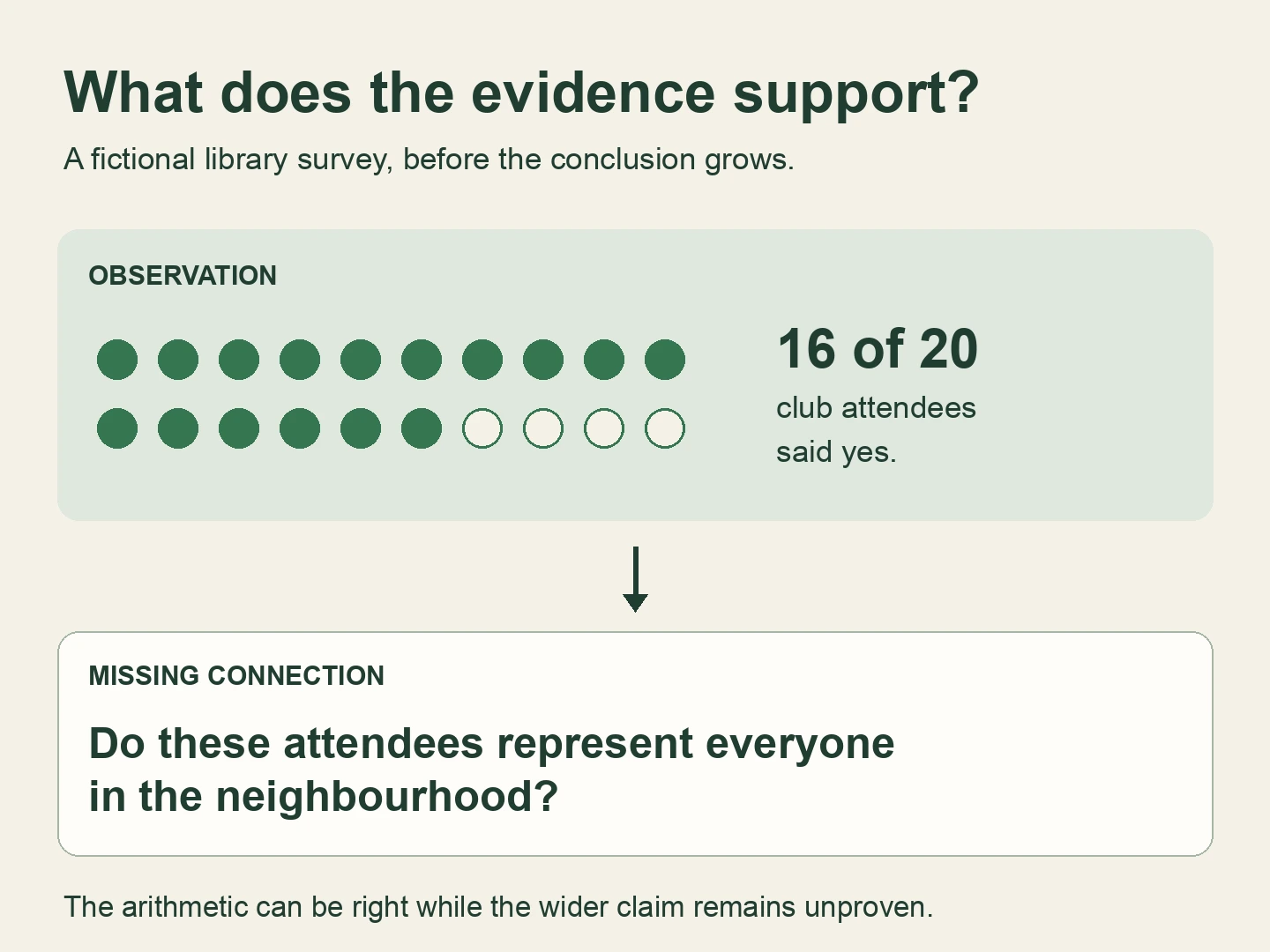
A fictional library asks 20 people attending its Saturday book club whether it should open on Sunday. Sixteen say yes. A poster announces: Eighty percent of the neighbourhood wants Sunday opening.
Pause before reading the answer. Identify the observation, the conclusion and the assumption connecting them. Then name one useful next check. All numbers here are invented for practice.
The observation is that 16 of the 20 book-club attendees surveyed said yes. The conclusion concerns the whole neighbourhood. The missing assumption is that these attendees adequately represent that wider group. People unable or unwilling to attend the club may have different needs.
A defensible sentence is: Sixteen of the 20 attendees surveyed support Sunday opening; this small survey does not establish neighbourhood-wide support. This does not prove Sunday opening is a bad idea. To investigate wider demand, seek input beyond existing club attendees and check likely use alongside staffing and cost. A bigger sample drawn from the same narrow group would not by itself repair the selection problem.
Question 1: Was the 80% calculation wrong? No. Sixteen divided by twenty is 0.8. The problem is extending the result to a population the survey has not shown it represents. Correct arithmetic can accompany an unsupported conclusion.
Question 2: Would one resident who disagrees disprove the claim? No. Even a representative result of 80% would leave room for disagreement. The useful check concerns how the survey reached people, what it asked and what population the conclusion describes.
Question 3: Should the library reject Sunday opening? The survey alone does not settle that decision. Demand is one input; feasibility and alternatives also matter. A careful conclusion can recommend further investigation without pretending to know the final answer.
Choose a course by your next question
Three starting points for learning to think more carefully.
If you want to check persuasive statements, begin with Judge claims more carefully. Its page describes a suggested custom course on evidence, missing comparisons and updating a view. You can read the first checks now and use its full learning request when setting up Cadence.
If you can inspect someone else's argument but struggle to question your own, Spot my thinking biases is a different suggested starting point. It focuses on checking first impressions and noticing recurring shortcuts. A list of bias names is not proof that you will recognise them in a real decision. Look for opportunities to explain your reasoning and review a concrete example.
For numerical claims, the existing Data literacy for non-analysts course is a more specific starting point. Its public outline and lesson preview let you inspect the subject before choosing it. The free graph-reading and correlation guides linked below also give you examples to work through first. These topics support critical thinking; they are not a complete qualification in statistics or research methods.
Coursera's Job Skills Report 2026 reports an average 120% year-over-year increase in critical-thinking enrolments across the career areas it analysed. Its dataset concerns enterprise learners, with Data, IT, and Software & Product Development among the analysed areas.
That is evidence of interest within that platform and population. It is not a measure of Google searches, proof that everyone needs the same course, or evidence that Cadence produces a learning gain. The useful question is still personal: which kind of claim do you want to evaluate more carefully?
Look for a clear level, an inspectable outline, worked examples, opportunities to attempt an answer, and explanations of why an answer is justified. Check whether you need instructor feedback, a formal qualification, or only a self-directed practice routine. Those are different learning jobs.
A university course may be a better fit if you need formal logic, assessed academic work or recognised credit. If you want a free place to begin, the Open University material below explains how claims, reasons and evidence fit together. Do not choose a course simply because it uses the words AI or critical thinking.
Cadence is our app. It offers short daily lessons, practice and saved progress around a learning goal. The suggested course pages above are starting requests and outlines, not claims that their personalised lessons have already been written or reviewed. Cadence does not award accredited degrees or professional certification.
A useful request is: I want to evaluate claims in everyday news and conversations. Use beginner examples, ask me to separate evidence from assumptions, and explain what would justify changing my conclusion. Adjust the situation so it fits you.
On iPhone, open the App Store link, download Cadence, and use the request when setup asks what you want to learn. Android access is available through the testing request. The website gives you public guidance and course information; continuing the course happens in the app.
Put it into practice
Start it today, ten minutes at a time.
We make Cadence. Explore the claims-and-evidence course idea, then start free on iPhone or request Android testing access. Lessons are built around the goal and setup answers you provide.
Questions
Common questions.
Can I learn critical thinking on my own?
You can begin with public examples: identify a conclusion, inspect its evidence, name assumptions and explain what would change your view. Check your attempts against worked answers. A teacher or subject expert may be useful when the reasoning or decision requires knowledge you do not yet have.
Which critical-thinking course should a beginner choose?
Choose by the task you want to practise. Claims and evidence, your own thinking habits, and numerical arguments are different starting points. Inspect the level, outline, examples, feedback and credential requirements before committing. A suggested custom-course outline is not an accredited qualification.
How long does it take to learn critical thinking?
There is no single completion time for a broad skill used across different subjects. The four-session routine here is an introductory practice plan, not a mastery guarantee. Review your reasoning on new examples and seek relevant feedback rather than judging progress only by days completed.
Does critical thinking mean finding something wrong with everything?
No. It means judging whether a conclusion is supported. Strong evidence may justify agreement. Missing evidence may justify uncertainty. An objection or dissenting source is not automatically better evidence.
We make Cadence. Explore the claims-and-evidence course idea, then start free on iPhone or request Android testing access. Lessons are built around the goal and setup answers you provide.