Name the measured relationship
Write the observation without a causal verb: discussion-group attendees had higher quiz scores. Avoid improves, produces or leads to until you have examined how the study was done.
Practical guide
Two things changing together is a starting observation. Before saying one caused the other, ask what else could produce the same pattern.
Explore Cadence's daily courses
We make Cadence, an app for short daily courses built around your goal. Explore the reviewed course library to see its current focus and decide whether it fits what you want to learn.

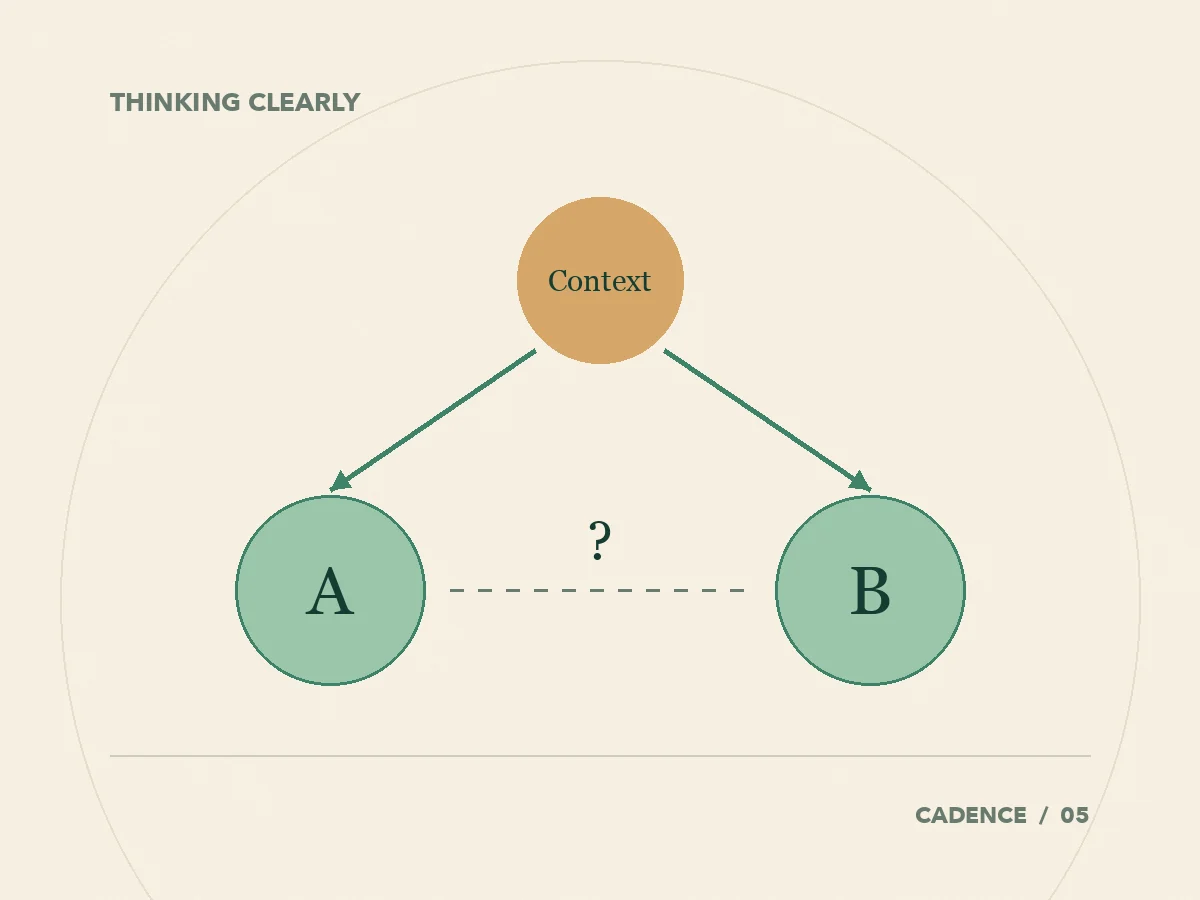
Suppose a learning club reports that members who attend its optional discussion group score higher on a later quiz. Should everyone join the discussion group? Perhaps. But the observed difference alone does not tell you what joining caused.
The example below is invented. Its purpose is to help you generate competing explanations and identify evidence that could distinguish them. You do not need statistical software to start asking better questions.
The short answer
An association shows that things vary together. A causal claim says that changing one would change the other. To assess that claim, examine timing, alternative explanations and how the comparison was constructed.
The method
Use these questions to inspect the evidence, not to dismiss every finding automatically.
Write the observation without a causal verb: discussion-group attendees had higher quiz scores. Avoid improves, produces or leads to until you have examined how the study was done.
Did attendance occur before the quiz? Were attendees already scoring higher before the group began? A later score cannot tell you whether the groups started from the same point.
Perhaps the attendees had more time, greater prior knowledge, or more motivation. Perhaps they also completed extra exercises. Choose alternatives that plausibly affect both attendance and performance, not an endless list of remote possibilities.
Look for baseline scores, how participants were selected, what else differed, and whether a fair experiment was possible. Ask what happened to people who dropped out. A causal story needs an account of the comparison, not just an impressive difference.
The statistical distinction
The Australian Bureau of Statistics distinguishes correlation, a measure of association, from causation. A correlation coefficient does not establish a cause. Another factor can influence both variables. That does not make the association useless; it changes what you can conclude from it.
Worked example
If both groups began with similar scores and participants were randomly assigned to an invitation, that would address some selection concerns. You would still ask about sample size, missing results, what the invitation actually changed and whether the outcome matches the claim.
If the only information is that enthusiastic volunteers attended and later scored well, the defensible statement is narrower: attendance was associated with higher scores in this group. Calling that proof of improvement skips the main uncertainty.
Practise the rewrite
Take the invented headline: discussion groups make learners smarter. Rewrite it as: did offering this discussion group improve this quiz outcome for these learners, compared with a specified alternative? The second version tells you which participants, action and result need evidence.
Try the same rewrite on a claim about productivity or study habits. You are looking for the missing comparison, not a clever reason to reject the idea.
From the publisher
Cadence is our app. We should be held to the same distinction: an app activity count or a learner's return visit does not by itself prove that the app caused learning. Ask what was measured and what comparison supports any outcome claim.
Put it into practice
We make Cadence, an app for short daily courses built around your goal. Explore the reviewed course library to see its current focus and decide whether it fits what you want to learn.
Questions
No. It can reveal a pattern worth investigating or help with prediction. The limitation concerns using the association alone to explain cause and effect.
No. Its design, participants, missing data and measured outcomes still matter. Ask which causal claim the experiment actually tests.
It is a factor that can influence both the proposed cause and the outcome. In the invented example, prior knowledge might affect both joining and quiz performance.
Describe the association and name the unresolved alternative explanations. You can remain interested in the idea without presenting it as established causation.
Sources

Try Cadence today
We make Cadence, an app for short daily courses built around your goal. Explore the reviewed course library to see its current focus and decide whether it fits what you want to learn.