Recall before you reread
Close the page or look away and try to say or write what you need to remember. Then check. The attempt, including the parts you get wrong, does more for later memory than another read through.
Practical guide
Memory is not one muscle you can train in general. You get better at remembering the specific things you practise pulling back out, so the useful question is what you need to remember.
Read the guidePractise remembering what you need
We make Cadence, an app that builds a short daily course around a goal you describe, such as remembering names at a new job. Start free on iPhone or request Android access.

Most people who say they have a bad memory mean something specific: they forget names a minute after hearing them, or they finish a book and cannot say what was in it. Those are different problems with the same root cause. The information went in once and was never pulled back out.
This guide works through two everyday examples, names and reading, with habits that have research behind them: recall attempts, spaced reviews, meaning and sleep. It also says plainly what the evidence shows for supplements and brain games, because those are often the first things people try.
The short answer
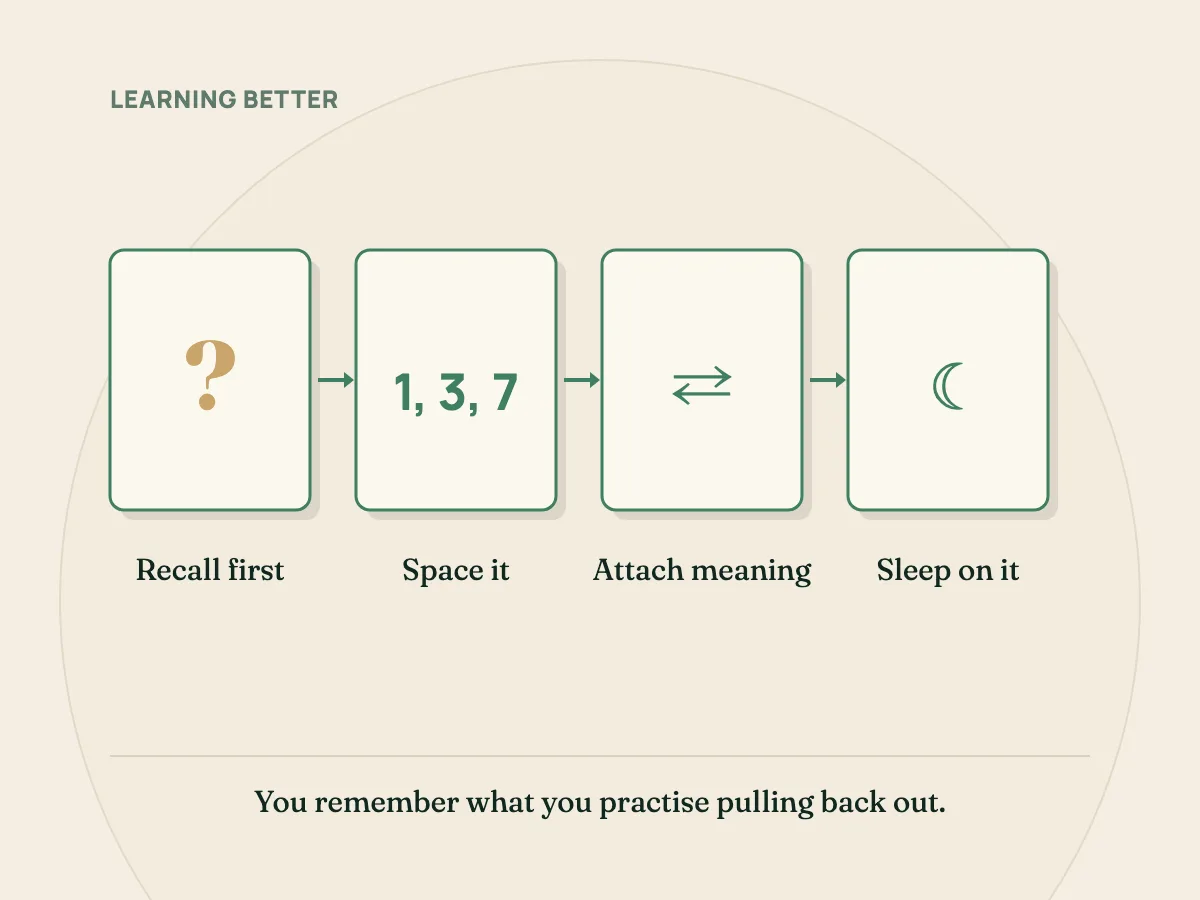
Decide what you need to remember. Instead of rereading, close the page and try to recall it, then check. Repeat that a day later and a few days after that. Connect new facts to something you already know, and protect your sleep. Supplements and brain games have weak evidence for everyday memory.
The method
Pick one thing you want to remember this week, such as names, a chapter or a process at work, and apply these to it.
Close the page or look away and try to say or write what you need to remember. Then check. The attempt, including the parts you get wrong, does more for later memory than another read through.
Try again the next day, then a few days later. A missed item comes back sooner; an easy one can wait longer. Our spaced repetition guide shows a simple schedule.
Link the new fact to a person, place or idea you already remember: why it matters, what it resembles, where you would use it. Meaning gives you more ways to find it again.
Sleep helps the brain form long-term memories. A late night of cramming trades away part of what makes the cramming stick.
Worked example
Invented scenario: you join a team and meet eight people on Monday. By Tuesday you remember two names. The others were heard once, while you were also thinking about what to say.
During each introduction, say the name back once and ask one question about the person's work. After the meeting, write the eight names with one detail each, such as Priya, payroll, cycles to work. That list is your answer key, not your study material.
Monday evening, cover the names and look only at the details. Say each name, then check. Tuesday morning, do it again; repeat on Thursday, then the following week. Use each name once in conversation that week. That is about five minutes in total, and each attempt shows you which two or three names actually need work.
Worked example
When you finish a chapter or a long article, close it and write three points it made and one place you could use one of them. Then reopen it and check what you missed or got wrong. This takes about three minutes.
Two days later, try the same three points from memory before looking at your notes. If you cannot get them back, that is useful information: the chapter needs one more pass, or the points were never clear to you in the first place.
Roediger and Karpicke (2006), Psychological Science: Test-enhanced learning
What the evidence shows
In a 2006 study by Henry Roediger and Jeffrey Karpicke, students read prose passages and then either reread them or took recall tests. Rereading did better on a test five minutes later. Testing did better after two days and after a week. The quick win from rereading is real, but it fades.
Spacing adds a second effect. In a 2008 study of more than 1,350 people learning facts, the best gap between reviews depended on how long the information needed to last: roughly 20 to 40% of the retention period for a one-week test, and 5 to 10% for a one-year test. These are results for particular tasks, not a personal formula, but the direction is consistent: review later, not just more.
What the evidence shows
The US National Center for Complementary and Integrative Health describes a federally funded trial of more than 3,000 people aged 75 or older who took ginkgo or a placebo for about six years. There was no difference in how many developed dementia. The center says there is no conclusive evidence that ginkgo helps any health condition. If you are worried about memory loss, talk to a doctor rather than a supplement shop.
Brain-training games have a similar pattern. A 2016 scientific review found that people improve at the games they practise, with little evidence that this carries over to everyday memory. Practising the actual thing you want to remember is both cheaper and better supported.
US National Center for Complementary and Integrative Health: Ginkgo
Start here
If you forget names, practise names: the routine above, used on real people. If you finish books and keep little, practise recalling and applying what you read. If you are studying for something, build recall and spacing into the study itself. If you want to understand why memories feel certain and still turn out wrong, that is a different question worth learning about on its own.
These are suggested courses in Cadence's library, listed further down this page. Each course page has a worked example you can try without the app. Sleep matters for all of them: the NHLBI notes that sleep helps with learning and the formation of long-term memories.
We make Cadence. The exercises here are free to use on their own; choosing a learning app is a separate decision about your goal and the support you need.
US National Heart, Lung, and Blood Institute: Why is sleep important?
Put it into practice
Pick the one problem from this guide that is closest to yours. Cadence turns it into short daily lessons with practice and checks. Cadence is our app.
Questions
For a specific thing you need to remember, recall it from memory and check, then repeat a day later and a few days after that. It feels slower than rereading, but more of it is still there a week later.
The evidence is weak. A large US trial of ginkgo in older adults found no difference from placebo in rates of dementia. Talk to a doctor if you are worried about memory loss.
Say the name back once, note one detail about the person afterwards, and test yourself on the names from the details that evening, the next day and later in the week. Use each name in conversation.
Close the book after a chapter, write three points and one way to use them, then check. Try the same points from memory two days later.
See it in concrete terms
Three of the memory problems above, each with daily practice and checks.
Sources
Try Cadence today
Describe what you want to learn and Cadence builds a course of short daily lessons you can read or play as audio. It is free to start on iPhone, and Android access is by request.