Pick something weekly
A class, club, team, volunteer shift or regular event with the same people each time. Weekly matters more than the activity itself.
Practical guide
Adult friendships rarely happen by accident, because school and shared housing no longer do the repeating for you. The fix is to build the repetition back in on purpose.
Read the guidePractise turning acquaintances into friends
We make Cadence, an app that builds a short daily course around a goal you describe, such as making friends after moving to a new city. Start free on iPhone or request Android access.

Adult friendships take more deliberate effort than the ones school handed you, and they matter more than they usually get credit for. The US Surgeon General treats social connection as a health issue, for reasons set out further down.
This guide works through one realistic plan, using a study on how many hours friendships take and another on how much people underestimate being liked. It is aimed at the most common situation: a new city, a new job, or a life stage where old friends drifted away.
The short answer
Join something that meets weekly with the same people. Keep going for months, not weeks. When you get on with someone, suggest one extra thing together, such as a coffee after the session. Assume they like you more than you think; research finds most people underestimate it. Friendship takes many hours, so measure progress in months.
The method
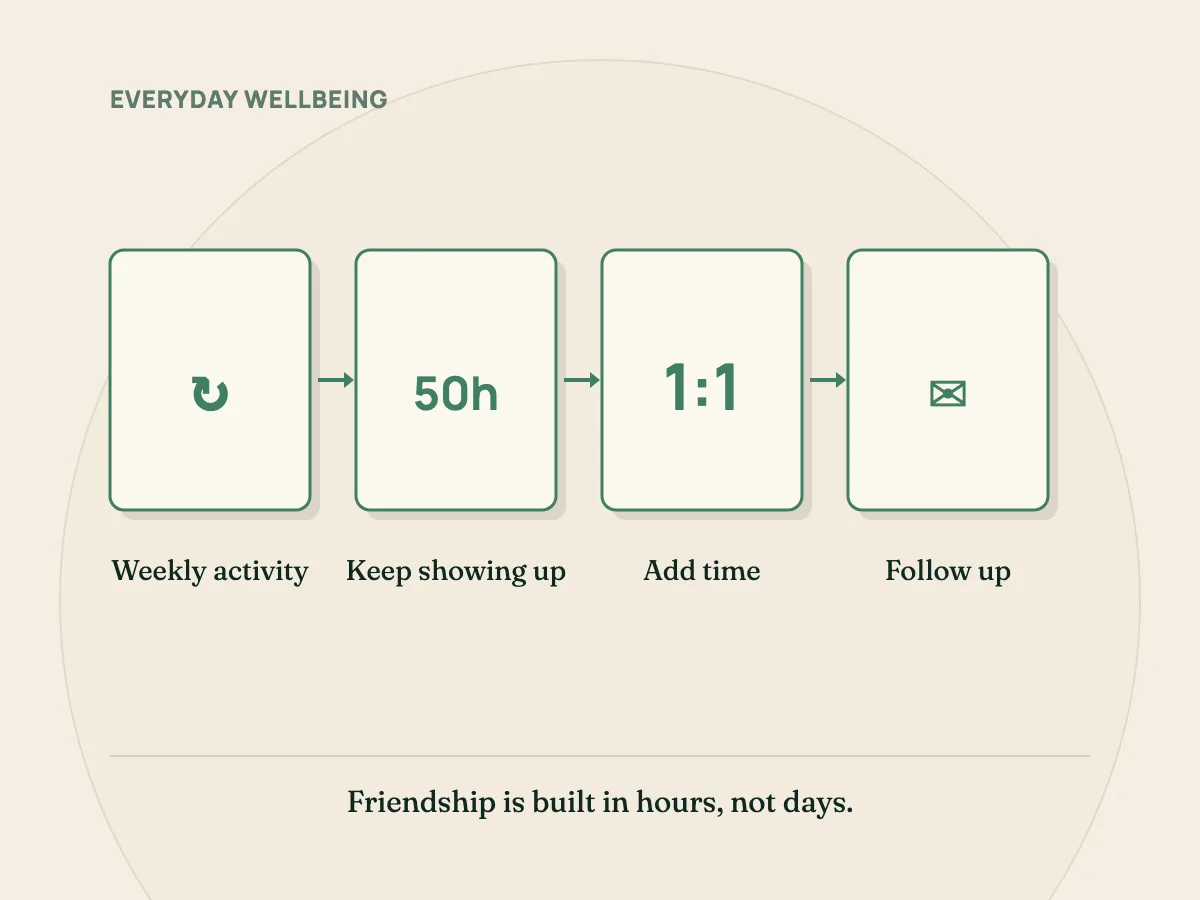
Choose one regular activity and give it three months before judging it.
A class, club, team, volunteer shift or regular event with the same people each time. Weekly matters more than the activity itself.
The first few weeks are mostly faces and names. Familiarity builds by repetition; most people stop just before it starts to pay off.
When you get on with someone, suggest a small extra: a coffee after, walking to the station together. That moves a group acquaintance towards a friendship.
Send a message about something you talked about. Then suggest the next thing. Someone has to go first; it may as well be you.
Worked example
A 2018 study from the University of Kansas estimated that it takes about 40 to 60 hours together to make a casual friend, 80 to 100 hours for a friend, and more than 200 hours for a close friend. Time spent hanging out counted for more than time spent working together.
Invented example: you join a weekly two-hour running club and get on with one person, Sam. You run alongside Sam and start a 30-minute coffee together after each run. That is about 2.5 hours a week with Sam, so roughly 16 to 24 weeks to a casual friendship and 32 to 40 weeks to a friendship. On those numbers, quitting after six weeks because 'nothing is happening' means stopping long before a friendship could have formed.
University of Kansas (2018): Study reveals number of hours it takes to make a friend
What the evidence shows
In studies with strangers, new roommates and workshop participants, people consistently underestimated how much their conversation partners liked them and enjoyed their company. The gap lasted for months among roommates. Researchers called it the liking gap.
In practice, that means the conversation you replayed as awkward probably went better than you think, and the other person may also be waiting for someone else to suggest meeting again. Suggest it.
Boothby and colleagues (2018): The liking gap in conversations, Psychological Science
Why it matters
The US Surgeon General's office brings together studies linking social isolation to a 29% higher risk of early death, and finds that adults who often feel lonely are more than twice as likely to develop depression. These are associations from many studies, not proof that one causes the other in every case, but they are why public health bodies treat connection seriously.
If loneliness feels heavy or long-lasting, it is reasonable to talk to a doctor or counsellor as well as working on new connections.
US Surgeon General: The healing effects of social connection
Start here
If you have acquaintances but no close friends, start with building deeper friendships: moving from regular contact to trust. If the main feeling is loneliness, start with feeling less lonely, which also covers the thoughts that keep people from reaching out. If first conversations are the hard part, start with small talk that goes somewhere.
These are suggested courses in Cadence, the app we make, and they are listed further down this page. Each course page has a worked example you can try without the app.
Put it into practice
Pick the one problem from this guide that is closest to yours. Cadence turns it into short daily lessons with practice, so the habit has somewhere to happen. Cadence is our app.
Questions
School and shared housing gave you repeated time with the same people. Adult life usually does not, so you need to build that repetition in on purpose, for example with a weekly activity.
A University of Kansas study estimated about 40 to 60 hours for a casual friend, 80 to 100 hours for a friend and more than 200 hours for a close friend.
Anywhere you will see the same people every week: classes, clubs, sports teams, volunteering or regular events. Regularity matters more than the activity.
Most people do. Research on the liking gap finds that people underestimate how much others like them after a conversation, so it probably went better than it felt.
See it in concrete terms
Three of the friendship problems above, each with daily practice and checks.
Try Cadence today
Describe what you want to learn and Cadence builds a course of short daily lessons you can read or play as audio. It is free to start on iPhone, and Android access is by request.