Write your point in two sentences
One sentence says what you think; the second says why. If you cannot fit it in two, you are not ready to say it yet, and no amount of confidence fixes that.
Practical guide
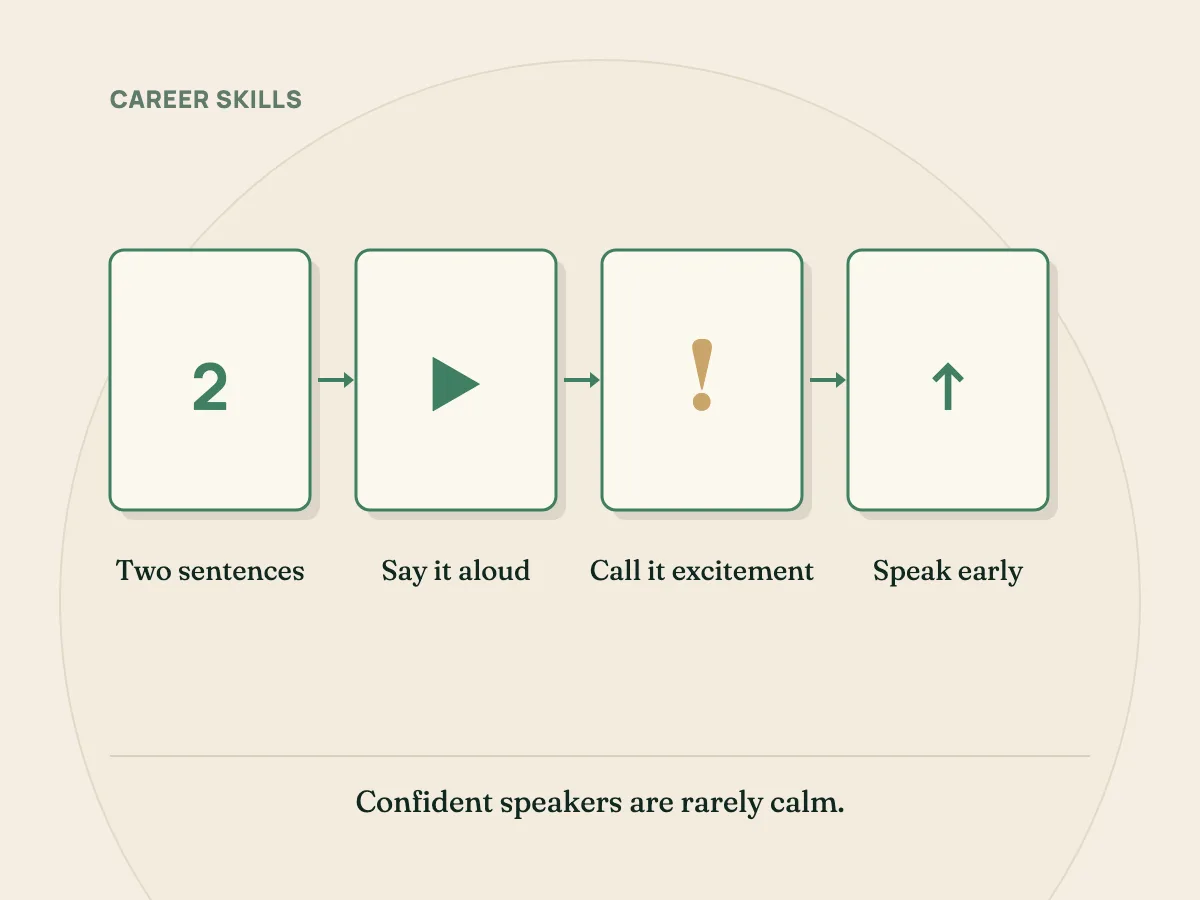
Confident speakers are rarely calm. They prepare a point they can say in two sentences, practise saying it out loud, and treat the racing heart as energy rather than a warning.
Read the guidePractise speaking up with the nerves still there
We make Cadence, an app that builds a short daily course around a goal you describe, such as speaking up in meetings when you feel nervous. Start free on iPhone or request Android access.

Fear of speaking in front of people is common. In a large US survey, public speaking or performing was the most common social fear, reported at some point in life by about one in five adults, and speaking up in a meeting or class was close behind. If your voice shakes when you speak, you are in large company.
This guide works through two everyday situations, speaking up in a meeting and giving a short talk, with three habits that have evidence behind them: clear preparation, rehearsal out loud, and reframing nerves as excitement.
The short answer
Decide the one point you want people to remember and write it in two sentences. Say it out loud three times before the meeting or talk. When the nerves arrive, tell yourself you are excited rather than trying to calm down. Speak early, before the waiting makes it harder. Repeat in small settings until it feels ordinary.
The method
Pick a real situation in the next week: a meeting, a short update or a question you want to ask. Use all four habits on it.
One sentence says what you think; the second says why. If you cannot fit it in two, you are not ready to say it yet, and no amount of confidence fixes that.
Reading it silently is not practice. Say it aloud three times, ideally once to a phone recording. The first attempt is always the clumsiest; better it happens alone.
Nerves and excitement feel alike in the body. Saying 'I am excited' rather than 'calm down' gives the same energy a direction.
In a meeting, speak in the first ten minutes. The longer you wait, the more the moment grows. A short early contribution makes the next one easier.
Worked example
Invented scenario: in a weekly team meeting you usually agree silently and then think of your point on the way out. This week the team is choosing between two dates for a launch.
Before the meeting, you write two sentences: 'I think we should take the later date. The earlier one leaves no time to fix anything the pilot customers find.' You say it out loud three times at your desk. In the meeting, when the dates come up, you say it in the first round of opinions rather than waiting for a gap.
Afterwards, write one line: what you said, how it landed, what you would change. Do this for four weeks. Most people find the second and third times are easier than they expected, and the notes show a concrete improvement you can see.
Worked example
For a short talk, such as a project update or a toast, write the point in two sentences, then three supporting details. Rehearse the whole thing out loud twice, then record it once on your phone and listen back. Fix the one thing that stands out, usually speed, and stop there.
Just before you start, take a breath and say, out loud or in your head, 'I am excited'. Then begin with your point, not an apology. 'I will keep this short' is fine; 'sorry, I am not good at this' sets the audience up to look for problems.
What the evidence shows
In a 2014 series of experiments, Alison Wood Brooks asked people facing stressful tasks to say either 'I am excited' or something else first. In a public-speaking study with 140 students, those who said 'I am excited' rather than 'I am calm' were rated more persuasive, competent and confident, and spoke for longer. The nerves did not disappear; they were treated as energy.
The studies used students and short, one-off tasks, so they do not show lasting change. For people whose fear is strong, a 2019 review of 30 randomised trials found that structured psychological treatments reduced public speaking fear, with effects that held at follow-up. If fear of speaking is limiting your work or life, those treatments are worth asking a professional about.
Brooks (2014): Get excited, Journal of Experimental Psychology: General
Start here
If your voice and body give you away even when you know what to say, start with speaking confidently: pace, pauses and how you sound. If you know what to say but stay quiet, start with speaking up when nervous, in small settings first. If presenting to a group is the specific fear, start with a course on getting over the fear of public speaking, built on gradual practice.
These are suggested courses in Cadence, the app we make, and they are listed further down this page. Each course page has a worked example you can try without the app.
Put it into practice
Pick the one problem from this guide that is closest to yours. Cadence turns it into short daily lessons with practice, so the habit has somewhere to happen. Cadence is our app.
Questions
Write your point in two sentences beforehand, say it out loud a few times, and speak in the first ten minutes rather than waiting. Note how it went afterwards and repeat weekly.
You may not stop it entirely, and listeners usually notice it far less than you do. Slow down, breathe out before you start, and treat the energy as excitement. Practice in small settings makes it less frequent over time.
Yes. In a large US survey, about one in five adults reported having had a significant fear of speaking or performing in front of others, the most common social fear in the study.
Yes. Saying it aloud exposes the awkward parts before the real moment, when they are easy to fix. For strong fear, a review of 30 trials found structured psychological treatments reduce it.
See it in concrete terms
Three of the speaking problems above, each with daily practice and checks.
Sources
Try Cadence today
Describe what you want to learn and Cadence builds a course of short daily lessons you can read or play as audio. It is free to start on iPhone, and Android access is by request.