Pick one purpose
Working through something hard, noticing what goes well, or learning from your week. Mixing all three at once is a common reason journals fizzle out.
Practical guide
A journal does not need to be a daily diary. Pick the format that matches what you want from it, keep it short, and change format if it stops helping.
Read the guidePractise a journaling format that helps
We make Cadence, an app that builds a short daily course around a goal you describe, such as keeping a journal past the first three days. Start free on iPhone or request Android access.

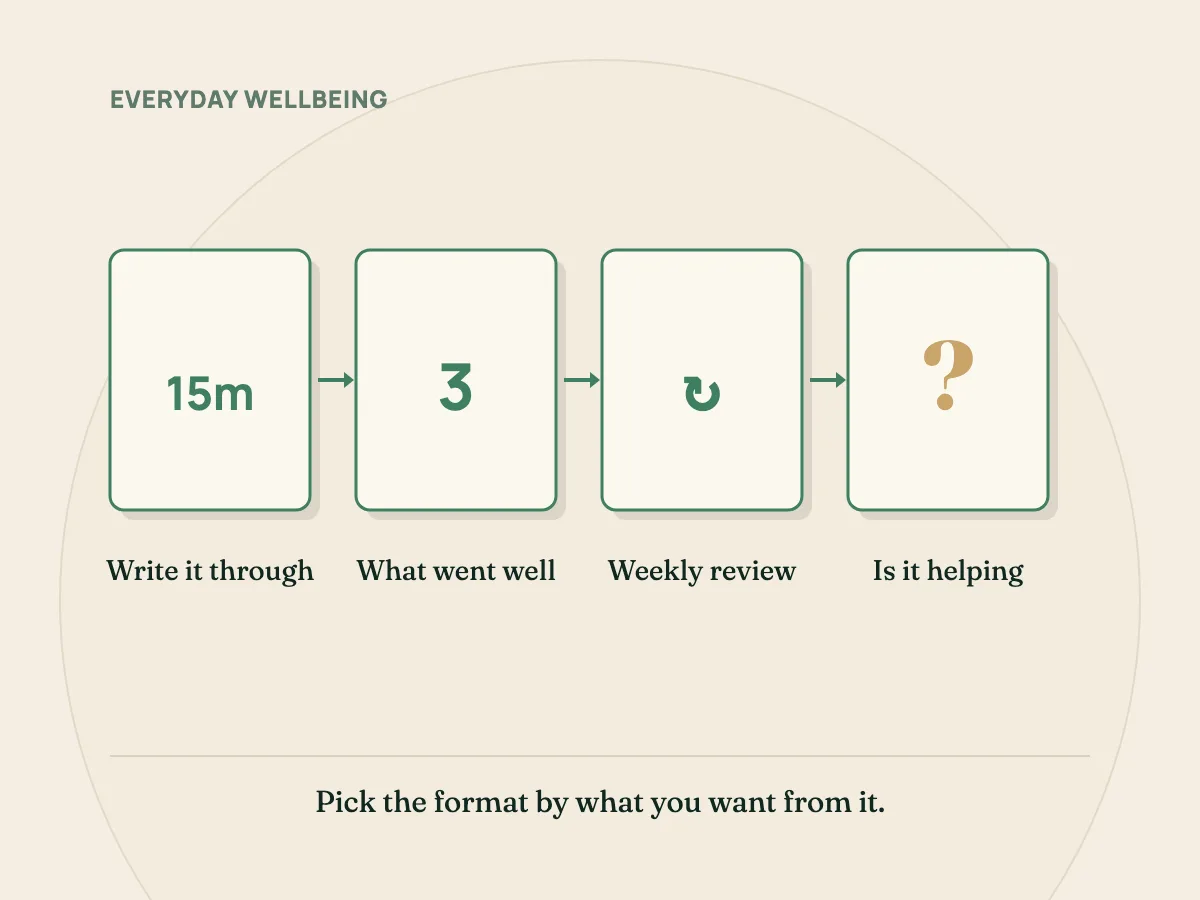
Many people start journaling, write for three days and stop, because the blank page has no job. The research on journaling is really research on a few specific formats, each with its own purpose and evidence. Choosing one makes it easier to keep going.
This guide describes three formats with a worked example each, and what studies have and have not found. Journaling can help, but it is not a treatment for depression or trauma. If you are struggling, talk to a professional.
The short answer
If something is weighing on you, write about it for 15 minutes on a few days in a row. If you want to notice more of what goes well, write down a few specific good things once a week. If you want to learn from your weeks, write a short review every Sunday. Keep it private, keep it short, and stop if it makes things worse.
The method
Pick one format below, set a time in your calendar, and use a notebook or a private note on your phone.
Working through something hard, noticing what goes well, or learning from your week. Mixing all three at once is a common reason journals fizzle out.
Fifteen minutes or less. A journal you write briefly every week beats one you write at length twice.
Do not edit or write for an imagined reader. Spelling, order and neatness do not matter; honesty does.
Ask whether it is helping. If not, change format or stop. A journal is a tool, not an obligation.
Format one
In the original expressive-writing study, students wrote for 15 minutes on four consecutive days about their most upsetting experiences, while others wrote about everyday topics. The writers made fewer visits to the health centre over the following months. Since then, more than 140 randomised studies have tested similar exercises.
Worked example: pick something you keep returning to, such as a falling-out with a friend. Write for 15 minutes about what happened and how you feel about it, without stopping to edit. Do the same the next three days. Expect to feel a little worse right after writing; reviews describe a short-term dip in mood as common. If it becomes overwhelming, stop and talk to someone.
Baikie and Wilhelm (2005): Emotional and physical health benefits of expressive writing
Format two
In a 2003 set of studies, people who regularly listed things they were grateful for reported higher well-being on several, though not all, measures than people who listed hassles or neutral events. A 2025 meta-analysis of 145 papers, with about 25,000 participants in 28 countries, found that gratitude exercises raise well-being by a small amount on average, and that the size of the effect differed between countries.
Worked example: once a week, write three specific things that went well and why, such as 'my colleague covered the call so I could leave early, because she noticed I was tired.' Specific beats general. Once a week is enough to start; daily lists can start to feel like a chore.
Emmons and McCullough (2003): Counting blessings versus burdens
Choi and colleagues (2025): Gratitude interventions across cultures, PNAS
Format three
A weekly review is less studied than the other two formats, but it is the most practical. Every Sunday, answer three questions: what went well, what did not, and what will I do differently next week. Keep each answer to a few lines.
Worked example: 'Went well: finished the report early by blocking Tuesday morning. Did not: skipped the gym three times after late meetings. Next week: move the gym to the morning on meeting days.' After a month, reread the four reviews. Patterns that were invisible day to day are usually obvious.
What the evidence shows
A large 2006 review of 146 randomised studies of expressive writing found a positive but small average effect, which varied a lot depending on who wrote and how. Gratitude exercises show a similar pattern: real but modest effects that do not suit everyone.
That is a reason to try journaling for a month and judge it by how you feel, not to expect it to change everything. If a format leaves you worse off after a few weeks, stop or switch.
Frattaroli (2006): Experimental disclosure and its moderators, Psychological Bulletin
Start here
If you want journaling to be a habit that helps rather than a chore, start with the journaling course. If you want to name and understand what you feel, start with understanding emotions. If the main thing you want to write about is stress, start with handling everyday stress.
These are suggested courses in Cadence, the app we make, and they are listed further down this page. Each course page has a worked example you can try without the app.
Put it into practice
Pick the one problem from this guide that is closest to yours. Cadence turns it into short daily lessons with practice, so the habit has somewhere to happen. Cadence is our app.
Questions
Pick one purpose: working through something hard, noting what went well, or reviewing your week. Set a 15-minute slot in your calendar and write without editing.
It depends on the format. For a hard experience, what happened and how you feel. For gratitude, a few specific good things and why. For a weekly review, what went well, what did not, and what you will change.
Expressive writing studies often asked people to write for 15 minutes on four consecutive days. For gratitude or a review, once a week is a good start.
Studies find modest average benefits for well-being, but journaling is not a treatment for anxiety or depression. If you are struggling, talk to a professional.
See it in concrete terms
Journaling as a habit, and two things people most often write about.
Sources
Try Cadence today
Describe what you want to learn and Cadence builds a course of short daily lessons you can read or play as audio. It is free to start on iPhone, and Android access is by request.