Log the week
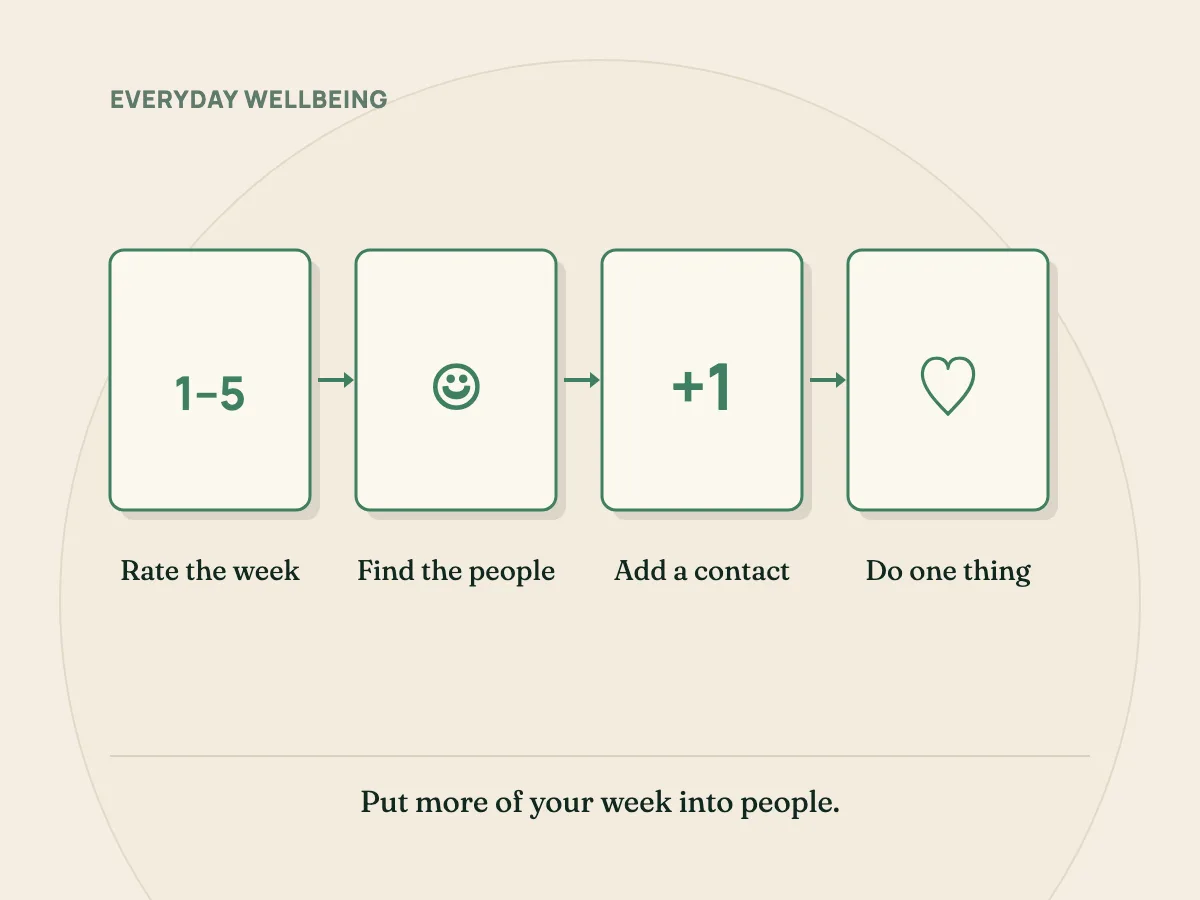
Each evening, list the main things you did and rate each from 1 to 5 for how it felt. Include work, chores, screens and time with people.
Practical guide
The most consistent finding is also the least surprising: people with warm relationships tend to be happier and healthier. The useful part is turning that into something you do this week.
Read the guidePractise putting more of your week into what matters
We make Cadence, an app that builds a short daily course around a goal you describe, such as spending more of your week on what matters to you. Start free on iPhone or request Android access.

The Harvard Study of Adult Development has followed the same men since 1938, and later their families. Its best-known finding is that close relationships mattered more for long-term happiness and health than money or fame. Satisfaction with relationships at 50 predicted health at 80 better than cholesterol levels did.
This guide turns that and a few other findings into a one-week audit and three small changes. It is general information. Long-lasting low mood is different from ordinary unhappiness; if that is what you are feeling, talk to a doctor or counsellor.
The short answer
List how you spent last week and how each part felt. Add one more regular contact with someone you care about. Do one small thing for someone else. Cut one thing that drains you and adds little. Happiness research finds relationships matter most, but effects of single tips are small, so judge changes over months, not days.
The method
You need a notebook and five minutes at the end of each day for one week.
Each evening, list the main things you did and rate each from 1 to 5 for how it felt. Include work, chores, screens and time with people.
At the end of the week, look at the ratings next to time spent with others. Check whether those are among your highest ratings. For many people they are.
Schedule one more regular contact with someone you care about: a weekly call, a walk, a meal. Regular beats occasional.
Each week, do one small thing for someone else: buy a coffee, help with a task, send a note.
Worked example
Invented example: a week's log shows evenings scrolling (rated 2), a long commute (2), work (3), a gym class (4), a Saturday lunch with a friend (5) and a call with a parent (4). The two highest ratings involved other people; the lowest took the most hours.
The changes: a fixed fortnightly lunch with the friend, a weekly call with the parent on Sunday evenings, and 30 minutes less scrolling on two evenings, replaced with a walk. Rate the week again a month later and compare, rather than judging after the first few days.
What the evidence shows
The Harvard study began with 268 Harvard students and later added 456 men from inner-city Boston neighbourhoods. Across decades, warm relationships were among the strongest predictors of happiness and health. The study is observational and originally included only men, so it shows a strong association, not proof that relationships cause every benefit.
The World Happiness Report, which ranks countries by how people rate their lives, finds that six factors, including having someone to count on, account for more than three-quarters of the differences between countries. Those are national averages, but having someone to count on is one of the few factors you can work on yourself.
What the evidence shows
A well-known 2008 study found that people who spent money on others were happier than those who spent it on themselves. A larger 2020 replication ran three experiments. Two found people happier after spending on others, though the differences were small, and one found no difference. The authors concluded that the effect is real but that its size depends on how the study is run.
So doing things for others is worth trying, but it is a nudge, not a transformation. Small, regular acts are more realistic than occasional grand gestures.
Start here
If you want to understand what research says supports happiness and what does not, start there. If you want to think about what a good life means for you, start with that question. If your week does not match what you say matters, start with living more in line with your values.
These are suggested courses in Cadence, the app we make, and they are listed further down this page. Each course page has a worked example you can try without the app.
Put it into practice
Pick the one problem from this guide that is closest to yours. Cadence turns it into short daily lessons with practice, so the habit has somewhere to happen. Cadence is our app.
Questions
Long-term studies such as the Harvard Study of Adult Development find that warm, close relationships are among the strongest predictors of happiness and health.
Studies find a small effect in some experiments but not all. It is worth trying in small, regular ways rather than expecting a large change.
There is no reliable quick fix. A one-week log of how you spend your time and how it feels usually shows one or two changes worth making, especially more regular time with people you care about.
No. Ordinary unhappiness and depression are different. If low mood lasts for weeks or affects daily life, talk to a doctor or counsellor.
See it in concrete terms
Three ways into the question, each with daily practice and checks.
Learn what actually makes everyday life better, according to the evidence.
Explore what philosophers mean by a good life, using your own.
Make everyday choices that match what you actually care about.
Try Cadence today
Describe what you want to learn and Cadence builds a course of short daily lessons you can read or play as audio. It is free to start on iPhone, and Android access is by request.