Name the result
Say what the workshop must achieve: by Friday, we need a 45-minute session where the team chooses two improvements for next month's customer handovers. Give the recipient and deadline, not just the activity label.
Practical guide
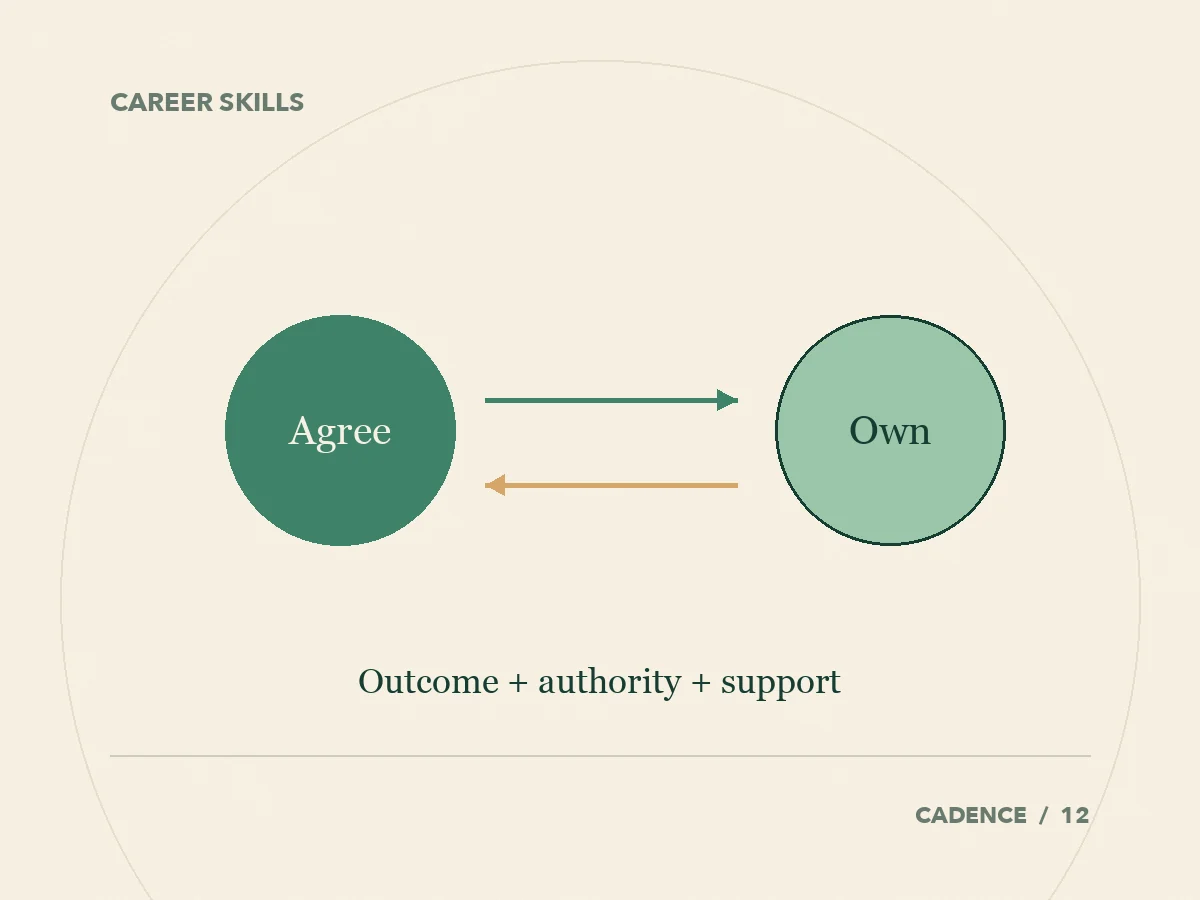
A handover needs more than a task name and a deadline. Agree what done means, which decisions belong to the other person, and when to raise a problem.
Explore Cadence's daily courses
We make Cadence, an app for short daily courses built around your goal. Explore the reviewed course library to see its current focus and decide whether it fits what you want to learn.

You ask a colleague to organise a team workshop. Three days later, they send six questions about the agenda, room, budget and invitations. You conclude that delegating took longer than doing it yourself. But which decisions did your original request actually give them?
The handover below is an invented workplace example. Adapt its boundaries to your responsibility, the person's experience and the consequences of a mistake. Delegation is not permission to transfer work someone has no capacity or authority to do.
The short answer
Delegate a defined result with enough authority, time and information to achieve it. Set a check-in around a meaningful decision or risk. When problems appear, clarify the gap before automatically taking the work back.
The method
Treat these as points to agree in a conversation, not instructions to drop into someone's inbox.
Say what the workshop must achieve: by Friday, we need a 45-minute session where the team chooses two improvements for next month's customer handovers. Give the recipient and deadline, not just the activity label.
Specify which choices they can make alone, which need consultation and which remain yours. For example, they can choose the agenda and room, but any external spending requires your approval. Keep existing financial or organisational rules explicit.
Ask what other work would need to move and what information they lack. Make introductions or grant existing appropriate access through the normal process. Saying you own it does not create the time or resources to deliver it.
Review a draft agenda before invitations go out, when a misunderstanding is still inexpensive to fix. Agree which issue requires an earlier message. Once the plan is aligned, let the person choose details within the agreed boundaries.
Leadership guidance
The Center for Creative Leadership connects delegation with trust, open communication, capability and support when problems arise. Our suggested handover turns those concerns into a practical conversation about the task. It is not a guarantee that every working relationship should use the same level of autonomy.
Center for Creative Leadership: building trust through delegation
What to say
Try: I would like you to own the workshop plan. The outcome is two agreed improvements, with an owner for each. You can choose the agenda and book an internal room. Check with me before any external spend. Let's review the agenda on Tuesday before you send invitations. What needs to move to make room for this?
Then ask the person to explain their understanding and raise constraints. This is not a memory test. It is a chance to discover that you meant different things before anyone does the work.
When it goes off track
If the draft agenda misses the intended decision, identify that gap directly. Ask how they would revise it and whether a missing example or explanation would help. If the task exceeds their current experience, narrow the scope or work through one part together.
Taking over may be necessary when a deadline or serious consequence leaves no reasonable alternative. Say why, preserve a fair account of the constraints, and review what needs to change next time. Do not call an unclear handover a failure of initiative.
From the publisher
We make Cadence. This guide is useful preparation for a handover, but the agreement has to happen with the person doing the work. Their capacity, authority and understanding are information you cannot replace with a generic checklist.
Put it into practice
We make Cadence, an app for short daily courses built around your goal. Explore the reviewed course library to see its current focus and decide whether it fits what you want to learn.
Questions
Give enough to make the outcome and boundaries clear. Adjust examples and check-ins to the person's experience and the task's risk, rather than prescribing every move by default.
Check whether it meets the agreed outcome and constraints. A different method is not automatically a problem that requires intervention.
A useful delegation agreement also addresses decision authority, information, resources, capacity and follow-up. Assigning a title and deadline leaves those questions unanswered.
Discuss priorities and constraints. Change scope, timing or ownership explicitly rather than assuming the work can be added without a tradeoff.
See it in concrete terms
Inspect the syllabus for these workplace courses to decide whether the topic and level fit your goal.
Shift from doing the work yourself to setting context, inspecting quality, and helping other people succeed.
Use one-on-ones to surface friction, coach decisions, and keep expectations current instead of filling the slot.
Make feedback specific, useful, and easier for a teammate to act on without burying the point.
Sources

Try Cadence today
We make Cadence, an app for short daily courses built around your goal. Explore the reviewed course library to see its current focus and decide whether it fits what you want to learn.