Choose a comparable amount
Compare grams with grams, volume with volume, or equivalent items with items. Read what each price covers, including every inner pack in a multipack.
Divide price by quantity, using the same unit for both packs. Then check the full bill and how much you need.
Use the free template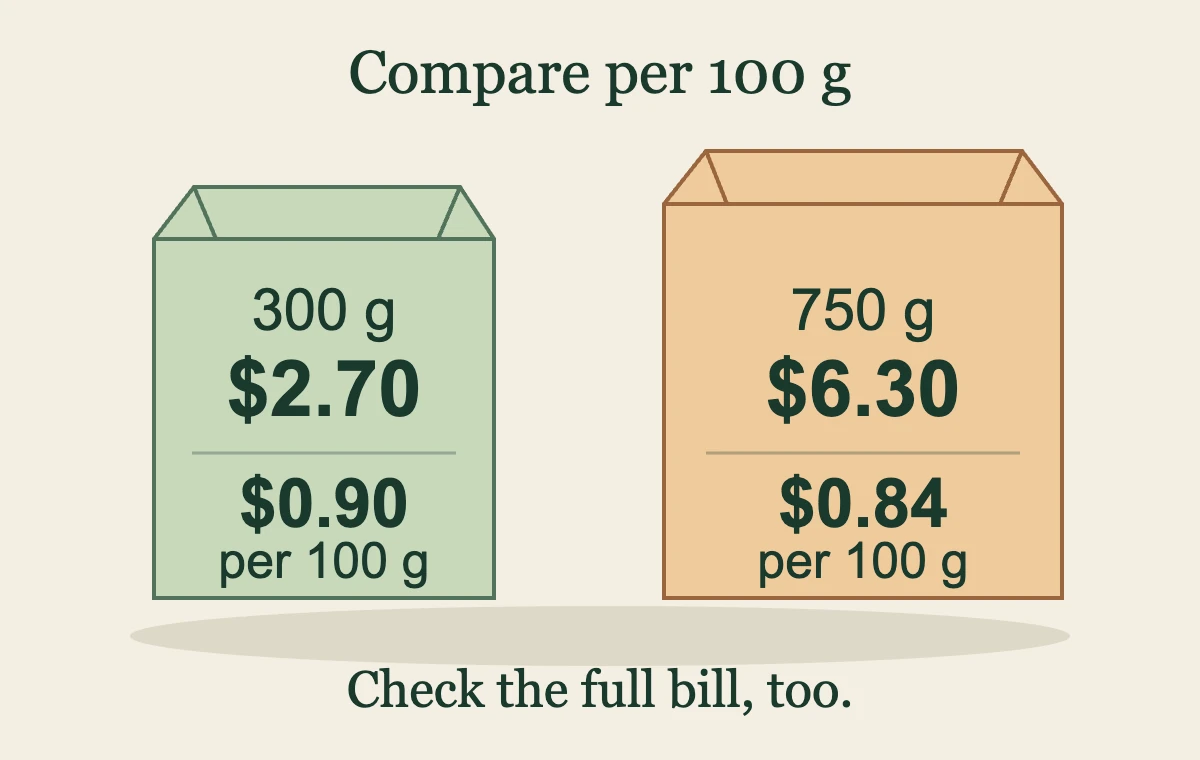
One pack is smaller and cheaper. Another says family size. A third is a multipack. The useful question is how much the same amount costs, followed by whether you need that much.
The numbers below are original fictional practice examples, not current shop prices or measured savings. You can complete the worked example, fresh questions and worksheet without Cadence or an account.
The short answer
Divide each pack's price by its quantity, using the same units. To find the price per 100 g, divide the price by the weight in grams, then multiply by 100. Compare those results, then check the total you must pay and how much you will use. The lowest unit price does not automatically make a pack the right purchase.
The method
A unit price is a comparison of equal quantities, not a recommendation to buy more.
Compare grams with grams, volume with volume, or equivalent items with items. Read what each price covers, including every inner pack in a multipack.
Use one currency and one quantity unit. For price per 100 g: pack price divided by grams, multiplied by 100. A price per kilogram needs converting before you compare it with a price per 100 g.
Multiply the unit price by the number of those units in the pack. It should reproduce the original pack price, apart from rounding. If it does not, check the amount, units and offer price.
Compare the full charge, the amount you expect to use and any conditions on the offer. A lower unit price can require a larger payment or leave you with more than you need.
Pack A contains 300 g and costs $2.70. Pack B contains 750 g and costs $6.30. Assume the oats are equivalent and there are no extra charges. Which costs less per 100 g?
Pack A contains three lots of 100 g. Divide $2.70 by 3: each 100 g costs $0.90. The formula gives the same result: $2.70 ÷ 300 × 100 = $0.90 per 100 g.
Pack B contains 7.5 lots of 100 g. Divide $6.30 by 7.5: each 100 g costs $0.84. That is $6.30 ÷ 750 × 100 = $0.84 per 100 g.
Pack B costs six cents less for each 100 g. Check by reversing the calculation: $0.84 × 7.5 = $6.30. Pack A's $0.90 × 3 = $2.70. The units and the original charges both match.
The ACCC explains that unit prices express a price using a standard measurement, which can be weight, volume, length, area or number. NIST describes using those labels to compare value. Their guidance supports comparing like quantities. It does not show that our worksheet improves shopping or learning outcomes.
A label showing $0.90 per 100 g equals $9 per kilogram: one kilogram contains ten lots of 100 g. A nearby $8.40 per kilogram label equals $0.84 per 100 g. Comparing 0.90 with 8.40 without their units reverses the answer.
Grams measure mass and milliliters measure volume. You cannot directly treat 500 g as 500 mL. Choose matching measurement types, or obtain the product-specific information needed for a valid conversion. Similar pack shapes do not establish equal contents.
Return to the oats. If you need 300 g today and have $4 available for this purchase, Pack A fits. Pack B has the lower unit price, but its $6.30 checkout charge exceeds that budget. Buying one pack of B costs $3.60 more than buying one pack of A; they also provide different amounts.
Now suppose you buy B but use only 300 g and discard the rest. Under that assumption, the $6.30 you spent bought 300 g that you actually used: $2.10 per 100 g used. That is different from the shelf unit price of $0.84 per 100 g purchased. This is a calculation under a stated assumption, not a prediction that you will waste the larger pack.
Ask whether you can use or store the extra amount appropriately, and whether the products meet the same need. Unit price alone does not establish quality, suitability or what you can afford. NIST's published example also shows why a larger pack need not have the lower unit price.
Offer A is six 200 mL cartons for $4.50 in total. Offer B is one 1.5 L bottle for $5.40. Assume the same drink, no extra charges and that each price covers the whole offer. Find the price per liter of each. Then choose an offer if your purchase budget is $5.
Check: A contains 6 × 200 = 1,200 mL, or 1.2 L. Its unit price is $4.50 ÷ 1.2 = $3.75 per liter. B costs $5.40 ÷ 1.5 = $3.60 per liter.
B has the lower price per liter. A has the lower total charge and is the only offer within $5. Dividing $4.50 by six gives a price per carton, which cannot be compared directly with a price per bottle when their volumes differ.
Pack A has four notebooks with 80 pages each for $6.40. Pack B has three notebooks with 120 pages each for $9.00. Assume every page has the same size and comparable paper. Which offers the lower price per page? Work out the total pages before dividing.
Check: A has 4 × 80 = 320 pages. $6.40 ÷ 320 = $0.02 per page. B has 3 × 120 = 360 pages. $9.00 ÷ 360 = $0.025 per page. A is lower at 2 cents per page, compared with 2.5 cents.
This calculation answers cost per comparable page. It does not answer whether you need four notebooks, prefer a different binding or want different paper. Choose the unit that fits the job, then keep the remaining tradeoffs visible.
Use the price you can actually pay. If a discount requires membership or buying two packs, calculate that qualifying offer separately from a single-pack purchase. Include charges that differ between the choices when they affect your decision. Do not assume the large printed number is the final charge.
Keep extra decimal places while calculating and round the displayed answer at the end. If two displayed unit prices are equal after rounding, calculate from the full prices and quantities before saying one is cheaper. If your inputs are uncertain, the result is uncertain too.
If you want more practice making sense of everyday numbers, try Cadence. We make the app. Describe the decisions you want to handle and answer the setup questions to build a course around your starting point.
The course pages below offer starting goals you can adapt, not a fixed version of this worksheet. Cadence is not a grocery-price scanner, a live price-comparison service or a guarantee of savings. The method and answer checks here are complete on their own.
Free practice worksheet
Compare equal amounts, check your calculation and decide whether the purchase fits.
Download the unit-price worksheet (.txt)UNIT-PRICE PRACTICE WORKSHEET Learning Cadence | Original practice | 6 November 2026 Use fictional or public examples. Keep account and payment information out of this file. MY COMPARISON What need must both products meet? Offer A: full price, quantity per pack, number of packs: Offer B: full price, quantity per pack, number of packs: Common measurement type and unit: Total comparable quantity for A and B: Price divided by quantity, on the same basis: Reverse check: unit price times quantity equals original charge? Lower unit price: Actual checkout charge for each offer: Amount I expect to use and any offer conditions: My choice and the reason: What could change that choice? TRY BEFORE CHECKING 1. Oats: 300 g for $2.70 or 750 g for $6.30. Compare per 100 g. Which fits a $4 purchase budget? 2. Same drink: six 200 mL cartons for $4.50 total or one 1.5 L bottle for $5.40. Compare per liter. Which fits a $5 budget? 3. Comparable notebook pages: four 80-page notebooks for $6.40 or three 120-page notebooks for $9.00. Compare per page. ANSWERS 1. A: $2.70 / 300 x 100 = $0.90 per 100 g. B: $6.30 / 750 x 100 = $0.84 per 100 g. B has the lower unit price; only A fits $4. Checks: $0.90 x 3 = $2.70; $0.84 x 7.5 = $6.30. 2. A: 6 x 200 = 1200 mL = 1.2 L; $4.50 / 1.2 = $3.75 per liter. B: $5.40 / 1.5 = $3.60 per liter. B has the lower unit price; only A fits $5. 3. A: 320 pages; $6.40 / 320 = $0.02 per page. B: 360 pages; $9.00 / 360 = $0.025 per page. A has the lower price per comparable page. Binding, paper and the number of notebooks needed remain separate choices. A lower unit price does not guarantee a lower bill or a suitable purchase. These are fictional prices. No savings or learning result is guaranteed.
Put it into practice
If you want more practice with everyday numbers, try Cadence. Describe your goal and answer the setup questions to build your course. Cadence is our app.


Want new features first?
Questions
Divide the full price by the quantity it covers. Use matching units for both offers. For price per 100 g, divide the price by grams and multiply by 100.
No. Calculate both unit prices instead of assuming. Even when the larger pack has a lower unit price, its total charge, extra quantity or offer conditions may not fit your needs.
Multiply the price per 100 g by ten to get price per kilogram. Or divide the price per kilogram by ten. Compare only after both prices use the same basis.
Yes. The examples, answer checks and downloadable plain-text worksheet are available here without Cadence or an account.
See it in concrete terms
These suggested goals can be adapted to your own situation. Course setup comes before your course is built.
Method
Original pack-size, multipack and notebook exercises teach the same-unit calculation, a reverse check and the limits of a unit-price decision.
What we checked directly: On 6 November 2026 we read the ACCC unit-pricing explanation and NIST's unit-price guidance, then checked every calculation and the stated assumptions.
Limits of this review: We did not collect shop prices, compare live offers or test this worksheet with readers. No savings, learning or retention benefit has been measured.
Sources

Try Cadence today
Bring an everyday learning goal to Cadence on iPhone or Android. Start with the setup questions and learn at your own pace.
Want new features first?