List income and fixed bills
Write your monthly take-home pay and every bill that arrives each month. If your income changes month to month, consumer.gov suggests adding up last year's income and dividing by 12.
Practical guide
Most saving plans fail on the day the money arrives, not in the budget spreadsheet. Decide the amount once, move it before you can spend it, and plan for the bills that do not come every month.
Read the guidePractise a budget built on your real numbers
We make Cadence, an app that builds a short daily course around a goal you describe, such as saving a little every month without feeling deprived. Start free on iPhone or request Android access.

Saving is usually framed as discipline: spend less, resist more. That works for a week. What the research on saving keeps finding is that the default matters more than the resolve. People save far more when saving happens automatically and stopping it takes effort.
This guide works through one invented monthly budget, shows how to make saving automatic, and explains the two studies most often cited for why it works. It is general information, not financial advice for your situation.
The short answer
Write down your monthly income and fixed bills. Pick a savings amount you can keep up, even a small one, and set an automatic transfer for payday. Add the bills that arrive once or twice a year as a monthly amount. Start with a small emergency fund, then raise the transfer when your pay goes up.
The method
You need your take-home pay, a list of bills and about an hour. After that, the plan mostly runs without you.
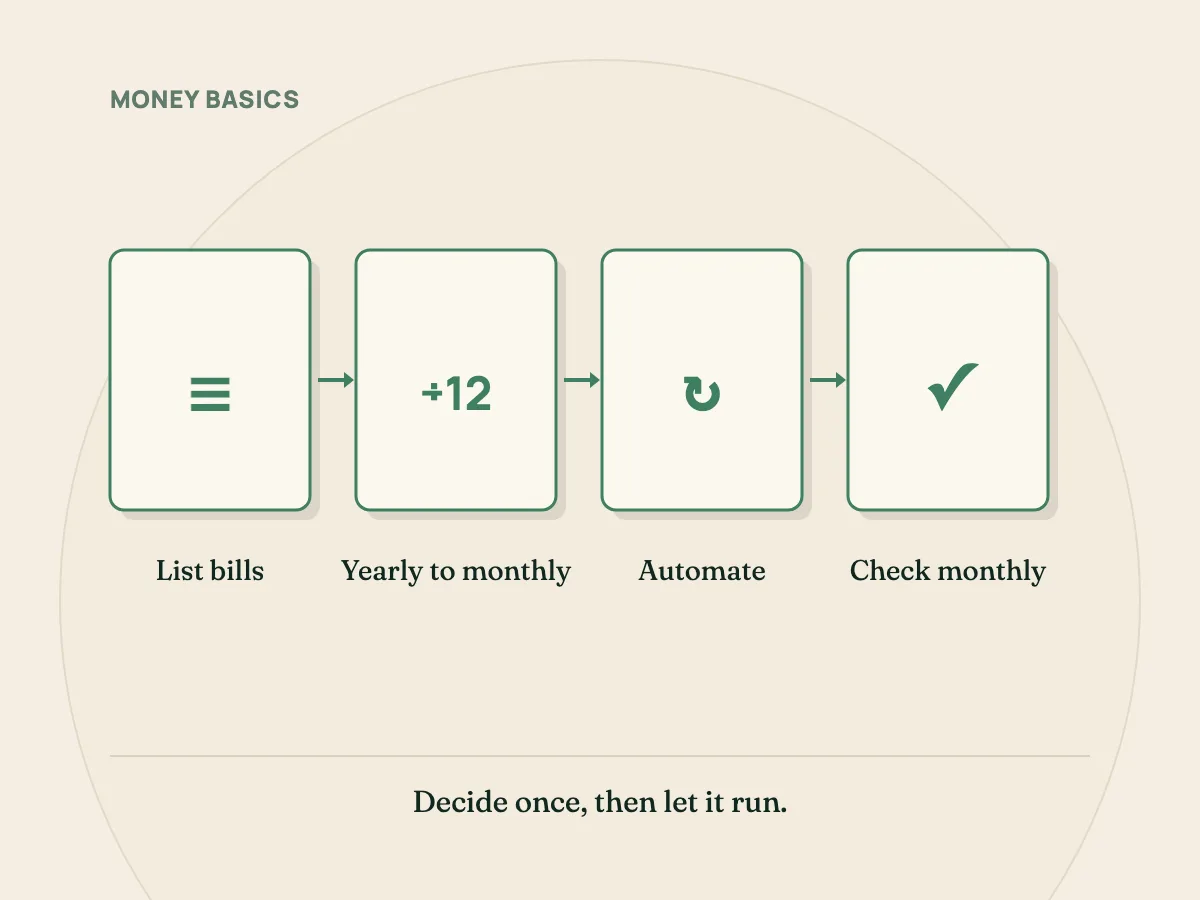
Write your monthly take-home pay and every bill that arrives each month. If your income changes month to month, consumer.gov suggests adding up last year's income and dividing by 12.
Insurance, subscriptions billed yearly, gifts and car costs break budgets because they arrive at once. Divide each yearly amount by 12 and treat it as a monthly bill you pay into savings.
Set a recurring transfer to a separate savings account on the day you are paid. The CFPB also suggests splitting your pay at work so part of it goes straight to savings.
Compare what you planned with what happened. If the transfer was too high, lower it rather than stopping it. When your pay rises, raise it.
Worked example
Invented example: take-home pay is 3,200 a month, in your currency. Rent, utilities, phone, transport and minimum debt payments come to 1,900. That leaves 1,300 for food, everything else and saving.
Yearly bills: car insurance of 600 and gifts of about 300 a year. That is 50 plus 25, so 75 a month goes into savings for them, whether or not they are due this month. Then pick a savings amount you can keep up: here, 200 a month on payday.
At 200 a month, the first 400 of emergency savings is there in two months and 1,000 in five. That leaves 1,025 for food and everything else after the 75 and the 200. If that turns out too tight in the first month, drop the 200 to 150 rather than stopping. A smaller transfer you keep beats a larger one you cancel.
Why it matters
In the US Federal Reserve's survey for 2025, 63% of adults said they would cover an unexpected 400 dollar expense with cash or its equivalent. The rest would have to borrow, sell something, or could not cover it. That figure has been 63% each year from 2022 to 2025.
The CFPB's guidance on emergency funds does not set one target for everyone. It suggests choosing a specific goal, saving consistently, and deciding in advance what counts as an emergency. A first goal of one unexpected bill, such as a car repair, is a useful place to start.
US Federal Reserve: Economic Well-Being of U.S. Households in 2025
US Consumer Financial Protection Bureau: An essential guide to building an emergency fund
What the evidence shows
When one large US employer switched its retirement plan from opting in to automatic enrolment, 86% of employees hired under the new rule were in the plan after 3 to 15 months, against 37% of those hired just before the change at the same point. Nothing else about the plan changed. Many people also stayed at the low default contribution, which shows the other side: a default sets where people stop thinking.
A second programme, Save More Tomorrow, asked employees to commit in advance to saving more out of future pay rises. In its first use, 78% of those offered it joined, and participants' average saving rate rose from 3.5% to 13.6% over 40 months. Both studies are about workplace retirement plans; the lesson that carries over is to set saving up once and let increases happen on a schedule.
Madrian and Shea (2001): The power of suggestion, NBER working paper
Thaler and Benartzi (2004): Save More Tomorrow, Journal of Political Economy
Start here
If you have never written a budget, start there; the steps above take an hour. If you have a budget but saving still feels like deprivation, the problem is usually the plan rather than you: savings needs to be a line you pay first, with room left for things you enjoy. If you keep making the same spending decisions you regret, look at the habits behind them before cutting harder.
These are suggested courses in Cadence, the app we make, and they are listed further down this page. Each course page has a worked example you can try without the app.
Put it into practice
Pick the one problem from this guide that is closest to yours. Cadence turns it into short daily lessons with practice, so the habit has somewhere to happen. Cadence is our app.
Questions
There is no single right percentage. Start with an amount you can keep up every month, automate it, and raise it when your pay goes up. A small amount you keep is worth more than a large one you cancel.
The CFPB does not set one number for everyone. A useful first goal is enough to cover one unexpected bill, such as a car repair, then build from there.
Set an automatic transfer to a separate savings account on payday. Deciding once is easier than deciding every month.
It depends on your interest rates and situation. Many people keep a small emergency fund while paying down high-interest debt so a surprise bill does not add new debt. For advice on your situation, talk to a qualified, independent adviser.
See it in concrete terms
Three of the money problems above, each with daily practice and checks.
Build a budget around your actual income and costs.
Save more without turning life into a spreadsheet.
See why you spend the way you do, and choose differently.
Sources
Try Cadence today
Describe what you want to learn and Cadence builds a course of short daily lessons you can read or play as audio. It is free to start on iPhone, and Android access is by request.