Learning Cadence editorial, , 8 min readHow we work
Someone sends a striking image with the message: this happened today. You wonder whether it was made with AI. There are two questions to answer: how the file was created, and whether it supports that particular claim.
Use the checks below before sharing an image or relying on it in a report. The bridge, archive and watermark examples are invented teaching cases. They do not describe a real event, a tested detector or an investigation of someone's photograph.
The short answer
Check the history, then test the claim.
Find the source behind the image, look for earlier uses, and inspect available creation or editing information. Then check the specific date, place or event claimed in the caption. A detector result or a realistic appearance does not settle all of those questions. If the evidence is incomplete, keep the conclusion open.
The method
Check four things before deciding.
Keep a short note of what you found. A useful conclusion names the evidence and the question it answers.
01
Write the exact claim
Separate what is visible from what the caption adds. A picture may show water around a bridge. The caption may add a town, a date and a cause. Write the particular claim you need to verify, such as: this bridge was closed this morning.
02
Find the source behind the repost
Open the linked publication, photographer's page or original post when available. Record who published it and what they actually say. A screenshot of a source name is a clue to investigate, not the source itself.
03
Look for earlier uses
Search with the image and inspect pages containing it or a similar picture. Compare distinctive details and read the surrounding text. A similar-looking result is a lead; it is not automatically the same image. The earliest page you find is not necessarily the original.
04
Separate creation evidence from event evidence
Inspect available creation history, Content Credentials or a relevant watermark check. Record what each actually reports. Then seek evidence for the caption's date, place and event. Several reposts of one claim do not make several independent confirmations.
Free worksheet
Keep the image and its claim separate.
Copy or download this worksheet for the next image you want to check. No account is needed.
IMAGE VERIFICATION WORKSHEET
Learning Cadence | Original worksheet | 27 October 2026

Image link or description:
Where I encountered it:
Exact claim in the caption:
What the image itself visibly shows:

SOURCE AND EARLIER USE
Publisher or original source found:
Source link and date:
Earlier matching use found:
What establishes a match, rather than a similar scene:
What that earlier use establishes:

CREATION HISTORY
Credential, watermark or detector checked:
Exact result and the tool's stated scope:
What this establishes about creation or editing:
What remains unknown:

THE CLAIM
Evidence for the claimed date, place and event:
Is this independent evidence or a repost of the same claim?
Conclusion: supported / contradicted / not established
Reason and source link:

NEXT ACTION
Share with accurate context / seek more evidence / do not share yet:
What evidence would change my conclusion:

A realistic appearance is not a verification result. Missing credentials,
no search match or no detected watermark does not establish authenticity.
Use image search to find context.
Google Lens can return similar images and websites containing the image or a similar one. Google's About this image feature can show earlier uses and when Google may first have seen a similar version. Availability varies by region. Open the underlying pages instead of treating a search summary as the final evidence.
A search first-seen date is not necessarily the date a photograph was taken. An empty result leaves the search inconclusive. Use a public image or public image link you are entitled to submit; do not upload private or sensitive images just to complete a checklist.
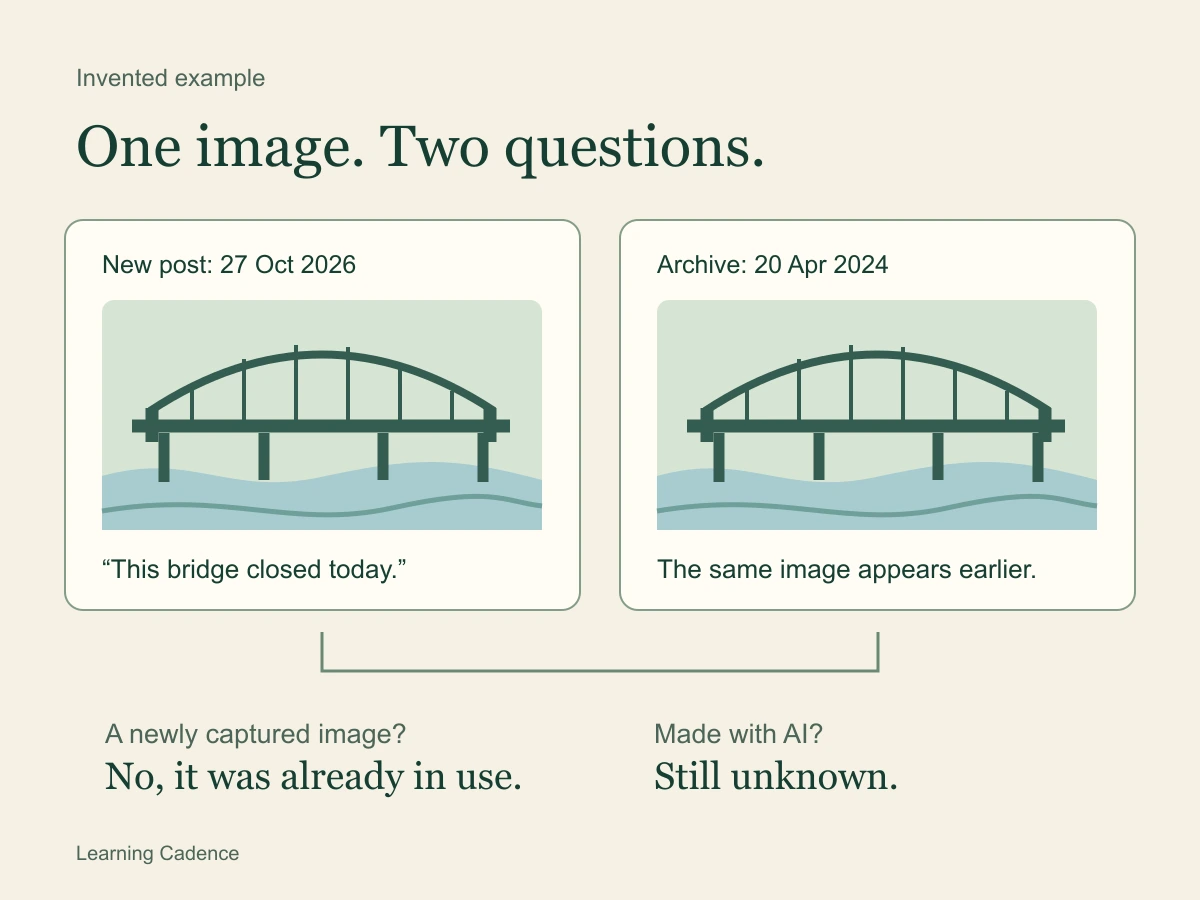
Invented case: a message dated 27 October 2026 says a bridge closed this morning. You find the exact same image in an archive entry dated 20 April 2024. For this exercise, assume the match and the archive date have been verified. You have no other evidence about today's bridge conditions.
Answer: the image was already in use in 2024, so it cannot be a newly captured picture of this morning's event. That does not establish whether the bridge closed again today, nor whether the image was created with AI. The current event remains unverified; the claim that this is a new picture is contradicted by the earlier use.
A precise note is more useful than simply calling it fake: this image appeared in an earlier archive entry; I have not verified today's closure. Seek current evidence from a relevant local source before repeating the event claim.
Read a credential as a record, not a verdict.
Content Credentials record information about a file's origin and editing history. C2PA explains that validating this provenance does not decide whether its contents are true. Credentials can also be separated from a file. Their absence does not establish how an image was made.
Invented case: a valid credential records that an image was edited with an AI tool. Answer: you have evidence about a recorded editing step. It does not follow that every part of the scene was generated, or that the caption's date and place are correct. Check the actual recorded action and the separate event evidence.
Google describes SynthID Detector as checking for a SynthID watermark in supported content. It is not a universal check for everything created by every image generator. This guide does not assume that a particular detector is available to your account or has tested your file.
Invented case: a tool reports that it found no watermark of the type it checks. Answer: that watermark was not detected. You still do not know whether the file was made by a different generator, edited in another way, or captured by a camera. Record the narrow result instead of translating it into a claim that the image is authentic.
Supported means that the evidence you checked addresses the particular claim. Contradicted means there is evidence against that claim, such as a verified earlier use contradicting a claim that a picture is new. Not established means the available checks have not settled it. None of these labels is a score for how convincing the pixels look.
Before sharing, write one sentence: this image supports this claim because of this source. If you cannot finish the sentence, name what is missing. You can wait for better evidence without declaring the image AI-generated or dismissing a real event.
Build the habit of checking evidence.
If you want to get better at checking images and claims in everyday life or at work, try Cadence. We make the app. Describe what you want to learn, answer the setup questions, and build a course around your starting point. You choose the pace and can return to your saved progress.
The suggested deepfake goal below is a starting point you can adapt. Cadence is a learning app, not an image detector, forensic service or guarantee that you will identify every misleading picture. The worksheet above is complete and free to use on its own.
Put it into practice
Practice checking evidence in Cadence
If you want more practice with images and claims, describe that goal in Cadence and answer the setup questions. Build a course around your starting point and learn at your own pace. Cadence is our app.
Can I always tell whether an image is AI-generated by looking closely?
Do not make a firm conclusion from appearance alone. An odd detail gives you a question to investigate; a realistic image still needs its source and context checked. The worksheet separates creation evidence from claims about an event.
Does no result from reverse image search prove the image is new?
No. It means your search did not find a match. It does not establish the image's creation date or how it was made.
Do Content Credentials prove the caption is true?
No. They provide a record of provenance that can be checked for integrity. A caption's date, place or event still needs evidence that addresses that claim.
What does no detected watermark mean?
It means the particular watermark check did not detect the watermark it looks for. It does not prove that the image was captured by a camera or never edited with AI.
Can I use the worksheet without joining Cadence?
Yes. Read it here or download the plain-text file without an account. Cadence is an optional way to continue learning about checking sources and evidence.
See it in concrete terms
Explore example courses for your goal.
Explore a suggested goal, then describe your own situation and answer Cadence's setup questions to build a course. These outlines are starting points, not fixed lessons or proof of forensic skill.
We built a practical guide around the separate questions of an image's creation history and the claim attached to it. The three cases and the worksheet are original teaching examples, not reports of real investigations.
What we checked directly: On 27 October 2026 we read Google's image-search and image-context help, the C2PA explainer and FAQ, and Google's description of SynthID Detector. We checked what each source establishes and kept the fictional answer keys within those limits.
Limits of this review: We did not test detector accuracy, submit a real image to a verification service or conduct a forensic investigation. Search coverage, features and tool access can vary. This guide organizes evidence; it does not certify an image or establish a real event.
Choose a question you want to judge more clearly. Start free on iPhone or Android, describe your goal and answer the setup questions to build your course.