Write a task you want to perform
For example: explain a chart without confusing percentage points and percent change. Write a short attempt before using the app. A specific starting task gives you something to revisit after the lesson.
Practical guide
A polished demonstration shows what an app can present. Your own small test should show whether its teaching, practice and routine fit what you want to learn.
Explore Cadence's daily courses
We make Cadence, an app for short daily courses built around your goal. Explore the reviewed course library to see its current focus and decide whether it fits what you want to learn.

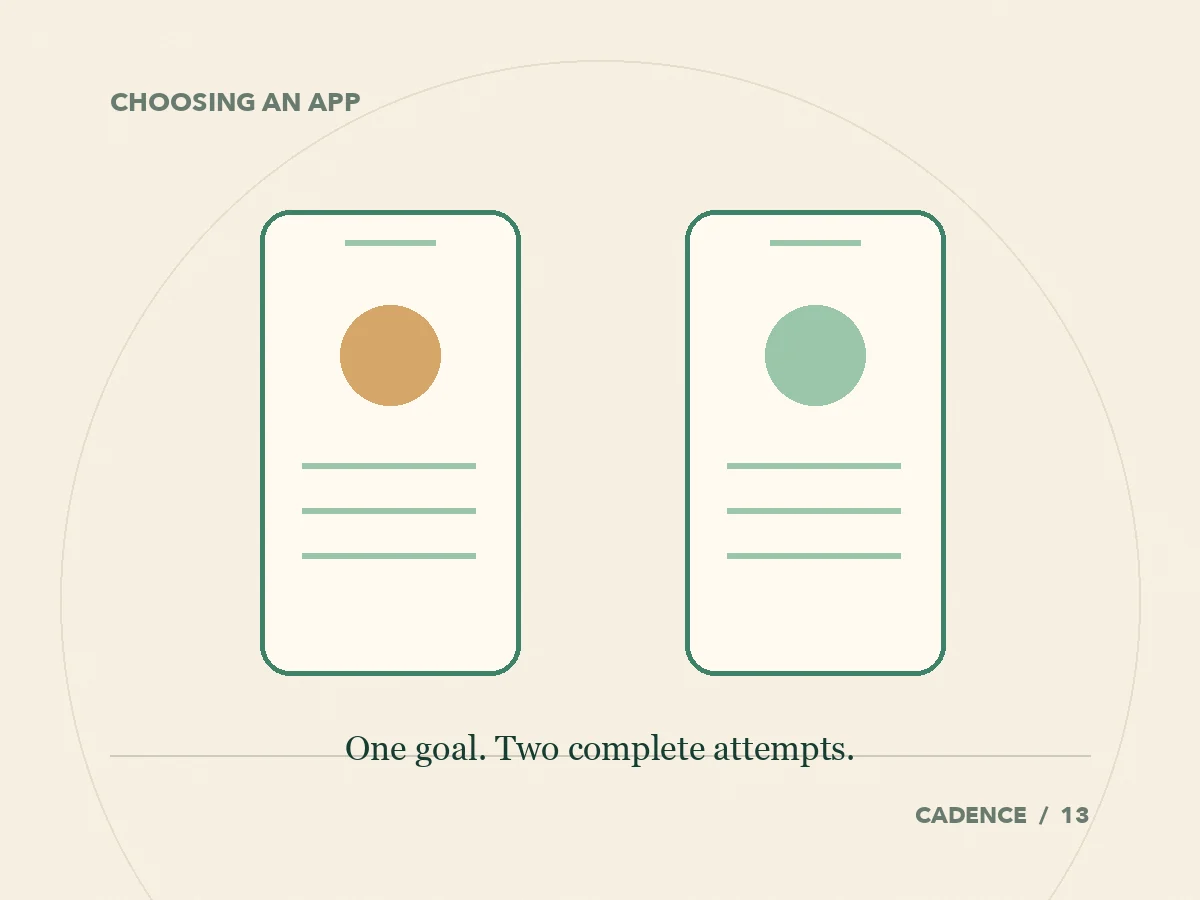
Two learning apps can both promise short daily lessons while asking you to do very different things. One might mainly present explanations; another might require you to solve problems, speak or write. A feature list does not tell you which experience suits your goal.
Use this editorial comparison exercise with a free preview or access you already have. You do not need to start a paid trial simply to complete it. The result is a decision about fit, not proof of an app's long-term effectiveness.
The short answer
Choose a specific goal, complete a representative lesson, try its practice and return later. Compare what you can explain or do with your starting point. Check the full price, renewal and cancellation terms before subscribing.
The method
Keep the goal and available time consistent so the comparison does not change halfway through.
For example: explain a chart without confusing percentage points and percent change. Write a short attempt before using the app. A specific starting task gives you something to revisit after the lesson.
Choose material at your level that relates to the task. Notice whether it explains the reasoning, gives useful examples and lets you revisit a difficult point. Do not assume the onboarding demonstration represents every lesson.
Try the exercise before revealing the answer. If you make a mistake, check whether the feedback explains why and gives you a next attempt. Record what the app actually asked you to do, rather than the feature name used to advertise it.
On another day, repeat your starting task with a new example, then reopen the app. Could you find where you left off? Did the time and format fit? Record unresolved questions as well as what worked.
An example decision
Imagine App A explains charts clearly but never asks you to interpret one. App B offers fewer topics but provides chart questions and explanations of wrong answers. For your chart-reading goal, B may be the more useful candidate. If you only wanted a broad introduction, your judgement might differ.
These are invented products, not hidden ratings of real apps. The point is to compare the complete activity against your goal instead of treating catalogue size or a streak as a sufficient decision rule.
Before paying
Find the renewal amount and period, cancellation route and what happens when access ends. For subscriptions billed through Apple, Apple's support page explains cancellation and advises cancelling an unwanted trial renewal at least 24 hours before it ends. Subscriptions billed elsewhere require the relevant provider's instructions; do not assume one store controls them all.
A comparison you can keep
Use six lines: goal; starting attempt; lesson completed; practice and feedback; later attempt; cost and conditions. Finish with a decision such as worth another week, wrong format for this goal, or not enough access to judge.
One better answer after one lesson is encouraging, but it does not establish durable improvement or prove the app caused it. For a purchase decision, the honest conclusion may simply be that this format fits your available time and gives you useful practice.
From the publisher
Cadence is our app, so apply this test to us too. We have a commercial interest in your choice. This article reports no comparative product trial and gives no measured ranking; it provides a method for making your own decision.
Put it into practice
We make Cadence, an app for short daily courses built around your goal. Explore the reviewed course library to see its current focus and decide whether it fits what you want to learn.
Questions
No. Start with available previews or existing access. If you cannot inspect the important teaching and practice without paying, record that limitation before deciding whether a trial is worthwhile.
They can record participation. Check a recall or performance task as well if you want evidence about what you can explain or do.
Only if that breadth serves your goal. Inspect the relevant lesson, practice and feedback before treating catalogue size as an advantage.
No. A small test can expose poor fit and provide an initial signal of usefulness. Durable learning and broader effectiveness require more evidence.
See it in concrete terms
Inspect the syllabus for these workplace courses to decide whether the topic and level fit your goal.
Read workplace metrics, question weak evidence, explain uncertainty, and recommend a next step without learning SQL.
Organize your point under pressure so updates, questions, and explanations sound clear without sounding rehearsed.
Make feedback specific, useful, and easier for a teammate to act on without burying the point.
Sources
Try Cadence today
We make Cadence, an app for short daily courses built around your goal. Explore the reviewed course library to see its current focus and decide whether it fits what you want to learn.