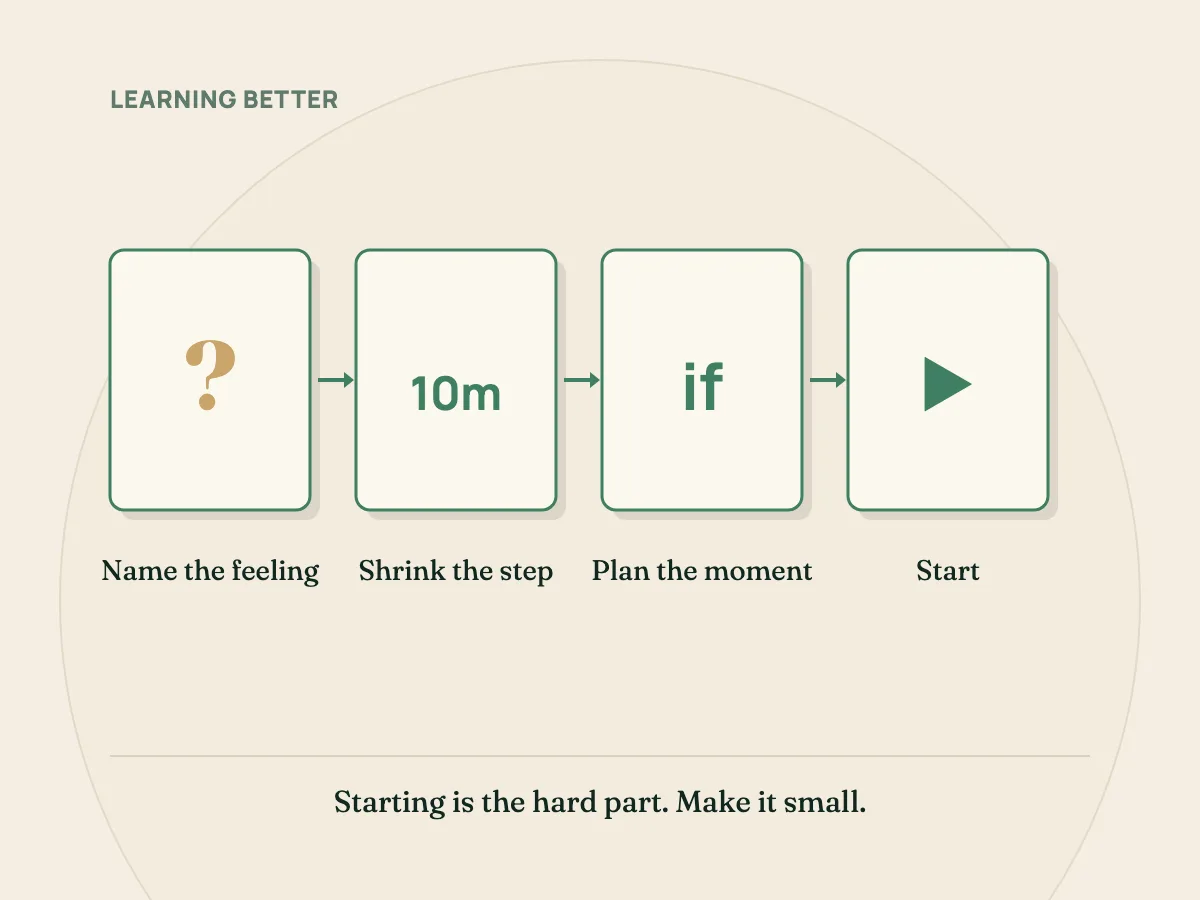
Name the feeling
Write one line about why the task feels bad: boring, unclear, likely to be criticised, too big. The answer tells you what to change.
Practical guide
Procrastination is usually about how a task makes you feel, not about time. Make the first step small enough to tolerate and decide in advance exactly when you will take it.
Read the guidePractise starting the task you keep avoiding
We make Cadence, an app that builds a short daily course around a goal you describe, such as starting the report you have put off for two weeks. Start free on iPhone or request Android access.

Most people who procrastinate know exactly what they should do. Researchers increasingly describe procrastination as a way of managing feelings: putting off an unpleasant task gives short-term relief, and the cost lands on your future self.
This guide works through one avoided task with two techniques that have research behind them: dealing with the feeling and shrinking the start, and planning the exact moment you will begin.
The short answer
Name what feels bad about the task: boring, confusing or risky. Shrink the first step until it takes 10 minutes or less. Write an if-then plan: if it is 9:00 on Tuesday and I am at my desk, then I open the file and write the headings. When the time comes, do only that step. Starting is the hard part; stopping after 10 minutes is allowed.
The method
Pick one task you have put off for more than a week. Use the four steps on it today.
Write one line about why the task feels bad: boring, unclear, likely to be criticised, too big. The answer tells you what to change.
Make it take 10 minutes or less: open the file and write headings, find the form, send one question. Small enough that it is hard to refuse.
Write an if-then plan: if it is this time, in this place, then I do this step. Put it in your calendar.
When the time comes, do the step. After 10 minutes, you may stop. Most of the time you will not want to.
Worked example
Invented example: a quarterly report has sat on your list for two weeks. Naming the feeling shows it is not the work itself but the data section: you are unsure the numbers are right and expect questions.
So the first step becomes 'list the three numbers I am unsure about', which takes ten minutes. The if-then plan: 'If it is 9:00 on Tuesday and I have my coffee at my desk, then I open the report and list the three numbers.' On Tuesday you do it, then send one question to the colleague who owns the data.
The report is not finished, but the part that made it feel bad is now a question in someone else's inbox. That changes the task from avoidable to ordinary, which is usually enough to get the rest done.
What the evidence shows
A 2007 review of 691 correlations found that the strongest predictors of procrastination included how unpleasant a task feels, how far away its reward or deadline is, how confident people feel about doing it, and impulsiveness. A 2013 review argued that procrastination is largely about repairing mood in the short term, at the cost of the future self.
That is why time management tips alone often fail: they do not change how the task feels. Shrinking the first step and resolving the specific worry do.
Steel (2007): The nature of procrastination, Psychological Bulletin
Sirois and Pychyl (2013): Procrastination and the priority of short-term mood regulation
What the evidence shows
A 2006 review of 94 tests found that if-then plans, which say when, where and how you will act, had a medium-to-large effect on reaching goals. They helped people start, keep going when distracted, and drop courses of action that were not working.
The review covered many kinds of goals, not procrastination alone, and mostly short-term outcomes. But the mechanism fits: the plan makes the decision in advance, so at 9:00 on Tuesday there is nothing left to decide.
Gollwitzer and Sheeran (2006): Implementation intentions and goal achievement, a meta-analysis
Start here
If you struggle to start, begin with the course on putting things off. If you start easily but stall halfway, begin with finishing what you start. If the problem is that your week is overloaded and things fall off the end, begin with planning a week you can actually do.
These are suggested courses in Cadence, the app we make, and they are listed further down this page. Each course page has a worked example you can try without the app.
Put it into practice
Pick the one problem from this guide that is closest to yours. Cadence turns it into short daily lessons with practice, so the habit has somewhere to happen. Cadence is our app.
Questions
Usually because the task feels unpleasant: boring, unclear or risky. Putting it off gives short-term relief. Research links procrastination to how aversive a task feels and how far away the deadline is.
Pick the smallest first step that takes 10 minutes or less and do only that. Starting is the hardest part.
A plan that says exactly when, where and what you will do: if it is 9:00 Tuesday at my desk, then I open the file. A review of 94 tests found these plans help people reach goals.
Not usually. It is more often a way of avoiding an unpleasant feeling about a task. Dealing with that feeling works better than criticising yourself.
See it in concrete terms
Three of the procrastination problems above, each with daily practice and checks.
Try Cadence today
Describe what you want to learn and Cadence builds a course of short daily lessons you can read or play as audio. It is free to start on iPhone, and Android access is by request.