Check your real times
For three working days, note roughly how long your regular tasks take: reports, email, meetings, preparation. Compare with what you would have guessed.
Practical guide
Most plans fail because they assume tasks take as long as we hope. Plan from how long things have actually taken you, leave room for the unexpected, and decide what will not get done.
Read the guidePractise planning a week that fits
We make Cadence, an app that builds a short daily course around a goal you describe, such as planning a week that still works on Friday. Start free on iPhone or request Android access.

Most time management advice is about tools: apps, matrices, colour-coded calendars. The bigger problem is usually the estimate. People reliably underestimate how long their own tasks will take, so even a beautiful plan is wrong by Wednesday.
This guide works through one weekly plan that corrects for that, and explains what research shows about time management overall. Our separate guide covers prioritising when everything feels urgent.
The short answer
For a few days, note how long your regular tasks actually take. On Sunday, list next week's tasks and estimate each using those real times. Fill only part of your free time, leaving a buffer. Put the most important tasks first in the week. Decide which tasks will wait. Review on Friday and adjust.
The method
Do this on Sunday or Monday morning. It takes about 20 minutes once you have a few days of real times.
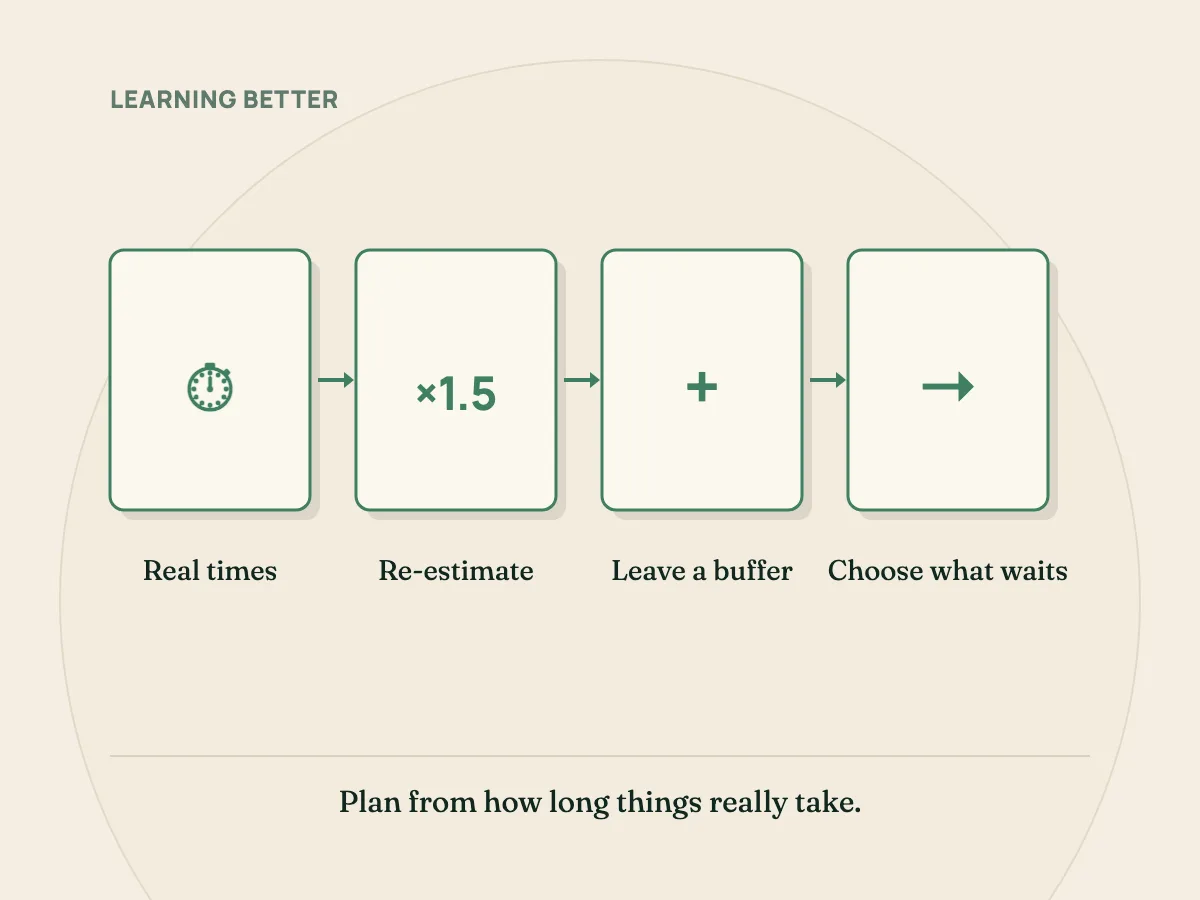
For three working days, note roughly how long your regular tasks take: reports, email, meetings, preparation. Compare with what you would have guessed.
List next week's tasks. Estimate each from how long similar tasks actually took, not how long you hope this one will take.
Do not fill every free hour. Leave part of the week unplanned for the things that always appear.
If the list does not fit, decide now which tasks move to next week, rather than discovering it on Friday.
Worked example
Invented example: after three days of noting times, you find that tasks you would have estimated at 1 hour usually took about 1.5 hours. Next week has 20 hours free outside meetings, and your task list adds up to 18 hours using your usual guesses.
Re-estimated with your real times, the same list is about 27 hours, which does not fit. You keep the 12 most important hours of work, which becomes about 18 hours with the correction, leave 2 hours as a buffer, and move the rest to the following week. The most important task goes on Monday and Tuesday mornings.
On Friday, compare plan and reality. If the buffer went unused, plan slightly more next week. If it overflowed, your correction needs to be larger. After a month, your estimates will be noticeably better.
What the evidence shows
In a 1994 study, students predicted when they would finish their theses. Their best guesses averaged 33.9 days; the actual average was 55.5 days, and only 29.7% finished by their best-guess date. Even their worst-case guesses were met by fewer than half.
In a later experiment in the same paper, the bias disappeared when people were asked to connect their past experiences to their prediction. That is the idea behind checking your real times: use your past, not your plan, to estimate.
Buehler, Griffin and Ross (1994): Exploring the planning fallacy
What the evidence shows
A 2021 review of 158 studies with nearly 54,000 participants found that people who manage their time well tend to perform somewhat better at work and in study, and are noticeably more satisfied with life and less distressed. The link with wellbeing was stronger than the link with performance.
Most of those studies measured both at one point in time, so they show association rather than proof that time management causes the benefits. The practical reading is that better planning seems to help most with how your week feels.
Aeon, Faber and Panaccio (2021): Does time management work? A meta-analysis, PLOS ONE
Start here
If your weekly plans never survive contact with the week, start with planning a week you can actually do. If everything seems urgent, start with the course on when everything feels urgent. If your calendar runs you rather than the other way round, start with using your calendar as a tool.
These are suggested courses in Cadence, the app we make, and they are listed further down this page. Each course page has a worked example you can try without the app.
Put it into practice
Pick the one problem from this guide that is closest to yours. Cadence turns it into short daily lessons with practice, so the habit has somewhere to happen. Cadence is our app.
Questions
Plan the week using how long tasks have actually taken you, leave a buffer, put the most important tasks early, and decide in advance what will wait.
Most people underestimate how long their own tasks take. In one study, students' thesis estimates averaged 34 days against an actual 56. Planning from your past times corrects for this.
Leave part of it unplanned as a buffer. If the buffer goes unused for a few weeks, plan a little more; if it overflows, plan less.
A review of 158 studies found it is linked to somewhat better performance and noticeably better wellbeing, though most studies show association rather than cause.
See it in concrete terms
Three of the time problems above, each with daily practice and checks.
Subtract fixed commitments before deciding what work can fit.
Compare real consequences and make the capacity tradeoff explicit.
Use your calendar to make tradeoffs, energy, deadlines, and recovery visible instead of just storing meetings.
Try Cadence today
Describe what you want to learn and Cadence builds a course of short daily lessons you can read or play as audio. It is free to start on iPhone, and Android access is by request.