Write one task
Not a list: the single task the block is for, written specifically. 'Draft sections 1 and 2 of the proposal' rather than 'work on proposal'.
Practical guide
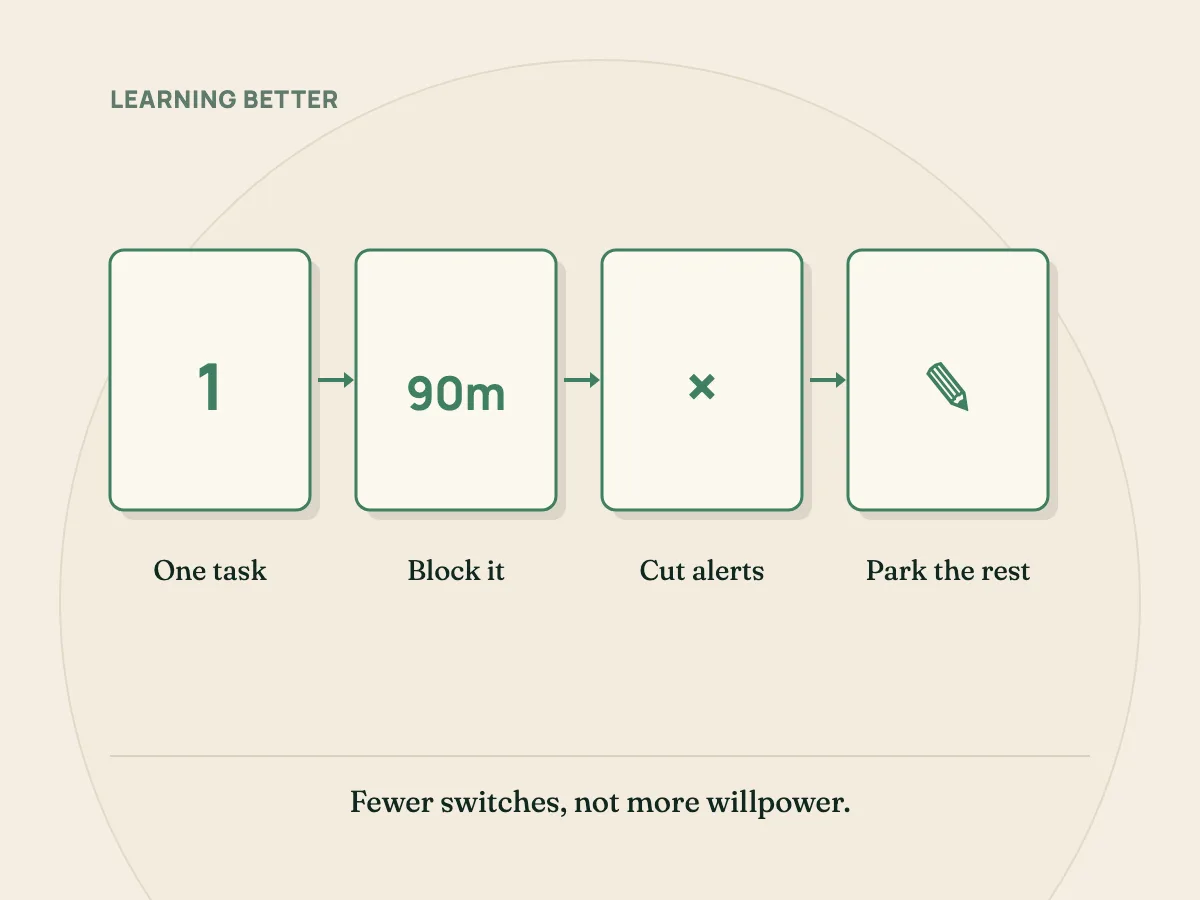
Focus is less about willpower than about fewer switches. One clear task, one protected block and a place to park interruptions do more than trying to concentrate harder.
Read the guidePractise focus on the problem you actually have
We make Cadence, an app that builds a short daily course around a goal you describe, such as finding time for deep work in a meeting-heavy week. Start free on iPhone or request Android access.

Most people trying to focus are not short of willpower; they are short of uninterrupted time. Each switch between tasks has a cost, and a working day full of messages can contain hardly any stretch long enough for hard work.
This guide works through one protected focus block, then explains what the research shows about interruptions, switching, phones and breaks, including where popular claims are weaker than they sound.
The short answer
Pick the one task that matters most today and write it down. Block 60 to 90 minutes for it. Turn notifications off and put your phone out of reach. Write interruptions on a list instead of acting on them. Take a short break between blocks. Start with one block a day and add a second when it holds.
The method
Do this the evening before, so the block starts without decisions.
Not a list: the single task the block is for, written specifically. 'Draft sections 1 and 2 of the proposal' rather than 'work on proposal'.
Put 60 to 90 minutes in your calendar, ideally at the time of day your energy is best. Treat it like a meeting with someone important.
Notifications off, email closed, phone in another room or a drawer. Each interruption you remove is one less switch.
Keep a paper list beside you. When a thought or task arrives, write it down and return to the block. Deal with the list afterwards.
Worked example
Invented example: you need to draft a proposal but your mornings disappear into messages. The evening before, you write 'Draft sections 1 and 2' on a sticky note and block 9:00 to 10:30. At 9:00 you close email and chat, put your phone in a drawer and start.
By 9:40 the list beside you has four items: reply to Alex, check the budget number, book a room, buy milk. None needed action in the next hour. At 10:30 you take a 10-minute break, then work through the list in 20 minutes.
The test is simple: did the block produce the draft? If not, look at what broke it. If it was a colleague, tell them about the block. If it was your own urge to check, the drawer was not far enough.
What the evidence shows
Laboratory studies of task switching find that changing from one task to another takes measurable extra time, and the cost grows when the rules of the tasks are more complex. In a 2008 study of interrupted office work, people interrupted every few minutes actually finished faster with no loss of quality, but they did it by speeding up, and reported more stress, frustration and effort after only 20 minutes.
So interruptions may not show up as missed deadlines straight away. They show up as tiredness and stress, which is why a protected block often feels better as well as working better.
Rubinstein, Meyer and Evans (2001): Executive control of cognitive processes in task switching
Mark, Gudith and Klocke (2008): The cost of interrupted work, CHI 2008
What the evidence shows
A widely shared 2017 study suggested that merely having your phone nearby reduced mental capacity. A later pre-registered direct replication did not find the effect. The evidence for moving your phone away is therefore mostly practical: it removes the easiest interruption, which costs you nothing to try.
A 2022 review of 22 samples found that short breaks reliably increased energy and reduced fatigue, but did not clearly improve performance overall, and longer breaks may be needed after very demanding work. Take breaks because they help you keep going, not as a performance hack.
Ruiz Pardo and Minda (2022): Reexamining the brain drain effect, Acta Psychologica
Albulescu and colleagues (2022): Micro-breaks for well-being and performance, PLOS ONE
Start here
If your attention wanders even when nothing interrupts you, start with focusing in a distracted world. If your calendar is full of meetings, start with deep work in a meeting-heavy job. If home is the hard place to concentrate, start with focusing while working from home.
These are suggested courses in Cadence, the app we make, and they are listed further down this page. Each course page has a worked example you can try without the app.
Put it into practice
Pick the one problem from this guide that is closest to yours. Cadence turns it into short daily lessons with practice, so the habit has somewhere to happen. Cadence is our app.
Questions
Choose one task, block 60 to 90 minutes for it, turn off notifications and park interruptions on a written list. Start with one block a day.
Often because the day has few uninterrupted stretches. Each switch between tasks has a cost. If poor concentration is new or severe, it is worth talking to a doctor.
It removes the easiest interruption, which is worth doing. The claim that a phone's mere presence lowers your mental capacity did not hold up in a later direct replication.
There is no single best length. Many people find 60 to 90 minutes workable. Short breaks reduce fatigue; very demanding work may need longer ones.
See it in concrete terms
Three of the focus problems above, each with daily practice and checks.
Choose a specific task and test conditions that help you work on it.
Protect meaningful work blocks without pretending meetings, Slack, and team obligations will disappear.
Make the work and availability agreement explicit.
Sources
Try Cadence today
Describe what you want to learn and Cadence builds a course of short daily lessons you can read or play as audio. It is free to start on iPhone, and Android access is by request.