Keep one wake time
Get up at the same time every day, including weekends. The CDC, NHLBI and NHS all list a consistent schedule first. A fixed wake time anchors everything else.
Practical guide
Most sleep advice is a long list. A few changes do most of the work: the same wake time every day, caffeine earlier than you think, and a dimmer last hour before bed.
Read the guidePractise the sleep habits that fit your evenings
We make Cadence, an app that builds a short daily course around a goal you describe, such as keeping a steady bedtime when evenings run late. Start free on iPhone or request Android access.

Health bodies such as the CDC recommend that adults aged 18 to 60 get seven or more hours of sleep a night. Many people know the number; the hard part is a routine that survives a busy week. This guide turns the official advice into one worked evening plan and a simple way to check whether it is working.
This is general information, not medical advice. If you snore loudly, stop breathing in your sleep, or have had trouble sleeping for months, talk to a doctor rather than relying on habits alone.
The short answer
Choose one wake time and keep it every day, including weekends. Count back at least seven hours of sleep to set a bedtime. Stop caffeine in the early afternoon. Put screens away and dim the lights for the last 30 to 60 minutes. Keep the bedroom cool, dark and quiet. If poor sleep lasts for months, talk to a doctor.
The method
Change these four things together and keep them for two weeks. Sleep often takes a while to settle into a new routine.
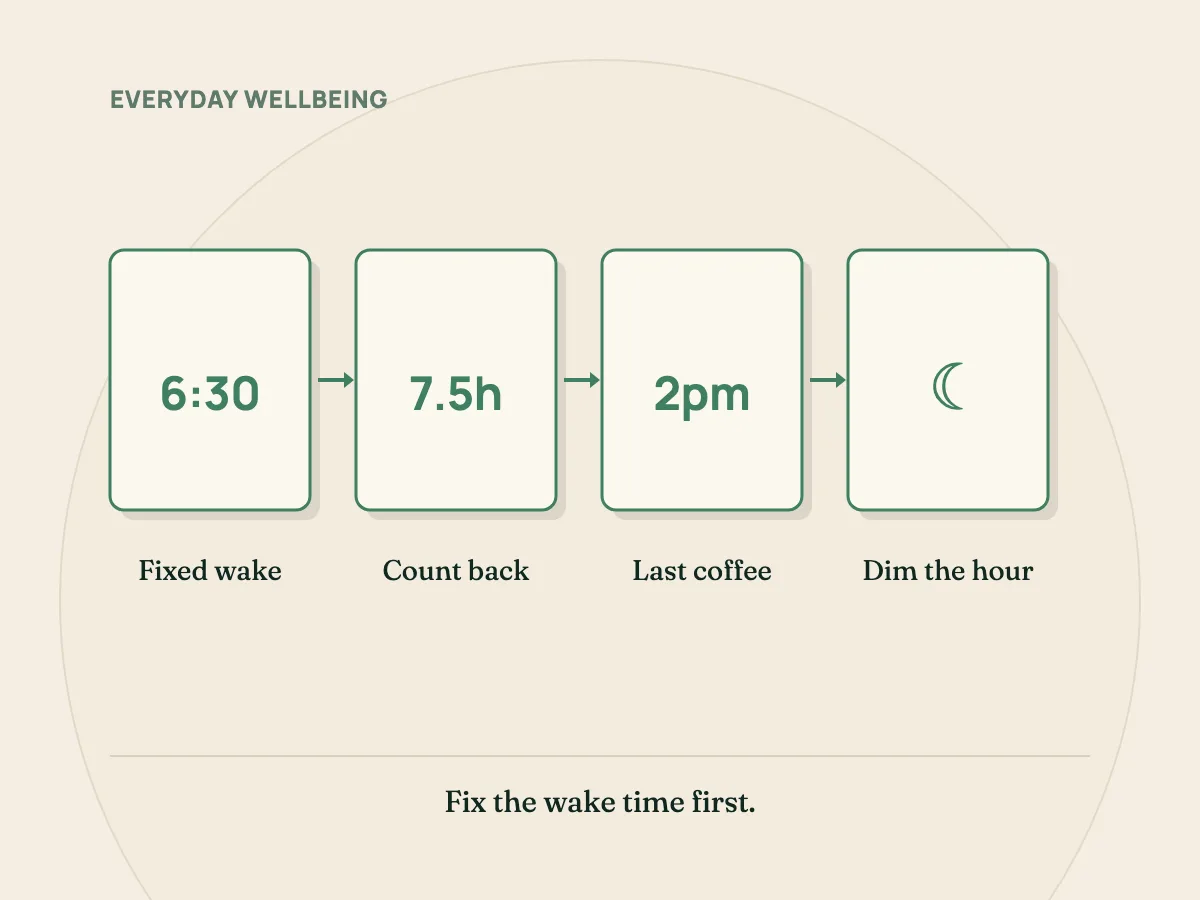
Get up at the same time every day, including weekends. The CDC, NHLBI and NHS all list a consistent schedule first. A fixed wake time anchors everything else.
From your wake time, count back seven and a half hours to give room for falling asleep. That is your latest bedtime. The NHS also suggests going to bed only when you feel sleepy.
The NHLBI notes caffeine's effects can last up to 8 hours. Set a cut-off in the early afternoon and keep to it for the two weeks.
Turn screens off at least 30 minutes before bed, as the CDC suggests, and use that time for something calm. Keep the bedroom cool, dark and quiet.
Worked example
Invented example: you need to be up at 6:30 on weekdays. Counting back seven and a half hours gives a latest bedtime of 11:00. You keep 6:30 on weekends too, even if you sleep a little later the first Saturday.
You usually have a coffee at 4 p.m. That is seven hours before an 11:00 bedtime, inside the 8-hour window the NHLBI describes. Moving the last coffee to 2 p.m. gives nine hours. Screens go off at 10:15, and the last 45 minutes are for reading, a shower or tidying for the morning.
Keep a two-week log on paper: bedtime, rough time to fall asleep, wake time, and how rested you felt from 1 to 5. Changes in sleep are easy to misremember; the log shows whether the new routine is helping.
US National Heart, Lung, and Blood Institute: Healthy sleep habits
What the evidence shows
In a 2013 study, 12 healthy sleepers took a 400 mg dose of caffeine, roughly the amount in several strong coffees, either at bedtime, 3 hours before or 6 hours before. Even 6 hours before bed, caffeine cut their measured sleep by about an hour. The authors suggested avoiding substantial caffeine for at least 6 hours before bed.
The study was small and used one high dose, so it does not give a personal cut-off. Its practical point is that you may not notice the effect: at 6 hours, the sleep monitors recorded the lost hour, but the participants' own sleep diaries did not.
Drake and colleagues (2013): Caffeine effects on sleep taken 0, 3, or 6 hours before going to bed
Know the limit
The NHS advises seeing a GP if changing your sleep habits has not helped, if trouble sleeping has lasted for months, or if it affects how you cope with daily life. The CDC similarly suggests talking to a healthcare provider if you regularly have problems sleeping.
Loud snoring, gasping during sleep, or falling asleep during the day despite enough time in bed are also reasons to get checked. Habits help most people sleep better; they are not a substitute for treatment when something else is going on.
Start here
If you cannot fall asleep or keep waking, start with sleeping better at night: routine, environment and what to do when you are awake at 3 a.m. If you sleep enough hours and still feel tired, start with understanding why you are always tired, which looks at the wider picture. If your days leave no room to recover, start with rest and recovery.
These are suggested courses in Cadence, the app we make, and they are listed further down this page. Each course page has a worked example you can try without the app.
Put it into practice
Pick the one problem from this guide that is closest to yours. Cadence turns it into short daily lessons with practice, so the habit has somewhere to happen. Cadence is our app.
Questions
The CDC recommends seven or more hours a night for adults aged 18 to 60, with slightly different ranges for older adults. Individual needs vary.
Keep the same wake time every day, stop caffeine by early afternoon, and turn screens off for the last 30 to 60 minutes before bed. Give the routine two weeks.
The NHLBI notes caffeine can affect you for up to 8 hours, and a small study found caffeine 6 hours before bed still reduced sleep. An early afternoon cut-off is a reasonable starting point.
If poor sleep lasts for months, affects your daily life, or comes with loud snoring or gasping, talk to a doctor.
See it in concrete terms
Three of the sleep problems above, each with daily practice and checks.
Understand what runs your sleep, then stop fighting it.
Understand the everyday causes of low energy and change what you can.
Understand why rest is not optional, and how to actually get it.
Try Cadence today
Describe what you want to learn and Cadence builds a course of short daily lessons you can read or play as audio. It is free to start on iPhone, and Android access is by request.