Find the research question
Write the question in ordinary language. Note whether the authors want to describe, predict, compare or explain something.
Follow one claim back to the people, measurements and comparison behind it. Then write what the study can actually tell you.
Use the free template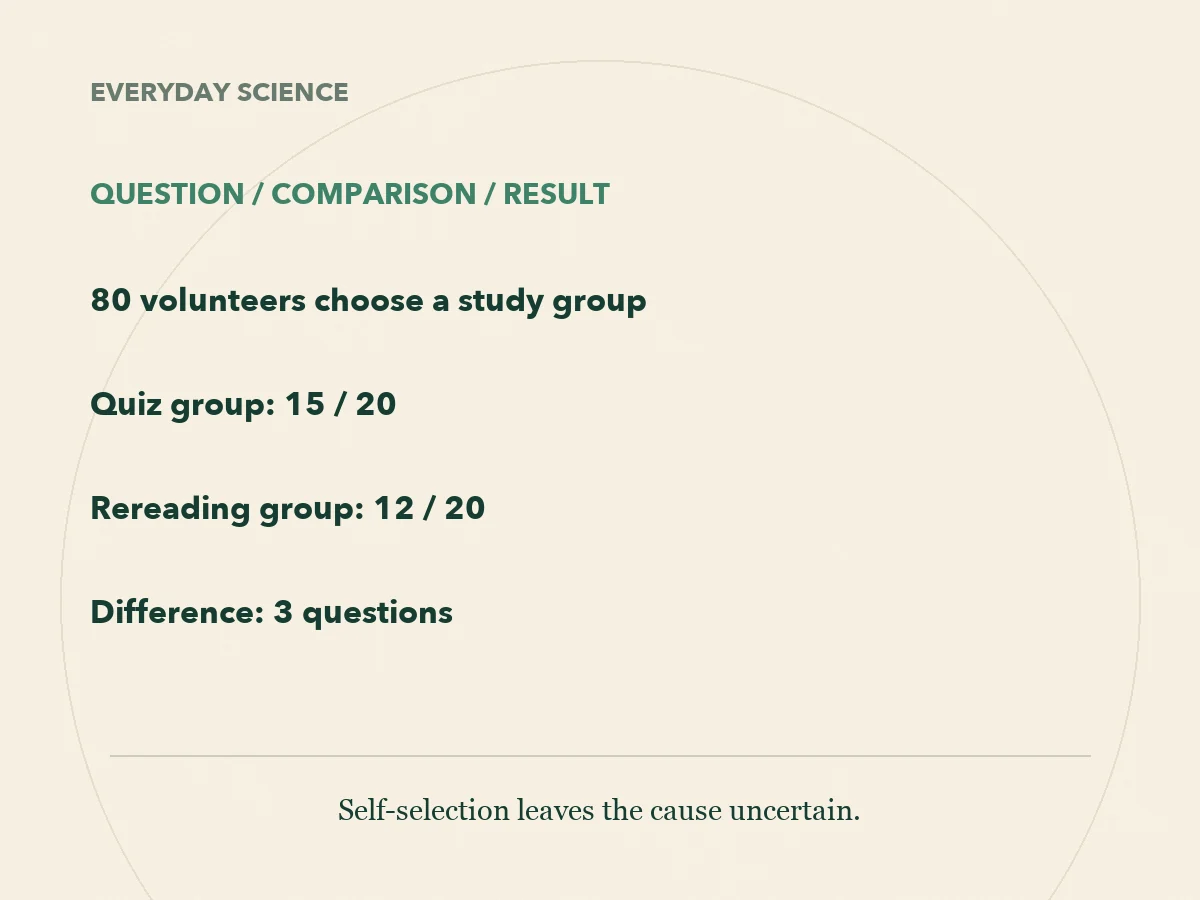
A headline says a new study found a better way to learn. The paper has unfamiliar terms, several charts and a conclusion that sounds confident. Your first task is to work out exactly what the researchers compared, not to understand every technical detail at once.
This guide focuses on empirical papers that report observations or experiments. Reviews, mathematical proofs and theoretical papers need different reading questions. The study below is entirely invented for teaching; it is not evidence about a real learning method.
The short answer
Preview the abstract to find the question, then inspect the methods and results behind the claim. Identify who or what was studied, what was compared and what was measured. Read the discussion for interpretation and limits. Finish with a short summary that separates the observed result from what remains uncertain.
The method
Use these questions as a reading route. Return to earlier sections when a result introduces a term or choice you do not understand.
Write the question in ordinary language. Note whether the authors want to describe, predict, compare or explain something.
Find the participants or units, selection method, groups and timing. Record how people entered each group.
Check the outcome, units, denominator and figure caption. Separate the numerical result from the explanation attached to it.
Say what happened in this study, what remains uncertain and what additional evidence would change your view.
Free worksheet
Use this plain-text worksheet with your own example. It is free to read and download without an account.
Download worksheet (.txt)SCIENTIFIC PAPER READING WORKSHEET Learning Cadence | Original worksheet | 18 October 2026 Paper and link: Question I am investigating: Study question: Who or what was studied? How were cases selected or assigned? Comparison: Outcome and units: Main result, with denominator: Missing results or follow-up: What the result supports: What it does not establish: Uncertainty I need help with: Next source to check:
Work through it
The introduction explains the problem and question. Methods describe the design, participants or materials, measurements and analysis. Results present findings; the discussion interprets them and places them in context. Papers vary, so use the function of a passage as well as its heading.
Trent University recommends previewing a paper, reading it for understanding and analysis, then reflecting on it. Its guide explicitly warns that an abstract alone is insufficient. Use the abstract as a map, then check the full evidence before relying on a claim.
Work through it
Imagine a paper about 80 volunteers learning the same unfamiliar map. Forty choose a practice-quiz group and forty choose a rereading group. Both study for 20 minutes. One day later, their average score on a 20-question map test is 15 and 12, respectively.
The observed difference is 3 questions out of 20. Expressed as percentages of the available score, the means are 75% and 60%, a difference of 15 percentage points. That arithmetic describes the group means; it does not show that every person improved by three questions.
A tempting headline is: Practice quizzes cause better memory. But participants chose their group. People who selected quizzes might already know more, be more motivated or use other study methods. The result alone does not separate those possibilities from an effect of the activity.
A defensible summary is: In this fictional volunteer sample, the self-selected quiz group scored three questions higher on average after one day. The design does not establish that the activity caused the difference. It also does not show what happens after a month or in a different subject.
Work through it
Before judging how convincing this result is, look for baseline knowledge, variation in scores, uncertainty estimates, missing follow-up tests and the analysis plan. With only two means and group sizes, this example does not establish statistical significance or the size of uncertainty.
If a graph appears to show a large gap, inspect its axis and units. If the caption reports only participants who finished, find out how many started. A limitation should change the conclusion where it matters; it is not a ritual sentence added after an overconfident claim.
Work through it
Original exercise: suppose a headline says, This method works for everyone. The underlying study randomly assigned 60 adult volunteers from one evening class to two activities and tested them immediately afterwards. What is one claim the design still cannot support?
Answer check: it cannot establish that the result applies to everyone, to children, to other subjects or to long-term retention. Random assignment can help a comparison within a study, but it does not make one class representative of every population. A good answer names a specific mismatch between the evidence and the headline.
Work through it
Record unfamiliar terms that affect the conclusion, such as how an outcome was defined or why records were excluded. Look up those terms before treating the finding as settled. A technical detail you cannot evaluate is an explicit limit on your assessment.
A single paper is one contribution to a wider body of evidence. Read related work and appropriate expert analysis when the decision depends on it. This worksheet helps organize a reading; it does not certify a paper or replace subject expertise.
We make Cadence. These examples and worksheets are free to use on their own. If you want more structured practice, explore the suggested learning goals below.
Put it into practice
If you want to keep going, Cadence turns what brought you here into a course of short daily lessons with practice and saved progress. Cadence is our app.


Want new features first?
Questions
It is a useful preview of the question and claim. Then inspect the full methods and results. An abstract does not contain enough detail to evaluate the whole study.
Start with the question, design and main result. Identify technical details that could change the conclusion and get suitable help with those. Do not treat an unclear analysis as verified.
State its question, who or what was studied, the comparison, the main result and a limitation that affects interpretation. Separate the measured result from explanations the design cannot establish.
The worksheet is designed for empirical studies. For a review, also inspect how studies were found, selected and assessed, and whether the conclusions reflect the included evidence.
See it in concrete terms
Continue with reading evidence or understanding the probabilities behind a claim.
Read a scientific paper and explain what its evidence supports.
Judge chance and odds in real life, not just on dice.
Catch your own mental shortcuts before they decide for you.
Sources
Try Cadence today
Describe what you want to learn and Cadence builds a course of short daily lessons you can read or play as audio. It is free to start on iPhone and Android.
Want new features first?