Recall before replaying
Write what you think the speaker meant in one or two sentences. Add the question you were listening to answer. Leave a gap where you cannot remember a number or condition instead of filling it with a guess.
Keep a useful idea, find what supports it, and try explaining it after the episode ends. A memorable claim still needs checking.
Use the free template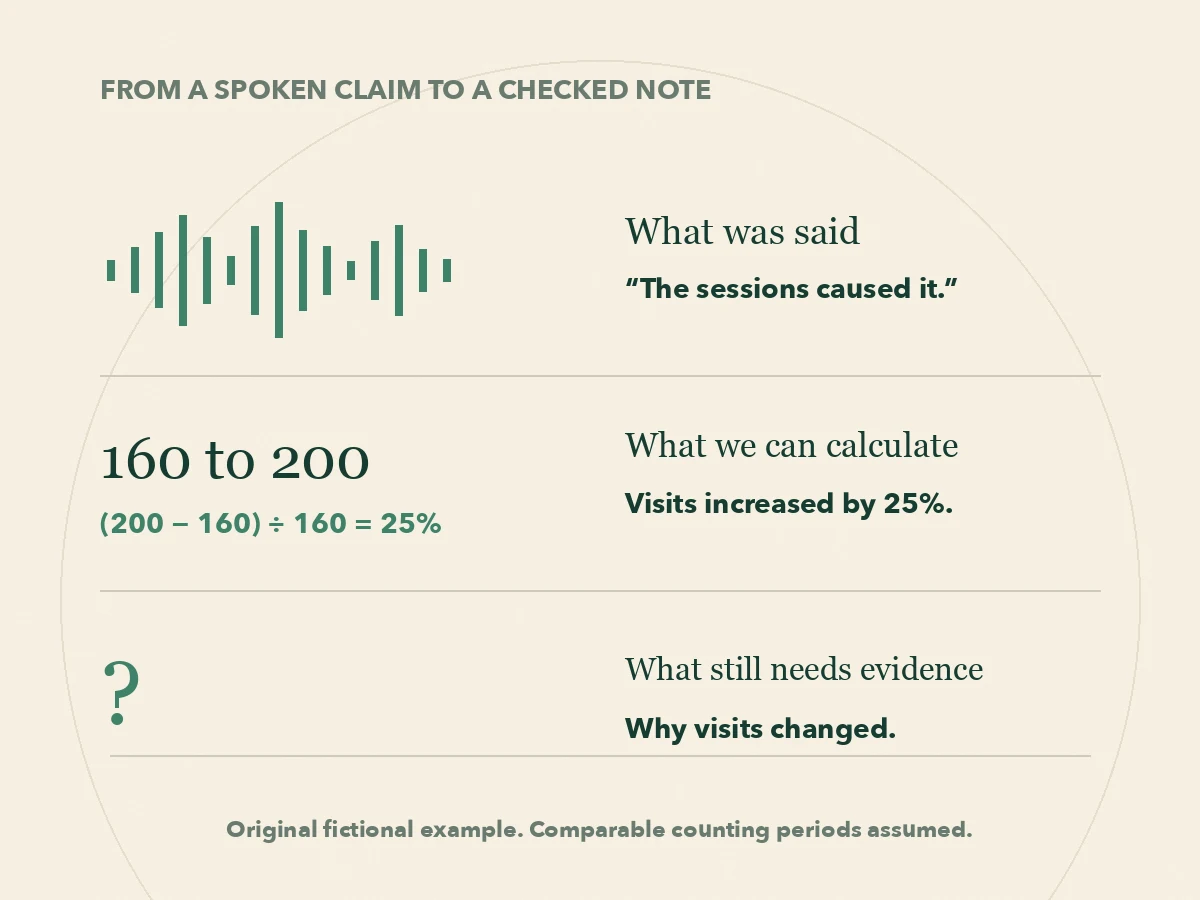
You finish an interesting interview and want to use something from it. The problem is no longer finding an episode. It is deciding what you understood, whether the claim is supported, and what you could do with it.
This guide gives you an original note-taking template and a fictional example you can inspect completely. It is for a podcast you want to learn from. An episode enjoyed for its story or company does not need to become homework. If you are driving or doing anything that needs your attention, leave the notes and questions until you are safely finished.
The short answer
After listening, explain one useful idea without reopening the episode. Then replay the relevant passage or check its transcript, correct your note, and record where the evidence comes from. Write a question you can answer later and a small task that would use the idea. You can do this on paper; you do not need another app.
The method
Use the episode, its public notes or transcript, and a blank page. Keep uncertain details marked as uncertain.
Write what you think the speaker meant in one or two sentences. Add the question you were listening to answer. Leave a gap where you cannot remember a number or condition instead of filling it with a guess.
Find the relevant timestamp, transcript paragraph or show-note reference. Compare it with your first attempt. Correct missing conditions and separate your interpretation from the speaker's actual claim.
Follow a material factual claim to its original evidence when available. A transcript can establish what was said; it cannot establish that the statement is true. Record unverified claims as unverified.
Create one question you can answer without the note and one small application. Return after a gap, try the question first, then check. Choose the gap for when you expect to need the idea; no single schedule fits every topic.
Free notes template
A plain-text record you can copy into your notes or print. No account or email is required.
Download notes template (.txt)PODCAST LEARNING NOTES Learning Cadence | Original template | 19 October 2026 Episode, publisher and date: Episode link: Question I wanted to answer: My explanation before replaying: Relevant timestamp or transcript section: Speaker's claim and conditions: Correction after checking the passage: Original evidence and link: Evidence status: checked / not checked / unavailable What the evidence supports: What remains uncertain: My own interpretation or next question: A recall question (answer before opening this note): Answer check and supporting source: One small application: When I will try the question again: Result of that attempt and next step: A timestamp checks what was said, not whether it is true. Leave notes until it is safe to stop and write. Guide: https://learningcadence.app/blog/how-to-learn-from-podcasts/
Original worked example
Imagine a fictional interview about a local museum. A guest says: We started Saturday drawing sessions, and weekend visits went from 160 to 200. The sessions caused a 25% increase. The episode gives the counts but no study, comparison museum or details about other changes. These are invented teaching figures, not a real museum or podcast.
Your first note says: Drawing sessions increased visits by 25%. Replaying the passage confirms the wording, but it does not confirm the causal explanation. Split the note into two parts: the reported visits changed, and the guest attributes that change to the sessions.
Check the arithmetic: 200 minus 160 is 40 additional visits. Dividing 40 by the starting count of 160 gives 0.25, or 25%. That calculation is correct if the counts describe comparable periods and use the same definition of a visit. It is a change in counts, not 25 percentage points.
Check the explanation: the figures alone cannot tell you why visits changed. A holiday, a separate exhibition or a different counting period could matter. You would want the dates, counting method, other changes and a suitable comparison before relying on the guest's causal claim.
The repaired note is: The guest reports 160 visits before and 200 after drawing sessions began, a 25% increase if the periods are comparable. The episode does not establish that the sessions caused it. My next source is the museum's original attendance record and its definition of the periods.
Make uncertainty visible
Claim: write what the speaker is asserting, including its conditions. Evidence: record the original source, the relevant passage and what it actually supports. My response: write the question, application or disagreement you are adding. Those are three different parts of the note.
For the museum example, the timestamp is evidence of the spoken claim. The original attendance record would be evidence for the counts. Neither alone establishes the cause. Mark the record as not yet checked instead of letting a precise-looking timestamp make the whole note look verified.
When no transcript is available, return to a short audio segment and record the timestamp and your paraphrase. If you cannot recover the wording or source, leave that detail unresolved. Do not turn a remembered impression into a quotation.
Close the note
First, answer from memory: what can the museum's before-and-after counts establish, and what can they not establish? Then check: they describe a reported count change under comparable measurement. They do not, by themselves, identify its cause.
Now try a different fictional episode. A host says: Eight of the ten people who answered our survey loved the workshop, so 80% of everyone who attended loved it. Fifty people attended. What should your note say?
Answer check: eight out of ten respondents is 80% of respondents. Forty attendees did not answer. Their opinions are unknown, so the survey does not establish that 80% of all attendees loved it. A useful note keeps the respondent group and the full attendee group separate.
A small application is to find one number in the next episode you hear and identify its group, period and source. You do not have to audit the whole episode. A good attempt produces a clearer claim or a specific unresolved question, rather than just a longer collection of highlights.
Evidence and limits
Carnegie Mellon's teaching guidance describes retrieval practice as recalling information and recommends feedback to correct mistakes. That supports trying to explain an idea before looking back and then correcting the attempt. It does not validate this exact worksheet, establish an ideal number of notes or show that a listener has checked the truth of a claim.
Use two checks: Can I explain what was said? What evidence supports it? You can remember an unsupported claim accurately. Keep that distinction when using a summary, transcript or generated quiz.
Choose a usable format
A 2018 randomized study of medical students compared learning through podcasts and blog posts. It found no statistically significant overall difference in knowledge acquisition between the formats. The small, specialized sample and incomplete participation limit what this tells us about other listeners or subjects; it does not prove the formats equivalent.
Choose a format that lets you inspect the material you need. A transcript may make a number or unfamiliar name easier to locate. Audio preserves the speaker's delivery. Neither format removes the need to check an important claim.
Lien and colleagues (2018): randomized podcast and blog comparison
Continue deliberately
A summary can help you locate a passage or decide whether an episode addresses your question. Treat its claims and any generated questions as drafts to check against the original. A transcript can also mishear names or numbers. Verify the audio when that detail changes the meaning.
After your later recall attempt, keep the idea as a reference, practise it again or use it in a small task. If it is no longer useful, you can stop. The worksheet is a way to make a learning choice, not a requirement to archive every episode.
We make Cadence. If the episode opens a topic you want to study further, describe that learning goal in Cadence and answer its setup questions to build a course. Cadence offers its own lessons with reading or audio and saved progress. This is a separate learning path, not a promise to import, transcribe or fact-check the podcast.
Put it into practice
Cadence builds a course from a learning goal and your setup answers, with lessons you can read or play as audio at your own pace. Cadence is our app.


Want new features first?
Questions
After listening, explain one useful idea from memory. Then check the relevant passage and correct your explanation. You can add a source and a later recall question when you are safely able to write.
Keep the episode and timestamp, your first explanation, the checked claim, its original evidence, unresolved questions, and a question to answer later. Separate the speaker's words from your own interpretation.
Replaying helps you inspect the source, but it does not show what you can explain without it. Try a recall question with the notes closed, check your answer, and use a new example when the goal is application.
A summary may help you navigate an episode, but check any claim you plan to rely on against the original passage and its evidence. A shorter version may omit a condition or misstate a number.
Yes. Read, copy or download the plain-text template without an account or email. It works independently of Cadence.
See it in concrete terms
Explore suggested goals for remembering, taking useful notes and checking your reasoning.
Keep what you learn instead of losing it in a week.
Take notes that help you think and that you will actually use.
Catch your own mental shortcuts before they decide for you.

Try Cadence today
Describe what you want to learn and Cadence builds a course you can read or play as audio at your own pace. Continue on iPhone or Android.
Want new features first?