Attach it to a routine
Choose a slot that already happens every day: the commute, lunch, or before sleep. A new habit sticks better on an old routine than on willpower.
Practical guide
Most adults read for only a few minutes a day. You do not need hours to read much more; you need a small, regular slot and a book within reach when it comes.
Read the guidePractise reading more and keeping it
We make Cadence, an app that builds a short daily course around a goal you describe, such as finishing more books and remembering what was in them. Start free on iPhone or request Android access.

In a 2025 Pew Research Center survey, a quarter of US adults said they had not read any part of a book in the past year. The US government's time use survey found people aged 15 and over spent about 16 minutes a day reading for personal interest in 2025, against about 2.6 hours watching TV.
That gap is the opportunity. This guide works through a simple reading plan, a quick way to see how much small amounts add up, and what research says about print, screens and remembering what you read.
The short answer
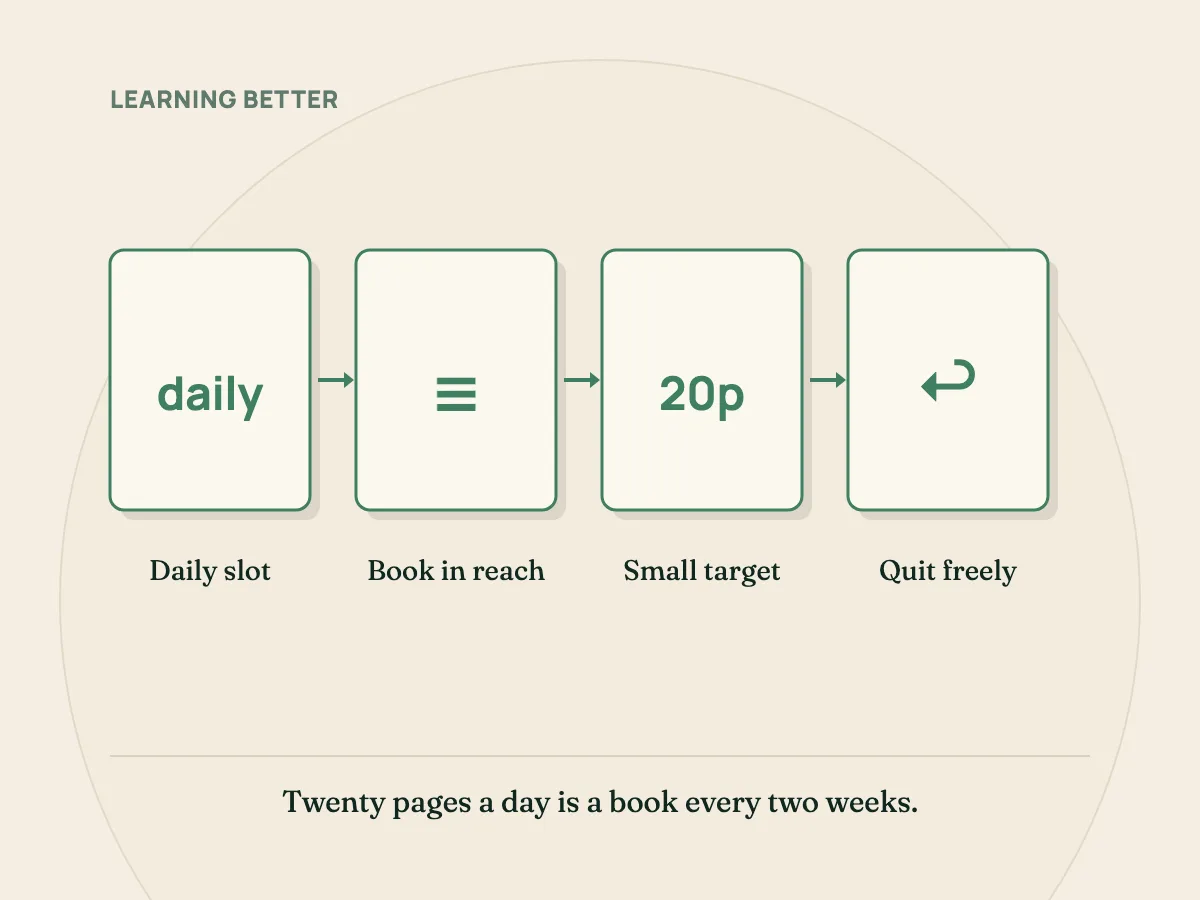
Pick one slot you already have every day, such as the commute, lunch or the 20 minutes before sleep. Keep a book, e-reader or audiobook ready for it. Set a small target, like 10 pages. Choose books you actually want to read, and stop ones you do not. Small amounts add up: 20 pages a day is a typical book every two weeks.
The method
You need one book you are curious about and one daily slot.
Choose a slot that already happens every day: the commute, lunch, or before sleep. A new habit sticks better on an old routine than on willpower.
Put the book or e-reader where you usually reach for your phone. Audiobooks count for commutes and chores.
Ten or twenty pages, or 15 minutes. Small enough to hit on a tired day.
If a book is not working after 50 pages, stop and pick another. Forcing through a dull book is the fastest way to stop reading altogether.
Worked example
Invented example: you read before sleep, 20 pages a night. A 280-page book takes 14 days, so about two books a month and roughly 26 a year. In the Pew survey, only 14% of US adults read more than 20 books in the past year.
Some nights you will read 5 pages and some 40. Track books finished rather than daily pages, and keep the next book ready before you finish the current one, so there is no gap where the phone takes over.
Pew Research Center (2026): Americans still opt for print books over digital or audio versions
What the evidence shows
A 2018 review of 54 studies with more than 170,000 participants found that people understood informational texts slightly better on paper than on screens, especially when reading under time pressure. The difference was small and did not appear for stories.
So read on whatever you will actually use. If you are reading something demanding to learn from it, paper may help a little. For novels, the format matters less than reading at all.
Delgado and colleagues (2018): Don't throw away your printed books, Educational Research Review
Make it stick
When you finish a chapter, close the book and write two or three points it made. Check them and try again a few days later. Our memory guide explains why recalling beats rereading, and how to space the attempts.
Reading more and remembering more are separate skills. Build the habit first; add recall once reading is regular.
Start here
If you read but forget most of it, start with reading more and remembering it. If you want notes you will actually use later, start with taking notes worth rereading. If the habit itself keeps slipping, start with building habits that last.
These are suggested courses in Cadence, the app we make, and they are listed further down this page. Each course page has a worked example you can try without the app.
Put it into practice
Pick the one problem from this guide that is closest to yours. Cadence turns it into short daily lessons with practice, so the habit has somewhere to happen. Cadence is our app.
Questions
Attach reading to a daily routine, keep a book where you usually reach for your phone, set a small daily target and quit books you are not enjoying.
Even 15 to 20 minutes adds up. At 20 pages a day, a typical book takes about two weeks.
For stories, research finds little difference. For informational texts, comprehension was slightly better on paper, especially under time pressure.
For building the habit and enjoying books, yes. They are especially useful for commutes and chores.
See it in concrete terms
Three of the reading problems above, each with daily practice and checks.
Try Cadence today
Describe what you want to learn and Cadence builds a course of short daily lessons you can read or play as audio. It is free to start on iPhone, and Android access is by request.