Find the beat unit
In 4/4, the upper 4 gives four beats in a complete bar; the lower 4 makes a quarter note the beat unit. Count 1, 2, 3, 4 at an even pace, then restart at 1. Do not restart for each note.
Keep the beat steady while the notes change. Start with one bar, then check where each sound begins.
Use the free template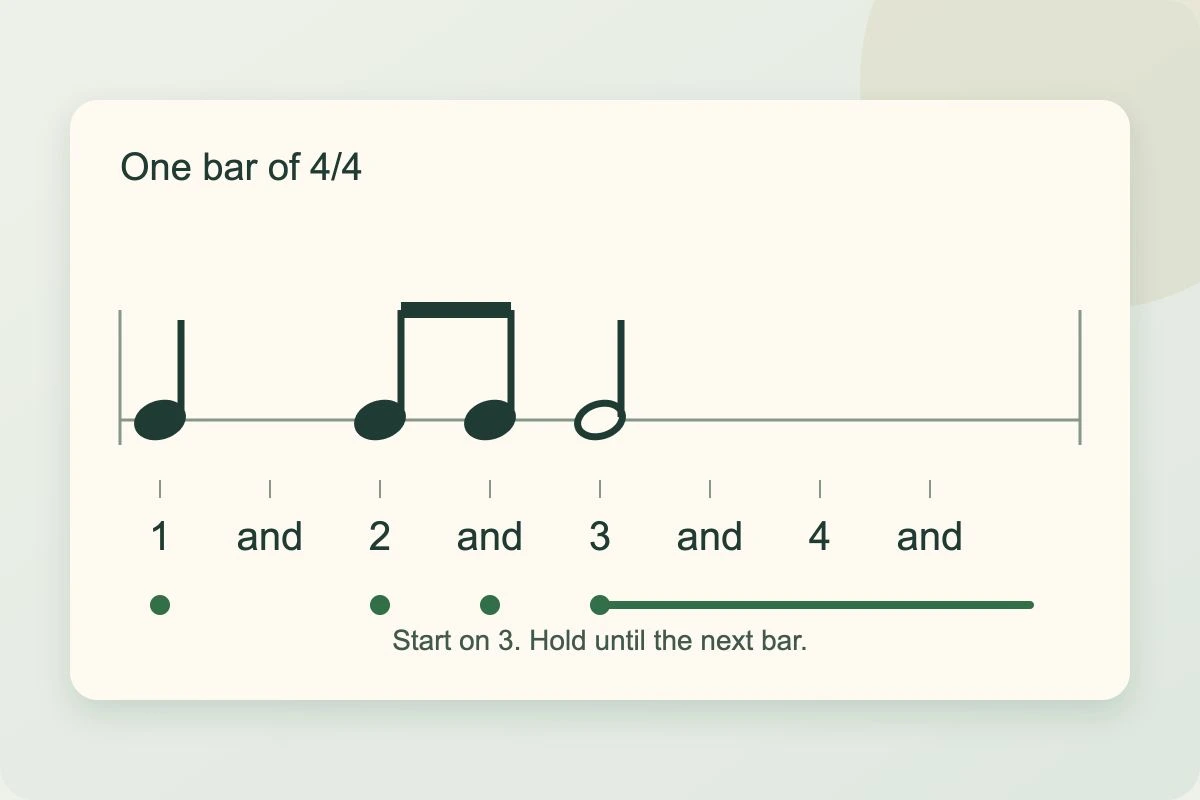
You can recognize the notes and still lose your place when one lasts longer than another. Separate two jobs: keeping the count moving and deciding when a new sound starts. You can speak or tap these original exercises without an instrument.
This guide covers rhythm in standard Western notation, using complete bars of 4/4. It does not teach pitch, playing technique or every time signature. The picture shows an original rhythm, not a transcription of a song. The worksheet and answers are free to use without an account.
The short answer
For these 4/4 exercises, count four steady quarter-note beats per bar. Say 1 and 2 and 3 and 4 and to split each beat in two. Start each note at its written count, hold it for its full value, and keep counting during rests. A longer note takes more time, not more attacks. These examples use straight eighth notes; other meters and swing need different counting.
The method
A bar is a group of beats separated from the next by a bar line. First find its count, then fit the sounds into it.
In 4/4, the upper 4 gives four beats in a complete bar; the lower 4 makes a quarter note the beat unit. Count 1, 2, 3, 4 at an even pace, then restart at 1. Do not restart for each note.
Here a quarter note lasts one beat, a half note two, and a whole note four. An eighth note lasts half a beat. A filled notehead with a stem is a quarter note; an open notehead with a stem is a half note. An eighth note has a flag, or a beam joining it to other eighth notes. The source diagrams below show the symbols.
Say 1 and 2 and 3 and 4 and. Each number and each and occupies half a beat. Keep that spacing even when there is no new sound at a count. This is straight subdivision, not swing.
Add the durations to check that the bar holds four beats. Then mark where each sound starts. A correct sum checks the amount of time; it does not by itself check your timing.
The beat is the recurring pulse. The rhythm places sound and silence around it. Tap four evenly spaced beats with one hand. Speak a single sustained tah through beats 1 and 2, then start a new tah on 3. The hand keeps moving while the voice holds.
The note-value relationships and 4/4 convention come from the two musictheory.net lessons below. Beat length in seconds depends on the tempo. A quarter note is one beat in this exercise, not in every possible meter.
Original bar: quarter note, two eighth notes, half note. Its duration is 1 + 0.5 + 0.5 + 2 = 4 beats. Before reading the answer, decide which four counts begin a new sound.
Answer: start sounds on 1, 2, the and after 2, and 3. Hold the last sound through 4 and the and after 4, until the next bar begins. Do not start another sound on 4. Count the empty positions at the same speed as the sounded ones.
Count: 1 and 2 and 3 and 4 and
Starts: 1, 2, 2-and, 3
Durations: quarter, eighth, eighth, half
A rest marks silence for its written duration. Original exercise: half note, quarter rest, two eighth notes. First find the silent beat and the two short-note starts.
Answer: hold the half note over beats 1 and 2, stay silent for beat 3, then start the eighth notes on 4 and the and after 4. The total is 2 + 1 + 0.5 + 0.5 = 4. If you skip the silent beat, the last notes arrive a beat early. Keep counting instead of treating silence as a gap outside the music.
A tie connects successive notes of the same pitch into one held sound. Original exercise: quarter note tied to an eighth note, another eighth note, then a half note. A tie is not a request to repeat the first sound.
Answer: the tied pair starts on 1 and lasts 1.5 beats. The next eighth note starts on the and after 2. The half note starts on 3 and holds to the next bar. There are three sound starts, even though four note symbols are written. Total: 1 + 0.5 + 0.5 + 2 = 4.
Compare this with the picture: the duration total is identical, but the start on 2 disappears because the tie continues the first sound. Counting the total alone would miss that difference.
Try this new pattern: quarter rest, two eighth notes, quarter note, quarter note. Write every sound start, say the complete count, then check below. This time the bar begins in silence.
Answer: sound starts are 2, the and after 2, 3 and 4. Beat 1 is silent. The durations add to 1 + 0.5 + 0.5 + 1 + 1 = 4. Count the first beat before sounding anything. Starting the first eighth note on 1 would make a different rhythm.
Self-check: can you keep the same pulse through the silent first beat and the held notes in the earlier examples? This written answer checks your count map. It cannot establish that your performed timing is accurate. If you need help hearing or playing the pattern, use an audio lesson or a music teacher.
Open Music Theory explains counting in simple meter, where beats divide into two. Our number-and count follows that approach. Do not apply the four-beat rule automatically to 3/4, 6/8 or cut time. In particular, 6/8 is commonly felt as two beats that each divide into three, rather than six quarter-note beats.
A dot lengthens a note by half its original value. A dotted quarter in our 4/4 count therefore lasts 1.5 beats, like the tied quarter-and-eighth pair above. It changes duration; the tied example teaches the separate question of whether to start a new sound. Pickups, tuplets and swing are useful next topics after these straight, complete bars.
If you want to understand more of the marks on a page, try Cadence. We make the app. Describe your goal, such as understanding rhythm before learning pitch, and answer the setup questions to build a course around your starting point. You choose the pace and can return to saved progress.
The sheet-music page below is a suggested goal you can adapt, not a fixed music curriculum. Cadence can explain notation; it does not assess your playing or certify sight-reading fluency. Keep using this guide and worksheet on their own if these counts are all you need today.
Free rhythm worksheet
Write the count and starts, then compare with the answer key. All examples use complete bars of 4/4 with straight eighth notes.
Download rhythm worksheet (.txt)RHYTHM COUNTING WORKSHEET Learning Cadence | Original exercises | 29 October 2026 All bars: 4/4, quarter-note beat, straight eighths. Count: 1 and 2 and 3 and 4 and Quarter = 1 beat; half = 2; eighth = 0.5. A rest uses time silently. A tie joins same-pitch notes without a new attack. A. Quarter, eighth, eighth, half. Total beats: ____ Sound starts: ____ B. Half, quarter rest, eighth, eighth. Total beats: ____ Silent beat: ____ Sound starts: ____ C. Quarter tied to eighth, eighth, half. Total beats: ____ Sound starts: ____ D. Quarter rest, eighth, eighth, quarter, quarter. Total beats: ____ Sound starts: ____ Try each before reading the answers. Keep counting through holds and rests. ANSWER KEY A: 1 + 0.5 + 0.5 + 2 = 4. Starts 1, 2, 2-and, 3. Hold from 3 to the next bar. B: 2 + 1 + 0.5 + 0.5 = 4. Beat 3 silent. Starts 1, 4, 4-and. C: 1 + 0.5 + 0.5 + 2 = 4. Starts 1, 2-and, 3. No new sound on 2. D: 1 + 0.5 + 0.5 + 1 + 1 = 4. Starts 2, 2-and, 3, 4. Beat 1 silent. This checks the written count, not the accuracy of your performed timing. Pitch, technique, swing and other meters need further instruction.
Put it into practice
Want to understand more than this one bar? Describe your music-reading goal in Cadence and answer the setup questions to build your course. Cadence is our app; it does not assess your playing.


Want new features first?
Questions
No. It is one beat in these 4/4 exercises. The beat unit and meter affect how you count other music.
No. A half note begins once and lasts two quarter-note beats here. A short clap can mark its start, but use your voice or an instrument to hear the held duration.
It marks the second half of each beat in this straight eighth-note count. It is halfway between the numbered beats.
Yes. Read it here or download the plain-text file without an account. Cadence is an optional way to continue learning notation.
See it in concrete terms
These are suggested goals. Open one for a starting outline, then describe what you want to learn and answer the setup questions. They are not fixed lessons or proof of playing ability.
Method
We separated the steady count from sound starts, then wrote four original bars with worked duration totals and an answer key. The diagram is a rhythm-only example; it does not show a melody.
What we checked directly: On 29 October 2026 we read the named musictheory.net and Open Music Theory lessons. We checked the beat totals, note starts, silent beats and tie against each original exercise.
Limits of this review: We did not measure learning gains or test a real performance. A written count map cannot verify timing by ear, instrument technique or sight-reading fluency.

Try Cadence today
Start free on iPhone or Android. Bring your own notation question, answer the setup questions and build a course around your starting point.
Want new features first?