Name the original yield
Yield means the amount the recipe produces. Write its number of portions and portion size, or its total mass or volume.
Divide the amount you need by the amount the recipe makes. Check what a portion means before you multiply.
Use the free template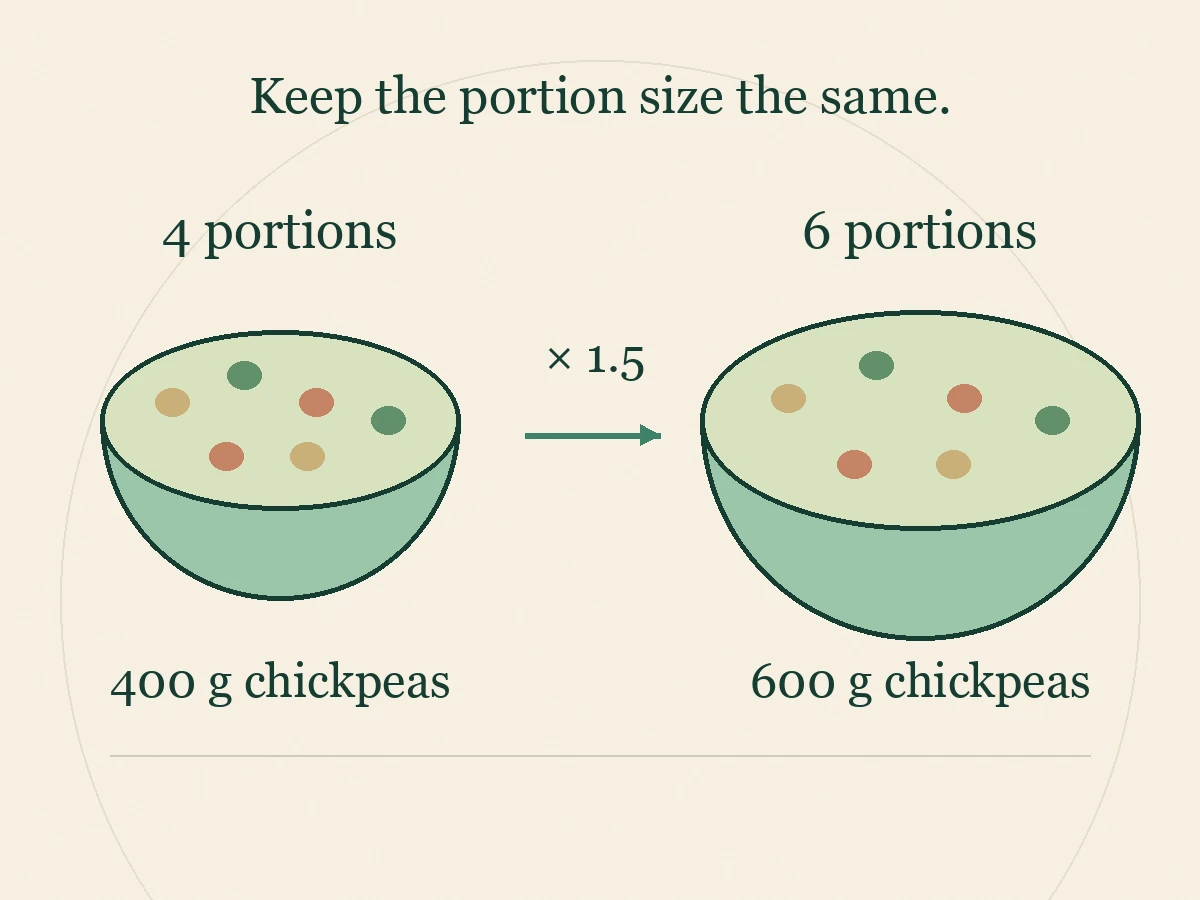
A recipe says it serves four. You need six servings, or dinner for one. Before changing the numbers, check whether you want the same amount per person. Six small portions can require less food than four large ones.
The fictional ingredient quantities below are arithmetic practice, not a tested recipe. They let you check proportions without cooking, an app or an account. For an actual dish, start with a reliable recipe and its guidance for changing the batch.
The short answer
For six portions instead of four of the same size, divide 6 by 4 to get 1.5. Multiply each measured ingredient quantity by 1.5. For one portion instead of four, use 0.25. If portion sizes change too, compare total amounts instead of headcounts. The multiplier scales quantities; it does not tell you how to change cooking time, temperature or equipment.
The method
Keep the original and new amounts beside each other so an unchanged ingredient is easy to spot.
Yield means the amount the recipe produces. Write its number of portions and portion size, or its total mass or volume.
Use the same basis on both sides. Portion counts work only when the portion size stays the same. Convert units first if needed.
New yield ÷ original yield is the multiplier. A larger batch needs a number above 1; a smaller batch needs one between 0 and 1.
Multiply each measured quantity by that number. Divide a new quantity by the multiplier to recover the original. Flag any amount you cannot measure sensibly.
Imagine a cold salad with these invented quantities: 400 g cooked chickpeas, 300 g tomatoes, 200 g cucumber and 100 g yogurt. Together they weigh 1,000 g, divided into four 250 g portions. We are checking the arithmetic, not recommending this as a recipe.
To make six portions of the same size, use 6 ÷ 4 = 1.5. Six portions need one and a half times the original batch, not two whole batches.
The new quantities total 600 + 450 + 300 + 150 = 1,500 g. Six portions of 250 g also total 1,500 g. Those two routes agree.
Now reverse one calculation: 450 g tomatoes ÷ 1.5 = 300 g, the original amount. Another useful check is the share: tomatoes were 300 ÷ 1,000 = 30% of the original mixture. They are still 450 ÷ 1,500 = 30% of the larger one.
If you increased only the chickpeas to 600 g and left everything else unchanged, the batch would weigh 1,200 g and chickpeas would make up 50%, rather than the original 40%. You changed the proportions as well as the amount. That might be an intentional recipe change, but it is not a proportional scale-up.
Keep the original four 250 g portions, but now aim for six 200 g portions. The original yield is 4 × 250 = 1,000 g. The target is 6 × 200 = 1,200 g. The correct multiplier is 1,200 ÷ 1,000 = 1.2, not 1.5.
The quantities become 480 g chickpeas, 360 g tomatoes, 240 g cucumber and 120 g yogurt. They sum to 1,200 g. Dividing by six gives the intended 200 g portion. Multiplying by headcount alone would have produced six 250 g portions instead.
The BC Cook Articulation Committee teaches this distinction between changing the number of portions and changing their size. Write down both before selecting your multiplier.
BC Cook Articulation Committee: converting and adjusting recipes
One portion instead of four uses 1 ÷ 4 = 0.25. The original example becomes 100 g chickpeas, 75 g tomatoes, 50 g cucumber and 25 g yogurt. The total is 250 g. Multiplying each result by four recovers the original quantities.
For a quantity written as a fraction, calculate the fraction before deciding how to measure it. Half of 3/4 cup is 3/8 cup: (3/4) × (1/2) = 3/8. Half of three eggs is 1.5 eggs, not one or two. That answer identifies a practical measurement problem; rounding it changes the recipe.
Use the original recipe's ingredient weights or specific reduction guidance when available. Grams measure mass and milliliters measure volume; changing 100 mL to 100 g is not a general conversion for every ingredient. A correct multiplier does not resolve an unknown unit conversion.
Scaling quantities is only one part of adapting a dish. King Arthur Baking treats weights, fractional eggs, pans and baking time as separate decisions in its reduction guide. Doubling the ingredient quantities does not mean doubling the oven temperature or the cooking time.
Use recipe-specific guidance for equipment, timing and doneness. Treat seasonings with care rather than assuming a larger arithmetic batch guarantees the same result. Scaled numbers alone do not establish safe preparation, storage or preservation. These examples teach the calculation; they are not a substitute for a tested cooking method.
King Arthur Baking: how to reduce a recipe
BC Cook Articulation Committee: converting and adjusting recipes
1. A recipe makes eight equal portions and uses 360 g of one ingredient. You need three portions of the same size. What multiplier and quantity do you need? 2. A batch makes five 180 g portions. You need six 150 g portions. Does the batch need to grow? 3. An amount of 240 g should be scaled by 1.5, but someone writes 300 g. Check the answer and identify the multiplier they actually used.
Check 1: 3 ÷ 8 = 0.375; 360 × 0.375 = 135 g. Reverse: 135 ÷ 0.375 = 360 g. Check 2: both yields are 900 g, so the multiplier is 1. The same total amount is divided into more, smaller portions.
Check 3: 240 × 1.5 = 360 g. The proposed 300 g uses 300 ÷ 240 = 1.25. It increases the quantity by 25%, while the intended factor of 1.5 increases it by 50%.
If you want more practice with fractions, ratios or planning quantities for one, try Cadence. We make the app. Describe what you want to understand and answer the setup questions to build a course around your starting point.
The suggested learning goals below are starting points you can adapt. They are not a fixed recipe collection or a promise that a course validates a dish. The examples and worksheet here are complete without the app.
Free practice worksheet
Name both yields, calculate the multiplier and check the result in reverse.
Download worksheet (.txt)RECIPE-SCALING PRACTICE WORKSHEET Learning Cadence | Original fictional quantities | November 8, 2026 MY QUANTITY CHECK Original number of portions: Original portion size and unit: Original total yield: New number of portions: New portion size and unit: New total yield: Multiplier = new total / original total: Ingredient | Original quantity and unit | Multiplier | New quantity Reverse check: new ingredient quantity / multiplier = original quantity What still needs recipe-specific guidance: units, fractional ingredients, seasoning, equipment, cooking, storage SAME-SIZE PORTIONS: FOUR TO SIX Multiplier: 6 / 4 = 1.5 Ingredient Original New Chickpeas 400 g 600 g Tomatoes 300 g 450 g Cucumber 200 g 300 g Yogurt 100 g 150 g Total 1000 g 1500 g Reverse check: 450 / 1.5 = 300 g tomatoes. DIFFERENT PORTION SIZES Original: 4 x 250 g = 1000 g. Target: 6 x 200 g = 1200 g. Multiplier: 1200 / 1000 = 1.2, not 1.5. New quantities: 480 g, 360 g, 240 g, 120 g. Total 1200 g. TRY BEFORE CHECKING 1. Eight equal portions use 360 g of an ingredient. Find the multiplier and quantity for three same-size portions. 2. Five 180 g portions become six 150 g portions. Find the multiplier. 3. Scale 240 g by 1.5. Someone writes 300 g. What multiplier did they actually use? ANSWERS 1. 3 / 8 = 0.375. 360 x 0.375 = 135 g. Reverse 135 / 0.375 = 360 g. 2. Both yields are 900 g. Multiplier 1. More portions, less per portion. 3. Correct quantity 360 g. 300 / 240 = 1.25, a 25% increase rather than 50%. These are arithmetic exercises, not tested recipes. Keep units consistent. Quantities do not establish cooking time, oven temperature, suitable equipment or safe preparation, storage or preservation. Use a reliable recipe and its specific adaptation guidance.
Put it into practice
If you want more practice with ratios, fractions or cooking quantities, try Cadence. Bring your learning question and answer the setup questions to build your course. Cadence is our app.


Want new features first?
Questions
Divide the new total yield by the original total yield, then multiply each measured ingredient quantity by that factor. You can use portion counts when the portion size stays the same.
For the same portion size, use 6 ÷ 4 = 1.5. Multiply the measured quantities by 1.5. Check the original recipe for separate cooking and equipment guidance.
The quantity multiplier does not determine cooking time or temperature. Equipment and the dish matter. Use recipe-specific guidance rather than multiplying the timer or oven setting.
No. It uses original fictional quantities to teach ratios, units and reverse checks. It does not validate a cooking method or establish food safety.
See it in concrete terms
Adapt a suggested learning goal to the calculation you want to understand.
Method
Original yield calculations, a changed-portion-size counterexample and new transfer questions make the multiplier and its limits checkable.
What we checked directly: On November 8, 2026 we read the BC Cook Articulation Committee's conversion chapter and King Arthur Baking's reduction guide, then independently checked every example and answer.
Limits of this review: We did not cook these examples or test learning outcomes. The quantities are fictional arithmetic, not recipes, safety advice or a verified generated lesson pack.

Try Cadence today
Bring your learning question to Cadence on iPhone or Android. Build your course around what you want to understand.
Want new features first?