How to keep an idea notebook you actually return to
A collection of interesting things becomes more useful when you add what you noticed and what you could make from it. Start with one page, not a new system.
Explore Cadence's daily courses
We make Cadence, an app for short daily courses built around your goal. Explore the reviewed course library to see its current focus and decide whether it fits what you want to learn.
Learning Cadence editorial, , 5 min readHow we work
Suppose you save a striking sentence, a photo of a shop window and an unusual question from a conversation. A month later, the folder is larger, but you cannot remember why any of them mattered.
Try a notebook that preserves your response as well as the thing you collected. The format below is our suggested exercise. Use paper, a notes app or a plain document you already have; the choice of tool is secondary to what you write.
The short answer
Capture an observation and give it a next move.
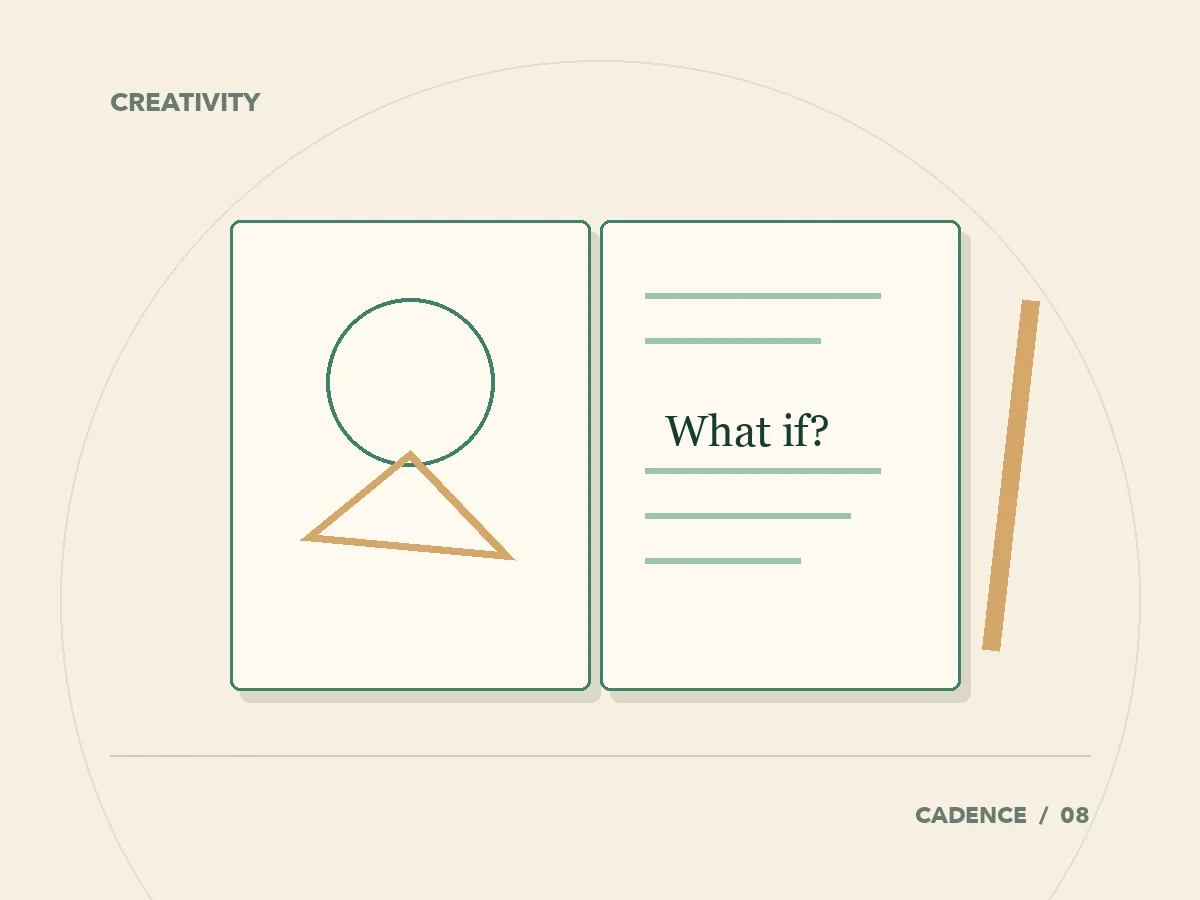
For each entry, record a concrete detail, why it caught your attention, and one thing you could try. Review a few entries together and develop one. A notebook is working material, not a finished portfolio.
The method
Turn one observation into an experiment.
Keep each entry small enough to finish while the observation is still fresh.
01
Describe the actual detail
Replace an entry such as nice poster with a description: the event name is tiny, but one enormous date fills half the page. If you save someone else's work, include its creator or source link so you can find and attribute it later.
02
Add your question
Write what you want to investigate: could a date be the most memorable part of an invitation? A question gives the saved item a purpose without forcing it to become a complete idea immediately.
03
Make a small variation
Create three rough versions of an invitation in which a different element takes the most space. Use your own words and shapes. You are testing a design choice, not tracing someone else's finished composition.
04
Record what you would keep
Choose one variation and say why. Then write the next experiment: try it with a longer event name, print it smaller, or ask a friend which detail they noticed first. Keep the discarded versions when they explain the decision.
A useful precedent
Start with an observation you can return to.
The Smithsonian's field-book activity combines detailed observations, drawings, notes and questions. Its purpose is scientific observation. Our creative notebook borrows that habit of preserving a specific detail and an open question, then adds a separate step for developing an original idea.
Imagine hearing the phrase a room that remembers in a conversation. Record who said it and in what context. Your question might be: what would an everyday room remember? Your experiment could be a paragraph told by a kitchen table, a sketch of worn floorboards, or a short scene built around a repaired chair.
The useful work happens when you choose a direction and make something specific. Collecting another fifty phrases may be enjoyable, but it does not complete this particular experiment.
A review that fits
Return to three entries.
At a time you can realistically protect, read three recent entries. Add one connection between them and choose one next action that fits the time available. If none is worth developing, write why and let it go. This is a selection process, not an obligation to rescue every idea.
When the notebook feels burdensome, remove fields. A detail, a question and a next action are enough for this exercise. Elaborate tags are optional.
From the publisher
Keep following the question.
We make Cadence, but you do not need another app to begin this practice. Use a tool you already open, keep attribution with borrowed material, and judge the notebook by whether it helps you make something.
Put it into practice
Start it today, ten minutes at a time.
We make Cadence, an app for short daily courses built around your goal. Explore the reviewed course library to see its current focus and decide whether it fits what you want to learn.
Questions
Common questions.
Should I use paper or an app?
Use whichever makes capture and review easy for you. This exercise does not depend on a particular medium or paid feature.
What if I cannot draw?
Use sentences, lists, rough boxes or voice notes. The entry only needs to preserve the detail and the question you want to explore.
How many ideas should I record each day?
There is no quota. One specific observation you develop can be more useful for your project than a large collection you never revisit.
Can I save other people's work?
Keep the creator and source with your notes. When sharing or publishing, respect the work's permissions and distinguish quotation, inspiration and your own contribution.
We make Cadence, an app for short daily courses built around your goal. Explore the reviewed course library to see its current focus and decide whether it fits what you want to learn.