Five active listening exercises you can try at work
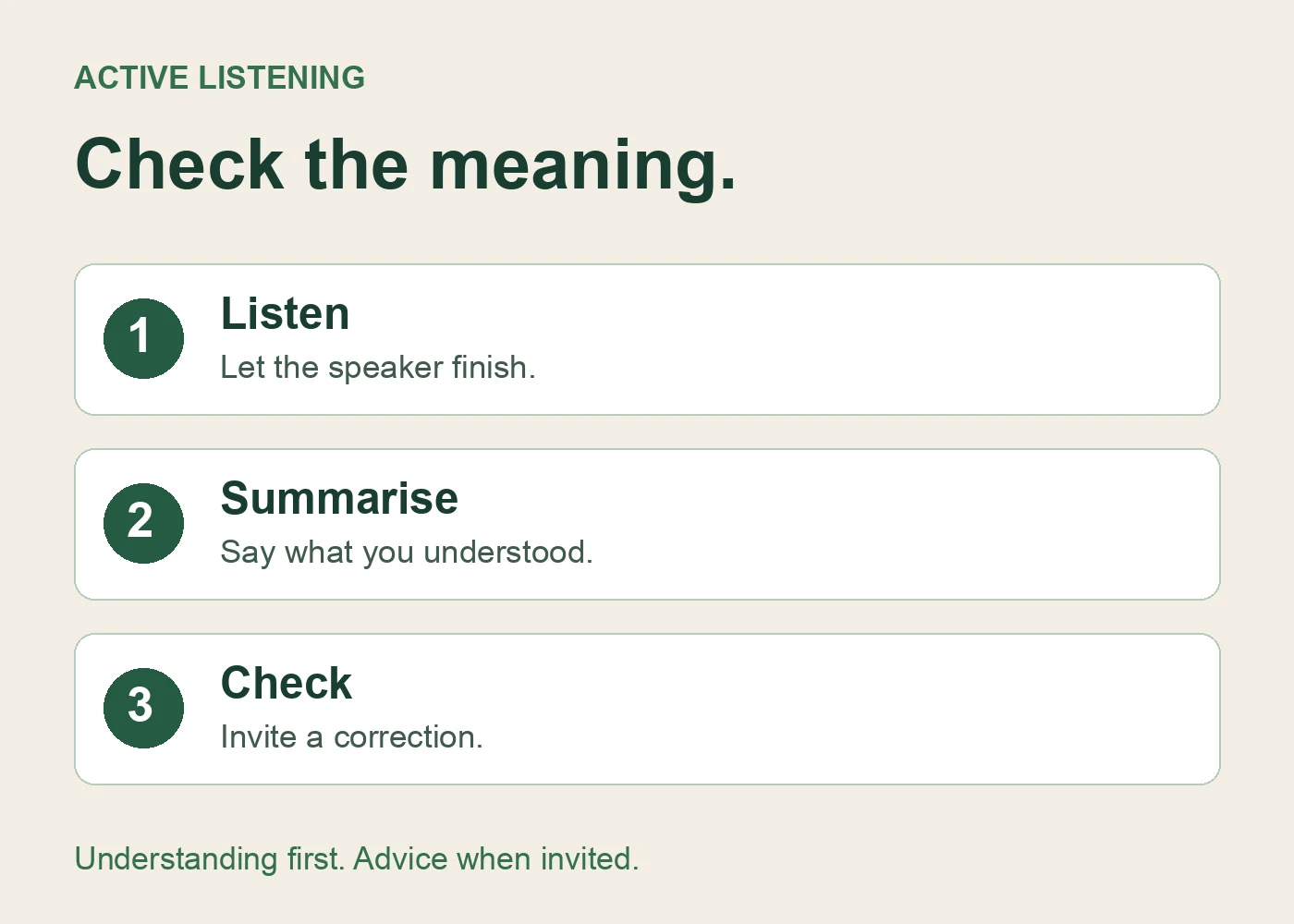
Listen to one short account, summarise what matters, then let the speaker correct you. Start there, or choose one of four other exercises for the listening habit you want to change.
Want to get better at something specific?
Try Cadence for a course built around your goal, with short lessons, practice, and saved progress. Start free on iPhone or request Android access.
Learning Cadence editorial, , 7 min readHow we work
A colleague says the deadline is difficult. You hear a request for more time and immediately suggest moving it. They meant that nobody has decided what must be ready by then. Your solution may be reasonable, but it solves a problem they did not describe.
Active listening means paying attention and checking your understanding before you respond. The exercises below are original practice activities from the Cadence team, not a validated assessment. Use ordinary, low-stakes examples with a willing partner. You do not need to record anyone or share private workplace information.
The short answer
Start with a summary the speaker can correct.
Ask a willing partner to describe a small challenge for one minute. Summarise the situation and what matters to them, then ask what you missed. Revise your summary before offering a solution. This simple exercise practises understanding rather than waiting for your turn to speak.
Choose one to practise
Five exercises, with a check for each.
Choose the exercise that matches your habit. The timings are convenient practice limits, not scientifically established doses. Start with one exercise, then swap roles.
01
The one-minute summary
For one minute, let your partner describe a minor challenge without interrupting. Then say: ‘The situation is ... and the part that matters most to you is ... Have I understood that?’ Ask them to correct one thing. Try again in your own words. Finish when they confirm the main point, not when you have repeated every detail. If you are guessing what matters, say so rather than presenting your guess as fact.
02
The follow-up tied to their words
Listen for one concrete phrase, such as ‘the handover was confusing’. Ask a question about that phrase: ‘Which part of the handover left you unsure?’ Avoid introducing your own story or asking three questions at once. Your check is simple: can your partner point to something they said that prompted your question? If not, you may have changed the subject rather than followed it.
03
The facts-and-assumptions split
After a short account, write two private lines: what they actually said, and what you inferred. For ‘I stayed late twice this week’, a fact is two late finishes. ‘They cannot manage their time’ is your interpretation. Turn the interpretation into a neutral question: ‘What kept you there late?’ Compare the answer with your initial guess. Do not turn the exercise into a judgement of the speaker.
04
The advice pause
When you feel ready to solve the problem, first summarise it. Then ask: ‘Would it help to think through options, or would you like me to understand what happened first?’ Respect the answer. If advice is welcome, offer one possibility and invite their view. The practice target is noticing and delaying an uninvited solution, not refusing to help or making someone repeat a request they already made clearly.
05
The repaired misunderstanding
Ask your partner to play a fictional colleague whose message you have misunderstood. State your first interpretation, let them correct it, and answer without defending your version. Try: ‘I took that to mean X. Now I understand you mean Y. Is that closer?’ Finish by naming what changed in your understanding. Being corrected is the useful part of this exercise, not a failed attempt.
What it sounds like
A deadline conversation, with the misunderstanding left in
This fictional exchange combines the summary, follow-up and repair exercises. The listener's first guess is wrong. Notice how the correction changes the next question.
Colleague
Friday feels impossible. Every time I think I know what to finish, something else gets added.
You
So you need a later deadline?
Colleague
Not necessarily. I need to know which version we are actually promising.
You
I jumped to the date. You need a clear agreement on what Friday includes. Is that right?
Colleague
Yes. I can finish the original version. I cannot keep adding to it.
You
Which additions are still undecided?
Colleague
The extra examples and the summary page.
You
Would it help to list those separately before we ask for a decision?
Colleague
Yes. Then we can keep Friday if the extras can wait.
The listener does not earn a perfect score for the opening. They recover by accepting the correction, using the colleague's actual concern and checking before moving into problem-solving. Understanding the concern does not settle who can change the deadline.
Choose your starting point
Match the exercise to the habit you notice.
Do not practise all five at once. Choose one behaviour you can notice during a real conversation.
You plan your reply while someone talks: start with the one-minute summary.
Your questions sound like a prepared interview: try a follow-up tied to their exact point.
You feel certain you know why someone acted that way: separate facts from assumptions.
People say they only wanted you to listen: try the advice pause.
A correction makes you defensive: rehearse repairing a misunderstanding.
What the research supports
Looking attentive does not prove you understood.
Harvard Business School's summary of research by Hanne Collins, Alison Wood Brooks and colleagues describes a gap between outward listening cues and actual attention. A nod or a well-timed expression can look attentive even when a person's mind has wandered. That is why these exercises ask for a checkable summary instead of a performance of attentiveness.
Separate research on conversations found that asking questions, particularly follow-ups, was associated with greater liking. Those studies included get-to-know-you chats and speed dating. They do not show that these five exercises improve workplace performance, or that asking more questions is always better. A follow-up is useful here when it clarifies this speaker's meaning.
Agree on a comfortable way to practise. Looking directly at someone, staying still or responding quickly is not required for this exercise. A written exchange, captions, a quieter setting or extra processing time may fit better. Ask what helps the other person communicate rather than scoring their body language.
Do not insist on personal disclosures. If the speaker wants to stop, stop. Use a fictional missed delivery or an unclear meeting request instead. Where a conversation concerns safety, harassment or a formal complaint, listening exercises do not replace the appropriate support or reporting process.
A small practice record
Check the conversation, not your personality.
After one practice round, answer these questions privately. They are prompts for noticing your behaviour, not a clinical scale or a score of whether you are a good person.
What did the speaker say mattered most? Did they confirm my version?
Which follow-up came from something they actually said?
What did I assume that turned out to need checking?
What correction did I accept? If there was none, did I leave room for one?
What will I try differently in the next ordinary conversation?
Where we fit
Continue with a listening goal of your own.
Cadence is our app. If you want a structured way to keep learning, the Listen beyond the words course idea starts from the habit of planning a reply while someone else is speaking. It describes a course Cadence can build from that goal; it is not a claim that the exercises above are an already-reviewed lesson pack.
Read the course idea before deciding whether to use the app. The activities on this page are free to use without signing up. An app can help you prepare and reflect, but it cannot tell you whether another person felt understood in a real conversation. Ask them.
If you want to keep going, Cadence turns what brought you here into a course of short daily lessons with practice and saved progress. Cadence is our app.
Questions
Common questions.
What is an easy active listening exercise?
Ask a willing partner to describe a small challenge for one minute. Summarise the situation and what matters to them, ask what you missed, and revise your summary. Swap roles. The correction matters more than reproducing every word.
Can I practise active listening alone?
You can pause a public interview, summarise the speaker's point and compare it with what they say next. This practises attention and inference, but the recording cannot confirm whether you understood. Practise with a willing person when you want that feedback.
Does active listening mean agreeing with someone?
No. You can understand and accurately summarise a view while disagreeing with it. Make the distinction explicit: ‘I understand that you want X because of Y. My concern is Z.’ Let them correct the summary before you debate the conclusion.
How do I use these exercises with a team?
Invite voluntary pairs to use fictional, low-stakes situations. Give each person time to speak and time to correct the summary, then swap roles. Discuss what helped understanding rather than ranking colleagues or collecting personal disclosures.
How can I tell if I am improving?
Look for concrete changes across conversations: you can state the other person's main concern, ask relevant follow-ups, accept corrections and avoid unwanted advice. Ask for their feedback. A self-rating or a completed app lesson alone cannot establish that you listened well.